Sunday, May 31, 2020

Week-end Wrap – Political Economy – May 31, 2020

Week-end Wrap – Political Economy – May 31, 2020
by Tony Wikrent


[Twitter, via Naked Capitalism Water Cooler 5-29-20]
Here's video of the first person alleged to have taken a hammer to the AutoZone window, which activists immediately suspected was a provocation. Black gloves, black boots, black clothes (not unkempt like antifa, no offense), nice gas mask. Who is this guy? https://www.facebook.com/juan.conner.58/posts/137533351239840?hc_location=ufi 

View image on Twitter

Strategic Political Economy

General Electric Co. is turning out the lights on an iconic part of its business.
[Wall Street Journal, via Naked Capitalism Water Cooler 5-28-20]
Trump's revival of American manufacturing....
“General Electric Co. is turning out the lights on an iconic part of its business. The company is getting out of making lightbulbs…. selling a unit that defined GE for nearly a century and was its last direct link to consumers. The company will sell its lighting business to Massachusetts-based Savant Systems Inc., a seller of home-automation technology in a transaction that values the unit at around $250 million.... That hardly makes the business a financial heavyweight, but the sale is the latest sign of the transformation of the American manufacturing landscape and a big marker in the changes at GE. The company has been selling off industrial units to pare down its debts, making GE smaller but also making it more reliant on an aviation unit that now faces tough prospects under the coronavirus pandemic.”
Sunday, May 24, 2020

Week-end Wrap – Political Economy – May 24, 2020

Week-end Wrap – Political Economy – May 24, 2020
by Tony Wikrent
Progressive Caucus of the North Carolina Democratic Party

Strategic Political Economy

The Big Failure of Small Government
Maria Mazzucato [Project Syndicate, via Naked Capitalism 5-22-20]
Effective governance, it turns out, cannot be conjured up at will, because it requires investment in state capacity....
Decades of privatization, outsourcing, and budget cuts in the name of “efficiency” have significantly hampered many governments’ responses to the COVID-19 crisis. At the same time, successful responses by other governments have shown that investments in core public-sector capabilities make all the difference in times of emergency. The countries that have handled the crisis well are those where the state maintains a productive relationship with value creators in society, by investing in critical capacities and designing private-sector contracts to serve the public interest....
Unfortunately, for the last half-century, the prevailing political message in many countries has been that governments cannot – and therefore should not – actually govern. Politicians, business leaders, and pundits have long relied on a management creed that focuses obsessively on static measures of efficiency to justify spending cuts, privatization, and outsourcing....
Vietnam’s successful approach to COVID-19 has emerged as a striking contrast to the US and UK responses. Among other things, the Vietnamese government was able to amass low-cost testing kits very quickly, because it already had the capacity to mobilize academia, the army, the private sector, and civil society around a common mission. Rather than simply outsourcing with few questions asked, it used public research and development funding and procurement to drive innovation. The resulting public-private collaboration enabled rapid commercialization of kits, which are now being exported to Europe and beyond.
New Zealand is another success story, and not by coincidence. After initially adopting the outsourcing mantra in the 1980s, the New Zealand government changed course, embracing a “spirit of service” and an “ethic of care” across its public services, and becoming the first country in the world to adopt a wellbeing budget. Owing to this vision of public management, the government adopted a “health first, economy second” approach to the current crisis.
[Huffington Post, via Naked Capitalism 5-21
Tax evasion, to pick just one crime concentrated among the wealthy, already siphons up to 10,000 times more money out of the U.S. economy every year than bank robberies. In 2017, researchers estimated that fraud by America’s largest corporations cost Americans up to $360 billion annually between 1996 and 2004. That’s roughly two decades’ worth of street crime every single year. As the links between corporations and regulators become increasingly incestuous, the future will bring more crude-soaked coastlines, price-gouging corporate behemoths and Madoff-style Ponzi schemes. More hurdles to suing companies for poisoning their customers or letting bosses harass their employees. And more uniquely American catastrophes like the opioid crisis and the price of insulin.

Monday, May 18, 2020

Too much spare time under quarantine??


Someone just figured out that it was possible to build a GOOGOL:1 gear reduction set using 186 Lego gears. Think of it this way. For every person you know who cannot add or explain the difference between a million and a billion, there is likely someone who does this sort of math for FUN. (Bell-shaped curve and all ;-) For extra fun, open this in YouTube and follow the comments. There's a bunch of math nerds out there!


Unfortunately, math nerds can only help a little with a problem like the Covid19 outbreak. In order to do good science, we need rigorous methods of collecting data—something made functionally impossible without widespread and highly accurate testing. We don't even make generic Advil in USA anymore. Those mass-produced accurate tests?—WAY harder. A safe and effective vaccine?—may never happen. Even treatments to control symptoms are still only in the imagining stage.

What this means is this is a disease that we are just going to have to learn to live with. Unfortunately, the folks in the businesses of managing meaningful social change such as political leaders are almost entirely populated by scientifically and mathematical illiterates who believe that major human problems are best addressed by scolding. It may be possible to organize a kindergarten that way but a global infectious pandemic?—probably not.


Sunday, May 17, 2020

Week-end Wrap – Political Economy – May 17, 2020

Week-end Wrap – Political Economy – May 17, 2020
by Tony Wikrent

Strategic Political Economy

The storm we can’t see
[WaPo, via Naked Capitalism 5-11-20] A must read.
Four relatively narrow policy questions hint at the difficulties ahead. First, the bailout: After the initial $349 billion allotment vanished in days, Congress threw an additional $320 billion into the Paycheck Protection Program, the effort to keep small-ish businesses from firing employees for roughly eight weeks. That just means companies, including many I’ve spoken to, are planning June layoffs. Will Washington put another $670 billion into the PPP just to keep those small businesses afloat through July?
....Third, states and cities are going broke, thanks to the costs of responding to the crisis — from unemployment claims to boosting hospital capacity and purchasing protective equipment — as well as the collapse of income, sales and meal tax payments. New York City says it will need $7.4 billion in federal aid, and the state faces a $13 billion shortfall; Alaska’s budget gap might top $1 billion; Colorado’s, $3 billion. The impact on California’s finances has been termed, simply, “beyond crazy.” That will be true for every single state, every single county, every single city, village and town in the country. Unlike the federal government, which can deficit spend with abandon, state and local governments must balance their budgets, meaning these holes must be closed, immediately, by federal aid, budget cuts or tax increases....
Addressing the Great Depression took enormous creativity and agility by Franklin Roosevelt’s New Dealers; it required massive new social programs, employment efforts that transformed the country and targeted individual industries, right down to literally paying writers to write about the Great Depression. The federal response to that crisis also underscores how large and long the U.S. government’s present-day interventions might need to be. When FDR ran for reelection in 1936 — four years into his New Deal — unemployment still stood above 16 percent, and rural electrification, a cornerstone of the New Deal’s economic development efforts, would take more than a decade to unfold.
It’s clear that we as a country need to be thinking in terms of tens of trillions of dollars of federal effort over the next decade. Planning in terms of weeks and $1,200 stimulus payments certainly helps now, but it’s no Marshall Plan. Every hour and day that the federal government fails to recognize the scale of this problem, the problem gets worse — and the solutions will be harder and more expensive.
by Rep. Pramila Jayapal [CommonDreams, via Naked Capitalism 5-13-20]
Our response here in Congress must match the true scale of this devastating crisis. The Heroes Act—while it contains many important provisions—simply fails to do that.

Wednesday, May 13, 2020

We need a radically different model to tackle the COVID-19 crisis - James Galbraith

Dr. Galbraith just emailed me permission (11:16 AM 2020 May 13) to repost his article in full. Originally posted on Defend Democracy Press​​​​​​​, May 12, 2020.


James K. Galbraith


The Current Situation in the United States: May 2020
James K. Galbraith

Two weeks ago week the US death toll from Covid-19 exceeded that of US soldiers in Vietnam, 1955-1974. On May 1 the one-day toll reached a new high, greater than that in New York City on September 11, 2001.  Meanwhile economic output has collapsed and over thirty million Americans had filed unemployment claims as of April 30, 2020. On the public health front, testing remains inadequate, contact tracing non-existent, treatment options appear stalled and millions remain uninsured.  The federal bailouts have worked well in one way only: to spur a modest revival of stocks and to forestall massive defaults on bonds.

The failures of the public health system border on sabotage. Test kits were available from the WHO in January; the US elected not to use them. The first production of tests from the CDC was botched.  Testing was deliberately limited as community transmission grew, so that the virus escaped from early containment that might have been possible. Lockdowns and quarantines came late, were poorly organized and weakly enforced. Supplies of PPE were not allocated to hospitals and health care providers according to need; the Defense Production Act was not deployed in timely and effective manner to ramp up home production; no effective federal system to manage international medical supply chains exists to this day. While some firms have no doubt done their best, reports of profiteering and scams are rampant.

The push to reopen the economy is a further mark of failure. As food supply workers were not properly protected, unacceptable levels of sickness and workplace contamination have occurred, notably in meat. Food banks are in crisis, while milk, eggs and other perishables are wasted. State governments facing fiscal catastrophe press businesses to reopen on terms that cannot be profitable, because capacity is constrained for health reasons. The openings are calculated to force workers off of unemployment insurance, which can be revoked if they decline to return to risky jobs. Many smaller businesses are deciding not to reopen; they will face bankruptcy instead and disappear. Although evictions and foreclosures are technically deferred, many landlords have ignored this and in any event rent, mortgages, utility bills and other debts continue to accrue.

Sunday, May 10, 2020

Week-end Wrap – Political Economy – May 10, 2020

Week-end Wrap – Political Economy – May 10, 2020
by Tony Wikrent


The Risks - Know Them - Avoid Them
[ErinBromage, via Mike Norman Economics 5-8-20]
We know most people get infected in their own home. A household member contracts the virus in the community and brings it into the house where sustained contact between household members leads to infection.
But where are people contracting the infection in the community? I regularly hear people worrying about grocery stores, bike rides, inconsiderate runners who are not wearing masks.... are these places of concern? Well, not really. Let me explain....
Remember the formulae: Successful Infection = Exposure to Virus x Time
....Ignoring the terrible outbreaks in nursing homes, we find that the biggest outbreaks are in prisons, religious ceremonies, and workplaces, such a meat packing facilities and call centers. Any environment that is enclosed, with poor air circulation and high density of people, spells trouble.
Some of the biggest super-spreading events are:
  • Meat packing: In meat processing plants, densely packed workers must communicate to one another amidst the deafening drum of industrial machinery and a cold-room virus-preserving environment. There are now outbreaks in 115 facilities across 23 states, 5000+ workers infected, with 20 dead. (ref)
  • Weddings, funerals, birthdays: 10% of early spreading events
  • Business networking: Face-to-face business networking like the Biogen Conference in Boston in March.
As we move back to work, or go to a restaurant, let’s look at what can happen in those environments.

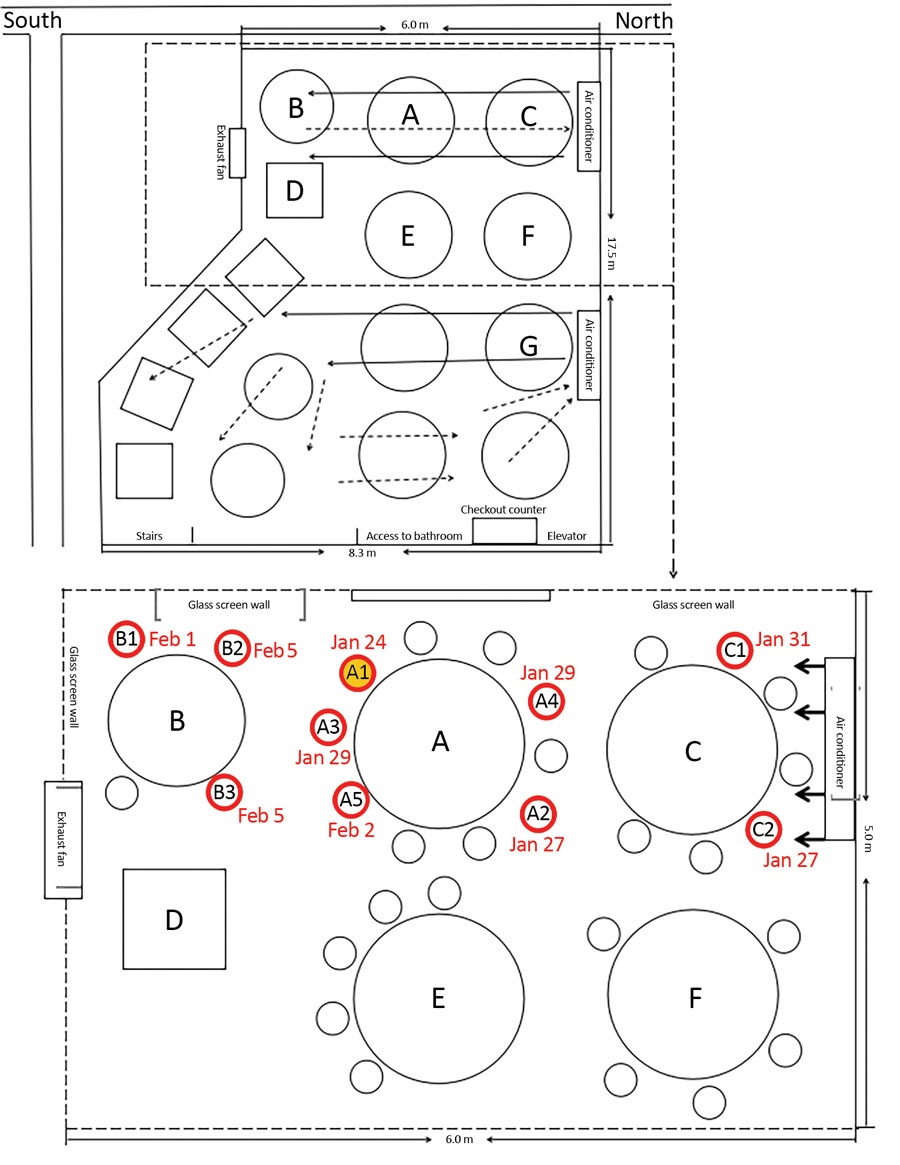
Restaurants: Some really great shoe-leather epidemiology demonstrated clearly the effect of a single asymptomatic carrier in a restaurant environment (see below). The infected person (A1) sat at a table and had dinner with 9 friends. Dinner took about 1 to 1.5 hours. During this meal, the asymptomatic carrier released low-levels of virus into the air from their breathing. Airflow (from the restaurant's various airflow vents) was from right to left. Approximately 50% of the people at the infected person's table became sick over the next 7 days. 75% of the people on the adjacent downwind table became infected. And even 2 of the 7 people on the upwind table were infected (believed to happen by turbulent airflow). No one at tables E or F became infected, they were out of the main airflow from the air conditioner on the right to the exhaust fan on the left of the room. (Ref)
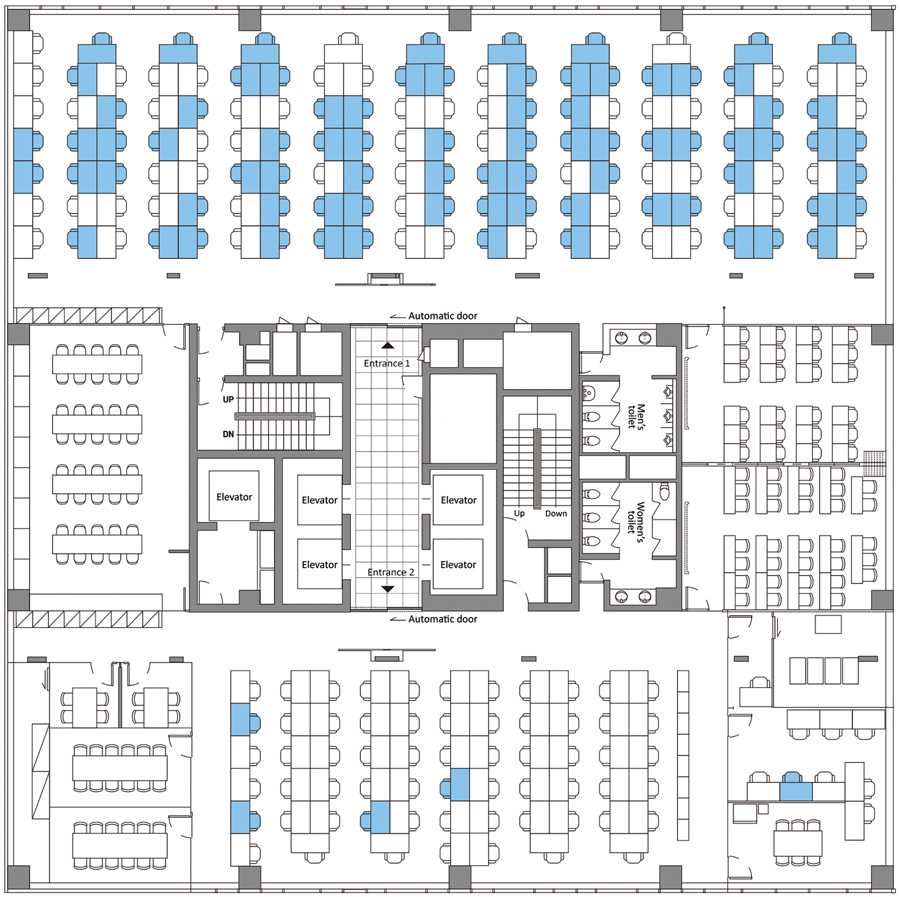
Workplaces: Another great example is the outbreak in a call center (see below). A single infected employee came to work on the 11th floor of a building. That floor had 216 employees. Over the period of a week, 94 of those people become infected (43.5%: the blue chairs). 92 of those 94 people became sick (only 2 remained asymptomatic). Notice how one side of the office is primarily infected, while there are very few people infected on the other side.

Sunday, May 3, 2020

Week-end Wrap – Political Economy – May 3, 2020

Week-end Wrap – Political Economy – May 3, 2020
by Tony Wikrent
Economics Action Group, North Carolina Democratic Party Progressive Caucus

Strategic Political Economy

Organizing for Survival in New York City
[Commune, via Naked Capitalism 4-26-20]

China Spends $600 Billion To Trump America’s Economy
[Forbes, May 1, 2020]
Ten years from now, when economists mull the exact moment the U.S. ceded the future to China this week’s events are sure to top the list of time-stamp candidates. 
This was the week, after all, when Chinese President Xi Jinping tossed another 4 trillion yuan, or $565 billion, at an economy taking devastating coronavirus blows.... 
Within the same 24 hours during which Xi’s announced a nearly $600 billion plan to build even more airports, railways and power grids, Senate Majority Leader McConnell gave the thumbs down to comparable upgrades to America’s economic hardware. “Infrastructure is unrelated to the coronavirus pandemic that we're all experiencing and trying to figure out how to go forward,” McConnell said. 
Music to Xi’s ears. The trillions of dollars his government lavished on the “Made in China 2025” extravaganza is already positioning China to lead the future of artificial intelligence, automation, micro-processing, renewable energy, robotics, self-driving vehicles, you name it. And Trump made it easy for Xi. As China prepares for the global economy it will confront in 2025, Trump is making coal great again.
Why Mitch McConnell Wants States to Go Bankrupt David Frum, April 25, 2020 [The Atlantic]
Note this is by former Bush Jr. speech writer Frum, so represents thinking inside the Republican party elites.
State bankruptcy is not some passing fancy. Republicans have been advancing the idea for more than a decade. Back in 2011, Jeb Bush and Newt Gingrich published a jointly bylined op-ed advocating state bankruptcy as a solution for the state of California. The Tea Party Congress elected in 2010 explored the idea of state bankruptcy in House hearings and Senate debates. Newt Gingrich promoted it in his run for the 2012 Republican presidential nomination.... A bankruptcy is not a default.... A default is a sovereign act. A defaulting sovereign can decide for itself which—if any—debts to pay in full, which to repay in part, which debts to not pay at all. Bankruptcy, by contrast, is a legal process in which a judge decides which debts will be paid, in what order, and in what amount....
Since 2010, American fiscal federalism has been defined by three overwhelming facts.
First, the country’s wealthiest and most productive states are overwhelmingly blue. Of the 15 states least reliant on federal transfers, 11 are led by Democratic governors. Of the 15 states most reliant on federal transfers, 11 have Republican governors.
Second, Congress is dominated by Republicans. Republicans controlled the House for eight of the last 10 years; the Senate for six. Because of the Republican hold on the Senate, the federal judiciary has likewise shifted in conservative and Republican directions.
A state bankruptcy process would thus enable a Republican Party based in the poorer states to use its federal ascendancy to impose its priorities upon the budgets of the richer states.

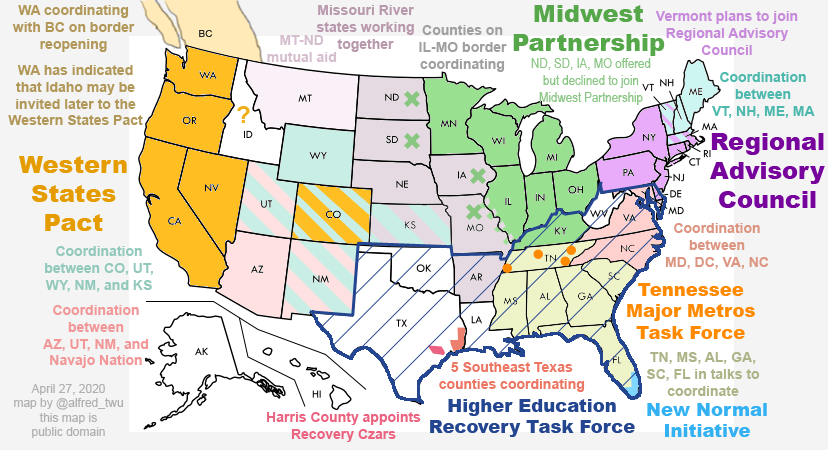
Regional compacts on #COVID19
[Twitter, via Naked Capitalism Water Cooler 4-28-20]
The fabric of the Union begins to unravel under the pressure of Trump's incompetence and Republican intransigence.

Friday, May 1, 2020

Federal funds must go to state and local governments


Over $3 trillion in emergency spending has been authorized by Congress in the past month, with another $6 trillion plus in money creation and lending powers given to the Federal Reserve. Judged solely by its size, this has been an impressive response.

There are two crucial facts to note and questions to ask:

1. Little of these trillions of new dollars has gone to help the people and businesses who need it most. Why?
2. In the discussion of these emergency spending measures, why is there no one asking: How are we going to pay for it? 

The answers to these two questions are pretty much the same: The United States is no longer a republic ruled by the Constitutional mandate to promote the General Welfare. As even former President Jimmy Carter has observed, the USA has become a plutocratic oligarchy, and the federal government has been mutated to protect and promote the wealth, power, and privilege of plutocrats and their retainers.

Ben Mathis-Lilley, Slate’s chief news blogger, argues that even the retainers are beginning to understand: The Coronavirus Is Showing Members of the Professional Class That the Government Doesn’t Work for Them Either.
...government programs in the United States—even those supported by the purportedly pro-government party—are not designed to solve problems. Rather, they are designed to solve a given problem only to a degree—and that degree can’t require an amount of spending that would necessitate financial sacrifice on the part of high-income taxpayers. This is not a leftist conspiracy theory, but the overt position of the party’s leaders, who believe they will not be able to achieve crucial voting margins in upscale suburbs if they authorize too much taxation and spending....

Sunday, April 26, 2020

Week-end Wrap – Political Economy – April 26, 2020

Week-end Wrap – Political Economy – April 26, 2020
by Tony Wikrent
Economics Action Group, North Carolina Democratic Party Progressive Caucus

Vic DiBitetto: Dear government: We need a real fucking plan, you shitbags


Shorter Twitter video:
Dear government: We need a real fucking plan, you shitbags
[via Mike Norman Economics]

Strategic Political Economy

Bill Clinton guru James Carville famously blurted "It's the economy stupid." Actually, it's the economic ideology. If the American people are going to save themselves, they need to understand that their ruling elites are Malthusians of the Social Darwinian type.

McConnell Says He Favors Letting States Declare Bankruptcy
[Bloomberg, April 22, 2020]
McConnell, a Kentucky Republican, said he blocked additional state and local aid in the latest relief package, which passed the Senate Tuesday and is set for a vote Thursday in the House. “I said yesterday we’re going to push the pause button here, because I think this whole business of additional assistance for state and local governments needs to be thoroughly evaluated,” McConnell added. Later, on Fox News, McConnell said that any state or local aid must be specifically linked to the pandemic and shouldn’t be viewed as an opportunity for “revenue replacement.” 
“We’re not interested in solving their pension problems for them,” McConnell said. “We’re not interested in rescuing them from bad decisions they’ve made in the past. We’re not going to let them take advantage of this pandemic to solve a lot of problems that they created for themselves with bad decisions in the past.”
Lee Saunders, president of the American Federation of State, County and Municipal Employees, said most states don’t need to restructure their debt. “Rather, they are suffering unprecedented revenue loss due to the shutdown of our economy just like so many businesses in the private sector,” Saunders said. “The money they need now is to maintain vital life-saving services provided by front-line workers in the face of the most dire public health emergency in a century.”
“We’re not interested in solving their pension problems for them.” Translation: we should avoid the costs of caring for retirees and just let them die off faster. And just in case you don't understand yet:

The Right Wing Wants You to Die
[Vice, via Naked Capitalism 4-25-20]
Earlier this week, someone showed up at a protest in Nashville, Tennessee with a sign reading "Sacrifice the weak.".... 
Other rich, advanced countries like South Korea and Germany have arrived at a solution. By using state power to do what scientists and economists say is necessary—testing the population, isolating the infected, and tracing their contacts, while financially supporting citizens who have lost income—they've reduced death and the spread of the virus without imposing mass suffering, offering the possibility of a return to something like normal life. The United States hasn't seriously prepared or planned to do any of these things. Instead of organizing a response, federal leaders are engaged in piracy. The Senate's majority leader wants states to declare bankruptcy. Trump has suggested injecting bleach into patients' lungs....
The phrase "death cult" has been used to describe the Republican Party enough lately that it's probably lost any real meaning, but it's not far off as a descriptor. Ohio congressman Jim Jordan, head of the House Freedom Caucus, supports the protests and doesn't understand why the economy shouldn't have been opened yesterday. Pennsylvania lawmaker Mike Jones participated in a protest in Harrisburg this week, calling it "the best of America." A protest in Michigan was organized by the vice-chair of Trump's state campaign and the grassroots vice-chair of the state Republican Party. Government is organizing protests of itself to rally support for policies that would result in mass death.

Sunday, April 19, 2020

Week-end Wrap – Political Economy – April 19, 2020

Week-end Wrap – Political Economy – April 19, 2020
byTony Wikrent
Economics Action Group, North Carolina Democratic Party Progressive Caucus

Strategic Political Economy

Is America Going to Have a Covid-19 Apocalypse?
Ian Welsh, April 17, 2020
In the US, we have predictions of a 30 percent unemployment rate. I just saw that less than half of Los Angeles county still has a job. The bailout for regular people is $1,200. In a place like Los Angeles, that won’t even cover most people’s rent.
There’s been a vast bailout, mainly–though not exclusively–through the Fed, for the rich. Basically, as much free money at the trough as they can gorge on. But small businesses are toast. A third of households, at least, are on the verge of not just homelessness but not being able to eat....
Meanwhile, multiple states have not instituted isolation, and there are “protests,” backed by Republicans, to reopen states that have. Not isolating nationally means there are pockets of plague which are still expanding exponentially, and which can reinfect the areas which did isolate. Coming out of isolation too soon will mean that cases will explode again a month to a month and a half after self-isolation ends.
The job issues mean trouble. People who can’t afford food become violent. Food riots bring down nations.
The New Fault Lines in a Post-Globalized World
Marshall Auerback [Economy for All (Independent Media Institute), via Naked Capitalism 4-16-20]
Forget about the “new world order.” Offshoring and global supply chains are out; regional and local production is in. Market fundamentalism is passé; regulation is the norm. Public health is now more valuable than just-in-time supply systems. Stockpiling and industrial capacity suddenly make more sense, which may have future implications in the recently revived antitrust debate in the U.S. 
Biodata will drive the next phase of social management and surveillance, with near-term consequences for the way countries handle immigration and customs. Health care and education will become digitally integrated the way newspapers and television were 10 years ago. Health care itself will increasingly be seen as a necessary public good, rather than a private right, until now in the U.S. predicated on age, employment or income levels.

The Plan Is to Save Capital and Let the People Die
[In These Times, via Common Dreams 1-9-20]
Those are all obvious steps to take if your goal was to protect humans. But imagine, instead, if you had an entirely different goal: protecting capital. What would you do then? Well, you would prioritize the health of corporate balance sheets, rather than human bodies. You would keep the healthcare industry, now booming, in private hands; you would stimulate consumer demand via unemployment benefits, rather than by keeping workers on existing payrolls, in order to create an enormous pool of cheap and desperate labor; you would pursue tax cuts for the investor class; you would welcome the opportunity to allow debt to pile up on individuals; and you wouldn’t be too sad about small businesses going bankrupt—they are, after all, just ceding market share to bigger, richer businesses. You would use this crisis to create a greater, not lesser, concentration of wealth. You would emerge on the other side with more, not less, inequality. The truth is, it would be easy.
Now, guess what the U.S. federal government is doing? It is allowing the unemployment rate to skyrocket, as tens of millions of workers are fired; it is allowing countless small businesses to go bankrupt, from incompetence and neglect; it has not even considered a national suspension of rent, nor a strong national policy of paid sick leave, much less a national system of free public healthcare; as millions of needy people struggle with decrepit and broken state unemployment systems and wait weeks or months for their emergency checks to come, and essential workers are forced to agitate or walk out to gain hazard pay, the administration plots a new bill featuring a capital gains tax cut and “a waiver that would clear businesses of liability from employees who contract the coronavirus on the job.”
....The true heroes of this crisis, from the perspective of those in charge, will be the private equity firms that rush in to buy up distressed businesses, and the hedge funds that pour money into cheap debt, and the investors that scoop up the homes that people will be evicted from. They are the ones that renew the blood of capital, you see. They are the ones that will rescue us. They are the ones who will shepherd our precious capital through this dangerous time, and into the promised land.

Wednesday, April 15, 2020

Demand Congress pass Saving Peoples’ Lives Act of 2020

People Demand Bold Action to Save Lives and 

Prevent Second Wave of COVID-19 Infections

Congress Must Approve “Saving Peoples’ Lives Act of 2020

Statement of the COVID-19 Emergency Response Group

(14 April 2020, Washington, DC) Social distancing is saving lives. But our national leaders, impatient to get Americans back to work, are sending messages that undermine on-the-ground health and safety recommendations that state governors, mayors and local health departments are urging.

Americans cannot count on their national leaders to make decisions that prioritize human lives and health over the economy. Everyday citizens must come off the sidelines, raise their voices and create the health-first policies that can keep our families and communities safe from COVID-19.

To stop the spread of COVID-19, and to manage the next wave of infections certain to come, we must demand extending federal stay-at-home guidelines through May 31, 2020 at minimum, and an aggressive campaign to put in place national testing, tracking, isolation and containment (TTIC) capabilities. Quite simply, we can’t let people return to work until we identify and isolate infected people; we can’t isolate infected people until we identify them; and we can’t identify them until they are tested.

The newly formed COVID-19 Emergency Response Group aims to give concerned Americans a voice in shaping the Trump Administration’s and the world’s response to this unprecedented health emergency.

The COVID-19 Emergency Response Group, made up of leading public health experts, faith and business leaders, former senior Congressional and legislative staffers, local and state elected officials, and leaders of national NGOs, will help draft federal legislation, support smart existing legislation, lobby the United Nations, and advocate for governments around the world.

Sunday, April 12, 2020

Week-end Wrap – Political Economy – April 12, 2020

Week-end Wrap – Political Economy – April 12, 2020
by Tony Wikrent
Economics Action Group, North Carolina Democratic Party Progressive Caucus

Strategic Political Economy

Is Capitalism a Threat to Democracy?
[New Yorker, via Naked Capitalism 4-5-20]
In a sweeping, angry new book, “Can Democracy Survive Global Capitalism?” (Norton), the journalist, editor, and Brandeis professor Robert Kuttner... [argues] today’s political impasse is different from that of the nineteen-thirties. It is being caused not by a stalemate between leftist governments and a reactionary business sector but by leftists in government who have reneged on their principles. Since the demise of the Soviet Union, Kuttner contends, America’s Democrats, Britain’s Labour Party, and many of Europe’s social democrats have consistently tacked rightward, relinquishing concern for ordinary workers and embracing the power of markets; they have sided with corporations and investors so many times that, by now, workers no longer feel represented by them. When strongmen arrived promising jobs and a shared sense of purpose, working-class voters were ready for the message.

Economic Armageddon

Key 2008 Financial Crisis Players Are Back for Coronavirus
[Bloomberg, via Naked Capitalism 4-5-20]
The same self-serving rentier parasites who were in charge in 2008-2009 are still in charge - another indication that USA political and economic systems are complete failures. They are unable to replace proven failed leadership with competent leadership. Not surprising that the professional class in the Democratic Party -- which declined the opportunity in 2009-2010 to uproot the failed leadership of Wall Street, and is now besieged by a reality of innumerable crisis -- responded to the challenge of Bernie Sanders, by desperately retreating to their Biden redoubt. 

  • Treasury Secretary Steven Mnuchin led a group of investors who purchased failed subprime mortgage lender IndyMac and ran the bank until its sale in 2015. Mnuchin is now leading President Donald Trump's economic response to the pandemic.
  • Tim Geithner, President, Federal Reserve Bank of New York in 2009. CURRENT POSITION: President, Warburg Pincus
  • Larry Fink, CEO, BlackRock Inc. in 2008. CURRENT POSITION: CEO, BlackRock Inc.
  • Tom Montag, Head of Sales & Trading, Merrill Lynch & Co. in 2009. CURRENT POSITION: 
  • Chief Operating Officer, Bank of America Corp.
  • Rodge Cohen, Chairman, Sullivan & Cromwell LLP in 2008. CURRENT POSITION: Chairman, Sullivan & Cromwell LLP
  • Alan Schwartz, CEO, Bear Stearns Cos. in 2008. CURRENT POSITION: Co-Chairman, Guggenheim Securities LLC
  • Gary Parr, Vice Chairman, Lazard Ltd. in 2008. CURRENT POSITION, Senior Managing Director, Apollo Global Management

  • To which let me add: Joe Biden, vice-president of the United States in 2009. CURRENT POSITION, Democratic nominee for U.S. President

'Breadlines' Erupt Across America As Lockdowns Crush America's "Working Poor"
[ZeroHedge 4-10-20]

Monday, April 6, 2020

Saving your local economy 4-6-20

This post is based on some key assumptions: 
  • You want to save and preserve small and local businesses in your community or town.
  • You don’t want a local economy that consists almost entirely of chain restaurants and big box stores with a central business district full of empty storefronts.
  • You value the diversity, creativity, idiosyncratic character, and friendliness that thriving small business owners bring to your community or town. 

Whenever there are enough links that I think might assist people in organizing responses from their local county and municipal governments, I will post them. It probably will not be every day. 

In a phoned-in interview on CNBC, Wilfred Frost urgently reported that Bank of America has received 177,000 applications for some $32.6 billion in emergency liquidity, but so far, only 100 of these loans have been disbursed.
The bank hopes to get most of the stack processed by mid-week, but it's unclear what they're basing these hopes on. 
Unsanitized: Why Banks Don’t Want to Help Small Businesses [David Dayen,  The Prospect, April 3, 2020]
So why the reticence from the banking sector? I think liability is a red herring; are they really afraid of the heavy regulatory hand of Steve Mnuchin (or any law enforcer involved in the financial crisis)? It looks to me like they don’t want to do the work. Every expectation is for an absolute crush of applications. Thirty million small businesses could be on the line here. The compliance requirements are minimal but banks always whine about the expense of that; that’s why BofA is restricting to already-vetted customers. And the guidelines, which have been “changing by the minute,” could change again. So why bother with the hassle? The money’s good, but it’s marginal, and the big banks think in billions, not millions…. 
...I’ve talked to dozens of small business owners who are confused by this program and also desperate to participate. There’s not going to be enough money—Congress gave $350 billion—to begin with. If lenders are slow to open the spigot, a lot of these businesses will go down. They don’t have any cash reserves. There’s a lot of concern. Maybe SBA should have found someone more willing to act quickly.

Sunday, April 5, 2020

Week-end Wrap – Political Economy – April 5, 2020

Week-end Wrap – Political Economy – April 5, 2020
by Tony Wikrent
Economics Action Group, North Carolina Democratic Party Progressive Caucus

Economic Armageddon

Coronavirus batters US economy as 6.65 million file for unemployment last week
[The Guardian April 2, 2020]
Some 3.3 million had filed for unemployment the previous week, bringing total claims to 9.95 million for the two weeks.
US Labor Market Update
Len Kiefer April 3-2020
Click through to his animated gif graph, which helps visualize the catastrophic economic convulsion we are in. It takes a few seconds to get to the stunning, shocking end.
http://lenkiefer.com/img/charts_2020_04_03/claimsSA_2020_04_03.gif


Jobs Aren’t Being Destroyed This Fast Elsewhere. Why Is That?
Emmanuel Saez and Gabriel Zucman [NYT, via Naked Capitalism 4-1-20] 
This dramatic spike in jobless claims is an American peculiarity. In almost no other country are jobs being destroyed so fast. Why? Because throughout the world, governments are protecting employment. Workers keep their jobs, even in industries that are shut down. The government covers most of their wage through direct payments to employers. Wages are, in effect, socialized for the duration of the crisis. 
Instead of safeguarding employment, America is relying on beefed-up unemployment benefits to shield laid-off workers from economic hardship. To give just one example, in both the United States and Britain, the government is asking restaurant workers to stay home. But in Britain, workers are receiving 80 percent of their pay (up to £2,500 a month, or $3,125) and are guaranteed to get their job back once the shutdown is over. In America, the workers are laid off; they must then file for unemployment insurance and wait for the economy to start up again before they can apply for a new job, and if all goes well, sign a new contract and resume working....
This situation for laid-off workers would be bad enough if it were not aggravated by a second American peculiarity. As they are losing their jobs, many workers are also losing their employer-provided health insurance — and now find themselves faced with the Kafkaesque task of obtaining coverage on their own. 
One option involves continuing to be covered by one’s former employer, a program known as COBRA. It is prohibitively expensive: Participants have to bear the full cost of insurance, $20,500 per year on average. Another option is to go shopping for a plan on the Affordable Care Act insurance exchange, where one is faced with a bewildering choice between plans like Blue Shield’s Bronze 60 PPO (with a deductible of up to $12,600 per year) and Aetna’s Silver Copay HNOnly (with a $7,000 deductible and up to $14,000 in annual out-of-pocket expenses). The last option is to join the ranks of the uninsured, a catastrophic solution during a pandemic. There are reports that people have already died of Covid-19 because they refused to go to the hospital, worried about bills, or because they were denied treatment for lack of insurance.

Sunday, March 29, 2020

Week-end Wrap – Political Economy – March 29, 2020

Week-end Wrap – Political Economy – March 29, 2020
by Tony Wikrent
Economics Action Group, North Carolina Democratic Party Progressive Caucus

The Pandemic

The Doctor Who Helped Defeat Smallpox Explains What’s Coming
[Wired, via The Big Picture 3-24-20]
Flatten the Curve
By slowing it down or flattening it, we're not going to decrease the total number of cases, we're going to postpone many cases, until we get a vaccine—which we will, because there's nothing in the virology that makes me frightened that we won’t get a vaccine in 12 to 18 months. Eventually, we will get to the epidemiologist gold ring.
What’s that?
That means, A, a large enough quantity of us have caught the disease and become immune. And B, we have a vaccine. The combination of A plus B is enough to create -herd immunity, which is around 70 or 80 percent....
How will we know when we’re through this?
The world is not going to begin to look normal until three things have happened. One, we figure out whether the distribution of this virus looks like an iceberg, which is one-seventh above the water, or a pyramid, where we see everything. If we're only seeing right now one-seventh of the actual disease because we're not testing enough, and we're just blind to it, then we're in a world of hurt. Two, we have a treatment that works, a vaccine or antiviral. And three, maybe most important, we begin to see large numbers of people—in particular nurses, home health care providers, doctors, policemen, firemen, and teachers who have had the disease—are immune, and we have tested them to know that they are not infectious any longer. And we have a system that identifies them, either a concert wristband or a card with their photograph and some kind of a stamp on it. Then we can be comfortable sending our children back to school, because we know the teacher is not infectious.
And instead of saying "No, you can't visit anybody in nursing home," we have a group of people who are certified that they work with elderly and vulnerable people, and nurses who can go back into the hospitals and dentists who can open your mouth and look in your mouth and not be giving you the virus. When those three things happen, that's when normalcy will return.
Total Cost of Her COVID-19 Treatment: $34,927.43
[Time, via Naked Capitalism Water Cooler 3-23-20]
And this isn't even actually treatment for COVID19, because she was sent home before the test results came back positive. 

Israeli doctor in Italy: We no longer help those over 60
[Jerusalem Post, via Naked Capitalism 3-23-20]

Sunday, March 22, 2020

Week-end Wrap – Political Economy – March 22, 2020

Week-end Wrap – Political Economy – March 22, 2020
by Tony Wikrent
Economics Action Group, North Carolina Democratic Party Progressive Caucus

The Financial Collapse 

The Fed Backfires: Shock and Awe Rate Drop to 0%, Emergency Bond Buying Program Leads to Limit Down Drops in US Equity Futures as Real World Coronavirus Damage Worsens
[Naked Capitalism 3-16-20]

Reserve Requirements
[Federal Reserve, Naked Capitalism 3-19-20]

[Twitter below via Naked Capitalism Water Cooler 3-17-20]
I can't believe I'm entering the second global financial meltdown of my adult life and more or less the same people are still in charge of everything


Fed Announces Program for Wall Street Banks to Pledge Plunging Stocks to Get Trillions in Loans at ¼ Percent Interest
Pam Martens and Russ Martens: March 18, 2020 [Wall Street On Parade]
Veterans on Wall Street think of it as the cash-for-trash facility, where Wall Street’s toxic waste from a decade of irresponsible trading and lending, will be purged from the balance sheets of the Wall Street firms and handed over to the balance sheet of the Federal Reserve – just as it was during the last financial crisis on Wall Street.

Capitalism in the time of COVID

Green Jobs Are the Answer to the Coronavirus Recession
[New Republic, Naked Capitalism 3-19-20]
Franklin Roosevelt used the Public Works Administration, Civilian Conservation Corps and Works Progress Administration, so that the federal government directly hired millions of people to give them a steady paycheck. Today, the federal government should be hiring millions of people and begin teaching them how to care for people that are ill with COVID19, or how to manufacture medical equipment, or how to operate emergency food distribution.

Why is there no discussion of the federal government building new emergency hospitals, or building new manufacturing plants to make ventilators, face masks, and other medical equipment? Why is there no discussion of the federal government seizing control of any drug company or medical device manufacturer or producer or seller of handiwipes that tries to take advantage of this crisis to price gouge? Because people have been indoctrinated with the idea that such a direct government role in the economy is bad. What we’re about to find out is, that idea is what’s bad. Another example of how our unquestioned economic ideology limits our options. 

Sunday, March 15, 2020

Week-end Wrap – Political Economy – March 15, 2020

Week-end Wrap – Political Economy – March 15, 2020
by Tony Wikrent
Economics Action Group, North Carolina Democratic Party Progressive Caucus

Health Crises


The comprehensive Ars Technica guide to the coronavirus
[Ars Technica, via Naked Capitalism 3-13-20]

WORTH REPEATING: In 2018, Trump fired the entire US pandemic response team. [Twitter, via Naked Capitalism Water Cooler 3-12-20]
These were the experts with decades of experience dealing with precisely the kind of situation we are in today. Trump did not replace them. He eliminated the positions.
Snopes: TRUE - The Trump administration fired the U.S. pandemic response team in 2018 to cut costs.
[Snopes]
Rear Adm. Timothy Ziemer abruptly departed from his post leading the global health security team on the National Security Council in May 2018 amid a reorganization of the council by then-National Security Advisor John Bolton, and Ziemer’s team was disbanded. Tom Bossert, whom the Washington Post reported “had called for a comprehensive biodefense strategy against pandemics and biological attacks,” had been fired one month prior.

It’s thus true that the Trump administration axed the executive branch team responsible for coordinating a response to a pandemic and did not replace it, eliminating Ziemer’s position and reassigning others, although Bolton was the executive at the top of the National Security Council chain of command at the time.

[New York Magazine, via Naked Capitalism 3-13-20] 
What we are seeing right now is the collapse of civic authority and public trust at what is only the beginning of a protracted crisis. In the face of an onrushing pandemic, the United States has exhibited a near-total evacuation of responsibility and political leadership — a sociopathic disinterest in performing the basic function of government, which is to protect its citizens. 
Things will get worse from here. According to a survey of epidemiologists released yesterday, the coronavirus outbreak probably won’t peak before May.... 
Trump is, of course, the last man in the world you would want in charge right now. In an extremely illuminating interview with Gabriel Debenedetti published this morning, Obama’s Ebola czar Ron Klain described his response to that threat, which he suggested was a relatively good model for how the U.S. might have responded to this one. That response began with 10,000 public-health workers sent to fight and investigate the disease. This administration has sent none, which means it has been, practically speaking, flying blind about the nature of the coronavirus and the challenges it represents to public-health systems. In fact, it’s worse than that; for all intents and purposes, the administration hasn’t been flying at all, spending the last three months sitting by entirely idle and indifferent, rather than scaling up testing regimes, issuing protocols, and preparing for a major surge of patients by developing contingency plans to expand hospital capacity around the country wherever it became needed.

Sunday, March 8, 2020

Week-end Wrap – Political Economy – March 8, 2020

Week-end Wrap – Political Economy – March 8, 2020
by Tony Wikrent
Economics Action Group, North Carolina Democratic Party Progressive Caucus

Strategic Political Economy

Lessons for the Green New Deal from the Economic Mobilization for World War Two (PDF deck) [Josh Mason, via Naked Capitalism 3-2-20]
(Based on forthcoming Roosevelt Institute paper coauthored with Andrew Bossie)
Why so much direct public investment?
  • Private sector unwilling/unable to bear risk, especially in newer industries
Lessons for Green New Deal
  1. Decarbonization may call for large direct investment by public sector as opposed to shifting private investment via prices/subsidies
  1. Public role largest in new industries/technologies
  1. Public role not just to provide resources, but to solve coordination problems and to bear risk
Third lesson: Full employment is powerful force for redistribution
  • 1940s saw the largest compression of incomes in US history as in most advanced countries
  • Lowest paid groups (African Americans, agricultural workers) gained most
  • Very little direct redistribution - all about labor market
Summary - Three lessons from wartime mobilization:
  1. Rapid economic transitions require larger role for direct public investment
  1. Output, employment are more elastic than conventional estimates of potential assume
  1. Full employment is powerful force for income compression, even without explicit redistribution

Sunday, March 1, 2020

Week-end Wrap – Political Economy – March 1, 2020

Week-end Wrap – Political Economy – March 1, 2020
by Tony Wikrent
Economics Action Group, North Carolina Democratic Party Progressive Caucus

Strategic Political Economy

Chile's Struggle to Democratize the State
[NACLA, via Naked Capitalism 2-25-20]
A useful overview of the neoliberal policies enacted by the Pinochet regime three decades ago -- protesters chant, “It’s not 30 pesos, it’s 30 years!” referring to the transit fare hike that sparked the social uprising in October 2019 and the 30 years of enforced neoliberal economic devolution. Neoliberal policies were written in Pinochet's constitution, which is why Chileans are demanding a new constitution. 
General Augusto Pinochet’s 1980 Constitution both symbolizes and imposes the authoritarian model at the root of the ongoing mobilization. The Constitution institutionalized the economic and political domination of the dictatorship and enshrined a neoliberal framework that erased the role of the state in social and economic areas. It restricted political participation, gave the Right disproportionate power, and installed a tutelary role for the armed forces.... 
Pinochet’s radical neoliberal transformation privatized the pension system and promoted the development of a private sector in the health and education fields. These privatizations have perpetuated inequality and reinforced extreme social divisions. Moreover, Chile is the only country in the world with almost completely privatized water—Chapter III, Clause 24 of the 1980 Constitution establishes the “right” to private ownership of water. 
....A 2019 study by The Lancet showed that a woman in a poor district of Santiago lives some 18 years less than a woman in a rich neighborhood in the same city.
.... popular symbols have changed. In large demonstrations in the past, people carried the banners of their political parties or social organizations. Such banners are gone in the protests today, reflecting the spontaneous nature of the social explosion and its distance from the political parties.
[I can see these types of protests erupting in USA, as people give up hope that either the Republican Party - taken over by grifter Trump who lied about his intention to implement populist policies - and the Democratic Party, which is fighting desperately to prevent populist policies from being carried into office by Sanders or Warren.]
Some 70 to 80 percent are in favor of a new Constitution—forged under democracy—to guarantee social rights. Chileans now look forward to the national plebiscite called for April 26 to vote for a path toward a Constitution that will protect the rights to education, health, and decent pensions, among others.
View of the protest of an estimated 1.2 million people in Santiago, October 25, 2019. (Hugo Morales/Wikimedia)

Sunday, February 23, 2020

Week-end Wrap – Political Economy – February 23, 2020

Week-end Wrap – Political Economy – February 23, 2020
by Tony Wikrent
Economics Action Group, North Carolina Democratic Party Progressive Caucus

Strategic Political Economy

The Oligarch Stage of the American Disease: Bloomberg Edition
[Ian Welsh, February 18, 2020]
The thing about Trump was always that he was a symptom of a disease. It’s hard to say exactly when the disease started, but serious symptoms started showing up after the elections of Reagan and Thatcher.  Rates of wage increases collapsed, stock markets and other asset prices rose much faster than inflation, regulations were gutted, people were thrown in jail at a ferocious rate and unions were smashed.
Inequality took off, and over time multiple billionaires were created. They used their money to buy politicians, and thru politicians to buy policy. Tax rates on corporations and rich people and estates and so on were slashed to the bone. Subsidies for the rich were increased, while subsidies for the poor and middle class were, in relative terms, cut.
The Federal Reserve (all of whose governors are political appointees), acted aggressively to keep wage increases at or under inflation, and targeted inflation rather than job growth. Good working class and many middle class jobs were off-shored and outsourced....
So the oligarchs, aided by the huge concentration of companies into oligopolies, have come to have or control vast amounts of wealth. They got money defined as free speech, and now that the political class has proven incapable of handling a left wing populist, an oligarch is stepping directly in because his class’s lackeys, like Biden and Buttigieg and indeed most of the field, are incompetent.
“Frederick Douglass Railed Against Economic Inequality” 
[Jacobin, via Naked Capitalism 2-21-20]
Douglass: “The Spartan lawgiver who discouraged the accumulation of wealth, because of its tendency to impair the liberties of his country, was fully justified in the extreme measures he adopted, by the universal experience of nations, and the fate of his own country; the fall of Spartan liberties dating from the introduction of wealth and consequent luxury of her citizens. His aim to exterminate wealth and refinement entirely, was, perhaps, not wise; it is not wealth of itself that produces the dreaded effects, but its accumulation in the hands of a few — creating an aristocracy of wealth, ready to be the tool of an aggressive tyranny, or to become aggressive upon its own account. With an increase of wealth comes an increase of selfishness, devotion to private affairs, and a contempt of public — unless politics can be made to minister to the all absorbing selfishness of the individual.”

Sunday, February 16, 2020

Week-end Wrap – Political Economy – February 16, 2019

Week-end Wrap – Political Economy – February 16, 2019
by Tony Wikrent
Economics Action Group, North Carolina Democratic Party Progressive Caucus

Strategic Political Economy

“The U.S. Military Is Not Ready for a Constitutional Crisis” 
[The Atlantic, via Naked Capitalism 2-13-20] 
I spent nine years on active duty in the U.S. Navy. I served as an aircraft commander, led combat reconnaissance crews, and taught naval history. But the first thing I did upon joining the military, the act that solemnized my obligation, was swear an oath to support and defend the Constitution. How strange, then, that despite all of my training, the millions of taxpayer dollars devoted to teaching me how to fly, lead, and teach, not once did I receive meaningful instruction on the document to which I had pledged my life....
I had left the Navy and was in law school when news of the torture memo broke. This was the George W. Bush administration’s attempt to offer a legal justification for “enhanced interrogation.” I had been through Survival, Evasion, Resistance, and Escape (SERE) school, the military’s interrogation training program, from which these techniques had been adopted. I understood the “enhanced” methods described by the Bush-administration lawyers for what they were: torture.
At the time, I found it unconscionable that legal scholars would be complicit in underwriting our government’s disregard for the Geneva Conventions. But with the benefit of hindsight, though I still find the torture memo appalling, I can at least acknowledge that the Bush administration cared enough about the law to offer the pretense of legality. 
The current administration is not even trying. President Donald Trump openly flouts laws at home, while threatening to destroy cultural sites abroad (a blatant violation of the Geneva Conventions).
How State Capacity Drives Industrialization
[Palladium, 2-12-20, via reader of RealEconomics]
These “tools that make the tools” are a crucial piece of modern supply chains, and most advanced manufacturing would be impossible without them. The ability to produce machine tools domestically is one of the foundations of a deep industrial base. Recognizing this, the South Korean state encouraged Hyundai, a chaebol which built the first all-Korean automobile in 1975, to begin making machine tools for the growing domestic market. Since then, the South Korean machine tool industry has grown steadily alongside the Korean economy as a whole. Production today is slightly larger than the machine tool industry of the United States, a country more than six times as populous....
Korea’s story may be more extreme than most, but this type of state-led economic development is how every wealthy country on Earth has industrialized. The sole exception is Britain during the original Industrial Revolution.... Only the state can coordinate many different industries to produce a transformation at the scale of industrialization. 
Interesting: even some leading libertarians are beginning to admit society needs government to actively promote the general welfare, though of course, they won't use such terms. Probably, the spectre of China building a 1,000 bed hospital in ten days has scared the living crap out of them. The USA, by contrast, and thanks in no small part to the popularization of libertarian ideology, can't even maintain the infrastructure it already has. 

Thy Neighbor’s Solar Panels: When our peers take actions to preserve the planet, we’re more likely to follow suit. How the human instinct to conform could help us address the climate crisis.
[The Atlantic, via The Big Picture 2-12-20]