Sunday, July 29, 2018

Week-end Wrap - July 28, 2018

Week-end Wrap - July 28, 2018
by Tony Wikrent
Economics Action Group, North Carolina Democratic Party Progressive Caucus

"...we had come to the stage where for our people what was needed was a real democracy; and of all forms of tyranny the least attractive and the most vulgar is the tyranny of mere wealth, the tyranny of a plutocracy." - Theodore Roosevelt,  An Autobiography, 1913
[Posted by someone on Facebook]

The Missing Profits of Nations
Posted on July 23, 2018 by Thomas Tørsløv, PhD student, University of Copenhagen and Ministry of Taxation, Denmark, Ludvig Wier, PhD candidate, University of Copenhagen, and Gabriel Zucman, Gabriel Zucman.
[Originally published at VoxEU, via Naked Capitalism]
Between 1985 and 2018, the global average statutory corporate tax rate fell by more than half. This column uses new macroeconomic data to argue that profit shifting is a key driver of this decline. Close to 40% of multinational profits were artificially shifted to tax havens in 2015, and this massive tax avoidance – and the failure to curb it – are in effect leading more and more countries to give up on taxing multinational companies. 
Perhaps the most striking development in tax policy throughout the world over the last few decades has been the decline in corporate income tax rates. Between 1985 and 2018, the global average statutory corporate tax rate fell by more than half, from 49% to 24%.
Why are corporate tax rates falling? The standard explanation is that globalisation makes countries compete harder for productive capital.... 
But is it well founded empirically? Today’s largest multinational companies don’t seem to move much tangible capital to low-tax places – they don’t even have much tangible capital to start with. Instead, they avoid taxes by shifting accounting profits. In 2016 for instance, Google Alphabet made $19.2 billion in revenue in Bermuda, a small island in the Atlantic where it barely employs any worker nor owns any tangible assets, and where the corporate tax rate is zero percent. 
....Overall, we find that close to 40% of multinational profits – defined as profits made by multinational companies outside of the country where their parent is located – are shifted to tax havens in 2015. Our work provides transparent, easy-to-compute metrics for policymakers to track how much profits tax havens attract, how much they gain in tax revenue, and how much other countries lose.... Our findings have implications for economic statistics. They show that headline economic indicators – including GDP, corporate profits, trade balances, and corporate labour and capital shares – are significantly distorted.

Thursday, July 26, 2018

Monetary Theory and the Left


Tony (probably correctly) believes that I should write more about monetary theory.

Good point. Without monetary reform, there is simply no way the the world can pay the huge bills that will be incurred running an effective program to combat climate change. So in no particular order, here are my excuses for not writing about the subject every damn day—like it probably deserves.

1) I have written extensively on money and the economics of development. I still consider the chapter on Money to be the most well-thought-out chapter in Elegant Technology. But over the years, I have sort of run out of things to say.

2) The "left" is notoriously uninterested in monetary debates—lord knows I have tried. I have heard money debated in barber shops, gas stations, feed mills, church basements—sometimes (rarely) even in political forums. I grew up in the corn belt. My grandfather was an active member of the Farmer-Labor Party. But I haven't heard anyone from the "left" discuss the money subject since I started at U Minn in 1967. And the few people I have tried to engage either get lost in the math or the fact that fractional banking is not as established / legitimate as the big myths of banking and finance. The fact that the evidence is beyond rational debate does not sway minds—especially those who believe that "the personal is the political" and so shun the notion that something as impersonal as money may be the most important political subject of them all.

3) That leaves the "right." There are people like Ron Paul who are very good critics of the Federal Reserve. But his "solution" is the Gold Standard. Now the Fed has fallen into the hands of some serious fools, but on their very worst days, they are still a superior alternative to the Gold Standard.

4) Ellen Brown. Enter her name in the search box of this blog and you will find dozens of posts related to some well-written argument she is making. She loves the Bank of North Dakota—easily the best idea Progressives ever had. Strange how no one has duplicated that institution in other states, but she has done a nice job of lighting the fire that may lead to a California version.

5) There are a lot of crackpots out there. Because the nature of money is a subject that is virtually absent in the mainstream financial press, most people who develop any theories at all are usually self-taught. Now because there are a wealth of good books written about money and folks like Franklin, Edison, and Ford took an active interest in the subject, it IS possible to get your arms around this sprawling subject by reading alone, but it is difficult. It's the folks who aren't willing to do the necessary homework that end up as cranks.

Anyway, I promise to try to address legitimate monetary questions directed my way.

Wednesday, July 25, 2018

HAWB 1954-1976: The three major developments in aerodynamics


How America Was Built
HAWB 1954-1976: NACA, NASA, Richard Whitcomb, the Area Rule, Supercritical Wings, and Winglets

Do you like to look at aircraft? Have you ever wondered about the forward, second-deck hump of the Boeing 747? What about winglets, those vertical tips at the end of wings?

These are all the result of the U.S. government's active intervention into the economy. When Republicans, conservatives, and libertarians insist that nothing good comes from government, remember winglets and the 747's hump and realize that they are either lying shamelessly, or are embarrassingly ignorant, about the role of government.

By the end of the Second World War in mid-1945, aircraft design was on the verge of breaking the sound barrier. But aerodynamicists and aeronautical engineers were finding that achieving Mach speeds was much more difficult than anticipated. What we now know is that as an aircraft approaches Mach One in velocity, the aircraft's body generates shock waves in the air, which causes a huge spike in aerodynamic drag. The then accepted equations mathematically describing the aerodynamic behavior of aircraft just did not account for shockwaves formed at the speed of sound.

In 1943, the National Advisory Committee for Aeronautics (NACA, the forerunner of NASA) Langley Research Center in Hampton, Virginia hired a young aerodynamicist  who had just graduated from the Worcester Polytechnic Institute in Massachusetts. His name was Richard T. Whitcomb, and he was originally assigned to the Flight Instrument Division. This was not an area that held any interest for Whitcomb. He wanted to work in aerodynamics, and made himself enough of a nuisance that he was soon assigned to Langley's Eight-Foot High-Speed Tunnel, under the supervision of John Stack. 

Tuesday, July 24, 2018

How are you going to pay for it? Why Understanding Monetary Theory and Policy Is Critical For the Left

We now have the technology in hand to solve all our problems. The only real obstacle moving forward is the thinking of all those people who ask: How are you going to pay for it? 

Fortunately, Jon and I are not alone in trying to answer that question. Even more fortunately, there are many people who have much more patience than Jon and I in trying to explain our answer repeatedly. Or, perhaps, more accurately, we have the technology in hand to record and replay at our convenience people doing a splendid job answering that question, How are you going to pay for it? Early in June 2018, it was at a symposium held by the Next System Project, an initiative of The Democracy Collaborative. The panel was moderated by Gar Alperovitz and included Stephanie Kelton, the key economist on Bernie Sanders’ presidential campaign, now professor of public policy and economics at Stony Brook University; Michael Hudson, professor of economics at University of Missouri, Kansas City; Pavlina Tcherneva, an associate professor and chair of the department of economics at Bard College and a research associate at the Levy Economics Institute; and Raúl Carrillo, staff attorney at the New Economy Project and a director of the Modern Money Network.

There is a YouTube video plus a full transcript at the NSP's website at Money Matters! Why Monetary Theory and Policy Is a Critical Terrain For the Left. The video is also on Michael Hudson's website.

Below the embedded YouTube are extended excerpts from the transcript.


Sunday, July 22, 2018

Week-end Wrap - July 21, 2018

Week-end Wrap - July 21, 2018
by Tony Wikrent
Economics Action Group, North Carolina Democratic Party Progressive Caucus

When a U.S. citizen heard he was on his own country’s drone target list, he wasn’t sure he believed it. After five near-misses, he does – and is suing the United States to contest his own execution 
by Matt Taibbi [Rolling Stone, via Naked Capitalism 7-20-18]
Not economics, but I'm having a really hard time not listening to the echoes of very old voices in my head: "Those who would give up essential Liberty, to purchase a little temporary Safety, deserve neither Liberty nor Safety." And Taibbi has the next one in our wrap.

Taibbi: No, the Mythical ‘Center’ Isn’t Sexy
by Matt Taibbi [Rolling Stone, via Naked Capitalism 7-17-18]
Taibbi provides an unrestrained response to New York Times columnist Frank Bruni's reaction to the surprise primary win of young Bronx Democrat Alexandria Ocasio-Cortez. Bruni channeled TPTB's dismay and alarm that Democratic Socialists have begun to score electoral victories at the Congressional level. A historical note: after the Non-Partisan League won an almost complete sweep of November 1916 elections in North Dakota and began to enact its program, including state-owned grain elevators, and a state bank, the New York Times fulminated about "bolshevism on the prairie."

Friday, July 20, 2018

Synthetic Photosynthesis


When I first started writing about climate change and the environment back in the 1980s, the atmospheric CO2 levels stood at approximately 340 parts per million. We are now firmly past 400. We are so far into uncharted territory, that all predictions are at best, educated guesses. However, very few of these guesses are encouraging. Anyway, I like this fictional account below.

Because it points out an obvious fact. Not only are we going to have to spend big bucks replacing the fire-based infrastructure, we must do something to return the CO2 levels to let's say, 310, or even 275. What we need is a synthetic version of photosynthesis. And we need it immediately because say we did invent a process that could capture atmospheric CO2 and turn it into O2 plus a very pure carbon, we are going have to put up probably 250,000 installations to start moving the needle down. Even Elon Musk wouldn't promise this in five years. We are talking a Manhattan Project-size effort x 50.


Compared to the effort to make inexpensive solar cells, the synthetic photosynthesis business is still pretty primitive. But at least there are folks who are producing hardware who also have a good idea how important this is.

Tuesday, July 17, 2018

Lots of folks dare call it treason


Trump really laid a turd in the punch bowl when he announced to the world that he trusted the word of Vladimir Putin over his own "intelligence" experts on Russiagate. The defenders of the conventional wisdom will be shaking with rage over that one for a long time—with "Progressives" leading the charge. Robert LaFollette (one of the founders of the Progressive movement) had his political career destroyed because he voted in the Senate against the USA entry into WW I. Pretty sure he would not have approved of the current war-mongering lynch mob.

For a guy with a reputation for lying, this was as close to the unvarnished truth as we have heard from a USA president since at least Carter. The Empire runs on lies—can't let any honesty creep into the conversation. And I am not sure what came over Trump but I'll chalk it up to Finland—the Nordics are notoriously honest and uncorrupt so maybe the air helped.

Because there is absolutely no hard evidence to back up the Russiagate claims, I always assumed that the backers of the narrative would eventually see the light and sheepishly re-enter a world where evidence still means something. But it hasn't happened yet and the unfounded accusations have been going on for almost two years.

Sunday, July 15, 2018

On Class and Climate Change


In 1899, Thorstein Veblen would publish perhaps the most interesting, and misunderstood, book ever. It was called The Theory of the Leisure Class. Many, perhaps most, of the readers of this scintillating tome consider it a wonderful work of satire that highlights the foibles of the idle rich, and those who would emulate their lifestyles. And while I would agree that many parts of Veblen’s analysis are screamingly funny, we miss the point if we assume that Veblen was merely trying to entertain. Because beneath the chuckles, there is a deadly serious class analysis that goes a very long way towards explaining why a problem like climate change doesn’t get treated as seriously as it should be.

In Veblen’s world, there are two basic classes. The Industrial Class organizes the community’s necessary work. The Leisure Classes fasten themselves on the backs of the industrial classes “through force and fraud” in the often successful attempt at getting something for nothing. The Marxists then ask, “Aren’t your industrial classes merely another name for the proletariat?” This is important—the answer is NO.

Back in the day when Marxists preached that they were the friends, advocates, and only true representatives of the Proletariat, there was always something demeaning in their analysis. When someone picks strawberries all day in the hot sun, the Marxist description of the Proletariat and their troubles is still surprisingly accurate. But what do you call an farmer with 2500 acres under cultivation, or an engineer, or a big building contractor, or any number of important and often high paying occupations? They are obviously Industrial Class jobs but they all come with very different problems than face someone doing stoop labor. Obviously, there is an incredible amount of stratification within the occupations that can be found under the heading of “organizing and performing the community’s necessary tasks.”

Just as the Industrial Classes are stratified, so are the Leisure Classes. There is a large gap in income and status between a pickpocket and a hedge fund manager. But while there are hundreds of differences between the two major classes, many quite profound, the most telling is that when the Leisure Classes engage in conspicuous consumption and waste, their highest calling is uselessness. On the other hand, the goal of the Industrial Class is to be useful.

This class analysis is almost universally despised by the academic idea police. The right wing hates it because so many of their elites are little more than well-dressed thieves. The “left” (especially the Marxist varieties) hates it because it opens the possibility that there are enlightened, imaginative, and quite necessary “capitalists.” But it continues to be relevant because it describes the existing social order so much better than probably all the competing class descriptions combined.

Week-end Wrap - July 14, 2018

Week-end Wrap - July 14, 2018
by Tony Wikrent
Economics Action Group, North Carolina Democratic Party Progressive Caucus


Bill Mitchell — Elements in a strategy for the Left
[via Mike Norman Economics 7-10-18]
In my recent book (with Thomas Fazi) – Reclaiming the State: A Progressive Vision of Sovereignty for a Post-Neoliberal World (Pluto Books, 2017) – a central organising concept is that a progressive future is only possible if progressive citizens do two things: 
1. Learn how the monetary system operates and understand the capacity of the currency issuer and the opportunities and constraints that the government has. In other words, educate ourselves so that we have the capacity to refute the neoliberal lies that sustains the current system that has seen progressive outcomes diminish markedly. 
2. Take control of the political process and expunge neoliberal factions from progressive political parties (like the Blairites in the British Labour Party, almost all the Australian Labor Party, the Wall-Street embedded elites in the US Democrats, much of the traditional machinery of the European Socialist parties etc).Reclaiming the state is about reclaiming the legislative and regulative capacity of the nation state so that it is directed at advancing well being for the many rather than the few, to steal Jeremy Corbyn’s so excellent catch-cry....
Mitchell is a proponent of Modern Monetary Theory, which argues that money can be created out of nothing, by either a bank, the banking system, or by government, and that since governments can create money just as well as banks, there is no need to worry about budget deficits, so long as the money created is used for productive purposes.  MMT explained, Sept. 8, 2015, and Wray on MMT, January 13, 2015

When North Dakota Farmers Blew Up Partisan Politics: the Nonpartisan League: By Focusing on Economic Cooperation, Early 20th-Century Small Landowners Pushed Back Against Crony Capitalism, by Michael J. Lansing, May 18, 2018 [Zocalo]
Jon Larson writes: "Last Thanksgiving, Tony produced a short post on the Nonpartisan League. Think of this as an update. I happen to think the history of the NPL is important because it shows how effective a movement can be if they have a workable agenda. Instead of running against parties and personalities, an agenda-driven party wins because they are FOR something. Even better, an agenda usually outlives even the best supporters. And the State Bank of North Dakota is arguably the best political idea Progressives ever had—the signal accomplishment that lives on to this day."

Wednesday, July 11, 2018

NPL in North Dakota (cont.)


Last Thanksgiving, Tony produced a short post on the Nonpartisan League. Think of this as an update. I happen to think the history of the NPL is important because it shows how effective a movement can be if they have a workable agenda. Instead of running against parties and personalities, an agenda-driven party wins because they are FOR something. Even better, an agenda usually outlives even the best supporters. And the State Bank of North Dakota is arguably the best political idea Progressives ever had—the signal accomplishment that lives on to this day.

Sunday, July 8, 2018

Week-end Wrap - July 7, 2018

Week-end Wrap - July 7, 2018
by Tony Wikrent
Economics Action Group, North Carolina Democratic Party Progressive Caucus
 
Mexico Votes Overwhelmingly for “Change” by Electing López Obrador President
by CEPR, July 2, 2018 [The Real News Network]
“This is a triumph against a great deal of fear-mongering and ‘fake news’ that attempted to link López Obrador [AMLO] to Russia and that warned that his policies would bring economic disaster to Mexico,” CEPR Co-Director Mark Weisbrot said today. “But people in Mexico appear to be fed up with an economy that’s failed them for 40 years now. Poverty is worse than a quarter century ago, real wages are lower than in 1980, inequality is worsening....
Sounds just like USA. And what policy do USA and Mexico have in common? NAFTA. A race to the bottom.

[Democracy Now!, via Mike Norman Economics]
This is actually AMLO’s [López Obrador] re-election: He first won the presidency in 2006. But back then the thieving, scheming, blood-stained criminal gang that rules Mexico (and I’m being polite), declared AMLO’s dissolute opponent the winner. In 2006, rather than concede to vote thievery, lick his wounds and toddle off on a book tour, AMLO took his supporters into the streets, raised hell, blocked the capital’s central square for months, held a People’s Inaugural, and vowed to never, ever concede. 
And tonight, twelve years later, AMLO has won a crushing, too-big-to-steal victory in Mexico’s presidential election. 
And while the Good and Great told him he’d be finished if he kept protesting the stolen election, he made counting every vote the very first of his five-point campaign platform. He understands that even those with empty stomachs also hunger for democracy. And there’s a lesson here. Are you listening, Al Gore? Mr. Kerry and Mrs. Clinton? 
....So, far, 132 officials and candidates have been murdered in this election cycle. I spoke with voting rights activist (and movie star) Yareli Arizmendi in Mexico City, who told me that the old guard politicians were tied up with the Zetas and other drug gangs. In all fairness, I should note that many victims were not just AMLO allies but also PRI, Green Party and independents who challenged the control of their cities and states by narco-traficantes. 
Indeed, AMLO’s campaign gained fuel when, in 2014, the public learned of the disappearance of 43 students (and 3 investigating journalists). Evidence now indicates they were hacked to pieces and dissolved in acid by the Guerreros Unidos gang – on orders from a politician connected to the ruling party.

Sunday, July 1, 2018

Week-end Wrap - June 30, 2018

Week-end Wrap - June 30, 2018
by Tony Wikrent
Economics Action Group, North Carolina Democratic Party Progressive Caucus

Democratic Elite Scrambles to Respond to Ocasio-Cortez 
by Norman Solomon, June 29, 2018 [ConsortiumNews , via Naked Capitalism]
But on Wednesday afternoon, the party committee approved a proposal to prevent superdelegates from voting on the presidential nominee during the first ballot at the 2020 Democratic National Convention. (The last time the party’s convention went to a second ballot was 1952.)
From Naked Capitalism, by Lambert Strether, Water Cooler, June 29, 2018:
🎂🌥"pie in the sky" is code for:
1) you're a threat: your proposals make economic, political, moral sense to too many people
2) I want the status quo even if it's reactionary or economically irrational
3) I will always fund 2) but cast 1) as out of reachhttps://twitter.com/StephanieKelton/status/1011969893099503616?s=19 

How Long Can The Federal Reserve Stave Off the Inevitable?, by Paul Craig Roberts, June 26, 2018 [Institute for Political Economy via Mike Norman Economics]
When are America’s global corporations and Wall Street going to sit down with President Trump and explain to him that his trade war is not with China but with them? The biggest chunk of America’s trade deficit with China is the offshored production of America’s global corporations. When the corporations bring the products that they produce in China to the US consumer market, the products are classified as imports from China. 
Six years ago when I was writing The Failure of Laissez Faire Capitalism, I concluded on the evidence that half of US imports from China consist of the offshored production of US corporations. Offshoring is a substantial benefit to US corporations because of much lower labor and compliance costs. Profits, executive bonuses, and shareholders’ capital gains receive a large boost from offshoring. The costs of these benefits for a few fall on the many—the former American employees who formerly had a middle class income and expectations for their children. 
In my book, I cited evidence that during the first decade of the 21st century “the US lost 54,621 factories, and manufacturing employment fell by 5 million employees. Over the decade, the number of larger factories (those employing 1,000 or more employees) declined by 40 percent. US factories employing 500-1,000 workers declined by 44 percent; those employing between 250-500 workers declined by 37 percent, and those employing between 100-250 workers shrunk by 30 percent."

Friday, June 29, 2018

Volkswagen at Pikes Peak


The only time I ever drove the road to the top of Pikes Peak was back in the 1980s when the final miles were still gravel. Because the air is so thin and the road had so many treacherous drop-offs, I approached the whole project carefully—even though I was driving a rental car. By the time I got to the top (14,115', 4302 m) the car was hardly producing any power and I was worried I could even restart it if I turned it off.

I came away impressed by the courage necessary to race such a road and the technical problems facing anyone who wanted to do it fast. It required almost a half hour to drive a stretch of road the serious racers could cover in ten minutes.

So now we see that a new record has been set by an electric car. The final nails are being driven into the coffin for the internal combustion engine. This was the first time that an EV won an all-comers competition against ICE cars. It will not be the last.

It's a good thing that EVs are proving their objective superiority. It wasn't so long ago that owning an EV was an exercise in how many hardships one could endure. That has changed.

Other links:

Why electric vehicles will continue to dominate Pikes Peak after record-shattering run

How the VW I.D. R Went from Daydream to Pikes Peak Record Holder in 249 Days

Saturday, June 23, 2018

Week-end Wrap - June 23, 2018

Week-end Wrap - June 23, 2018
by Tony Wikrent
Economics Action Group, North Carolina Democratic Party Progressive Caucus

The Supreme Court Has Decided to Shut Workers Out of the Courthouse for Good
[byCristian Farias, May 21, 2018 New York Magazine, via Avedon's Sideshow]
...the Supreme Court ruled ... that workers who are made to sign arbitration agreements that rule out class or collective lawsuits may not then band together and rely on federal labor law to give them legal recourse to sue their employers anyway. The ruling is a devastating blow to employees who are required to sign arbitration agreements as a condition of employment — according to one report, more than 60 million workers operate under such an arrangement, which effectively forces them to resolve their disputes with their employers in a quasi-judicial hearing rather than in a court of law. Of those, about 25 million are subject to a class-action bar. 
So high were the stakes in Epic, that during the hearing for the case — which saw lawyers for employers, workers, the Department of Justice, and the National Labor Relations Board all squaring off with everyone else — Justice Stephen Breyer openly wondered if a ruling for the employers would effectively cut out 'the entire heart of the New Deal.'" 
....Dissenting, Justice Ruth Bader Ginsburg and her liberal colleagues called the majority’s conclusion “egregiously wrong,” and in the process offered a brief history of labor law in the United States. In a sense, they seem to see the Epic controversy as part of a larger retreat of sorts to the Lochner years, when an activist Supreme Court was unafraid to strike down, among other things, child labor laws and other workplace protections under freedom-of-contract principles. That era is long gone, but Ginsburg wouldn’t be too far off in fearing a return to it, as some conservatives and libertarians have suggested we should. In one eye-opening footnote, Ginsburg puts the spotlight on some of the parties to this set of cases to undermine the majority’s entire premise for its ruling: that arbitration agreements are good and wholesome and statutorily sound because they’re freely negotiated between equals: 
Were the ‘agreements’ genuinely bilateral? Petitioner Epic Systems Corporation e-mailed its employees an arbitration agreement requiring resolution of wage and hours claims by individual arbitration. The agreement provided that if the employees ‘continue[d] to work at Epic,’ they would ‘be deemed to have accepted th[e] Agreement.’ Ernst & Young similarly e-mailed its employees an arbitration agreement, which stated that the employees’ continued employment would indicate their assent to the agreement’s terms. Epic’s and Ernst & Young’s employees thus faced a Hobson’s choice: accept arbitration on their employer’s terms or give up their jobs.
The link to the "suggestions" by conservatives and libertarians is to a Cato Institute (founded and funded by the Koch brothers and other rich reactionaries) June 2011 book review promoting a Cato book calling for the historical rehabilitation of the Lochner doctrine: "The Progressives’ anger at the Lochner majority was not thus exclusively about its reasoning, but also to a great degree about its unwillingness to overlook constitutional controls that would limit the creation of a “union-led social democracy in place of a regime of general contractual freedom.” " It is short, and worth reading to get a sense of how the conservative and libertarian apparatus is engaged in a far-ranging attack on the achievements in social and economic justice under Democratic Party rule from 1932 until 1968. The framing of this attack is often amazingly sly and insidious:

Wednesday, June 20, 2018

James Hansen 30 years on


I remember James Hansen's 1988 testimony in front of the Senate as if it were yesterday—has it really been 30 years? Hit me like a lightening bolt. Most importantly, Hansen had instant credibility with me because I knew his backstory. We who live in the world powered by our land-grant universities like to tout the contributions of these revered institutions. James Hansen was one of us. He was the fifth child of dirt-poor tenant farmers in Iowa. But because of public schools like the University of Iowa he would graduate as a world-class scientist. In fact, he became one of James van Allen's fair-haired boys. Yes the guy who got his name on the Van Allen Belts was an astrophysics professor at Iowa. (NOW do you see why folks around here get touchy about insults to the land-grant university?)

Hansen must lead a miserable existence. He knows that while there are variations on the outcome of climate change, none are good. And as it gets increasingly worse with nothing more interesting happening than agreements to try to do better, it must get cripplingly frustrating. Compared to the problem, this is about on the same level as calling for prayer meetings. But as his frustration has grown over the years, he has engaged in symbolic actions like getting arrested at the White House. Don't blame the man but climate change is not a matter addressed with the tactics of Gandhi's Salt March.

My take is that climate change is a problem that lives at the intersection of technology and economics. Hansen is a true scientist and sometimes we forget that this is a different occupation from Progressive economist, industrial designer, or civil engineer. His revelations on climate change were sourced in his investigations of the atmosphere of Venus. World-class science. For this, Hansen is forever forgiven for tactics born of frustration. I just wish that once in a while, he would sound a bit more like that other towering intellect from Iowa, Henry Wallace.

Renewable energy in India


While I was at the University of Minnesota, I had several neighbors from India—engineering and computer science majors (yes, there was a time when Minnesota had several leading-edge computer makers including Honeywell and Control Data.) These young men were very interested in India's modernization and discussed development issues a lot. At one point, one grumped, "Our problem is that we have but two sources of energy—nuclear and dung."

That might have been true in 1971 but as the clip below shows, it is not true any longer. India has a bunch of serious environmental problems but when it comes to converting to sustainable energy supplies, they have an enormous advantage—they don't have to replace as much embedded infrastructure as someplace like USA and Western Europe. Plus they have an excellent system for training young STEM students and a vast labor pool to maintain the sometimes fussy solar and wind systems.

Go India!


PROMISE OF PANELS —

India eyeing a new monster 100GW solar-capacity goal

Country still working to meet its current solar goals and staggering under pollution.

MEGAN GEUSS - 6/24/2018, 8:00 AM

Earlier this week, India's energy minister R.K. Singh suggested that the country is considering issuing a tender for 100 gigawatts of solar energy. PV Tech confirmed the report, which added that the tender could be tied to solar panel-manufacturing buildout. In 2015, India set a goal to reach 100GW of solar capacity as part of its larger aim of 175GW of renewable energy in general by 2022. This latest 100GW tender would be for a 2030 or 2035 target.

The existing goal is ambitious, so a stretch goal further into the future is even more so. The country's current total solar capacity is just 24.4GW, according to The Economic Times. (For context, as of this month the US has about 55.9GW of installed solar capacity total.) But although the solar sector there is still small compared to the US, it's growing quickly. Utility-scale solar capacity grew by 72 percent in the previous year, The Economic Times noted.

Johannes Urpelainen, an India-based fellow at the Columbia University Center on Global Energy Policy, said that the 100GW tender wouldn't be for one massive plant but would represent financing for small projects.

"Solar is very popular in India," Urpelainen wrote to Ars. "It's not expensive, Prime Minister Modi repeatedly talks about it, and people everywhere now see solar being used. I have been going to India for the past six years, and in 2012 solar was still very rare. Now it is everywhere."

Keeping the momentum on buildout would be significant for India, a country where explosive economic growth and a continued reliance on coal have created terribly polluted cities and skylines drenched in smog. (Despite all this new solar, India also added 4.6GW of coal-fired capacity in the previous year, the Times noted.) In his comments this week, Singh said there is an urgent need for renewable energy in India, where 20 of its cities are ranked among the most polluted in the world.

In addition to adding capacity, India has also been building out its Inter-State Transmission System (ISTS).

Urpelainen told Ars that a single 100GW solar tender would be ambitious but feasible as long as India's economy keeps growing. "The cost of a 100GW tender at current prices could be in the ballpark of 100 billion dollars," he said, "but renewable energy prices will continue to decrease. If the government insists on domestic manufacturing, though, the cost could be higher because the inexpensive Chinese panels would be inadmissible." more

Sunday, June 17, 2018

Week-end Wrap - June 16, 2018

Week-end Wrap - June 16, 2018
by Tony Wikrent
Economics Action Group, North Carolina Democratic Party Progressive Caucus

Sen. Sanders writes op-ed: Trump administration isn't slowing renewables' momentum
(6/6) [Wind Energy Association]
A renewable energy revolution is sweeping the US and will continue to do so as prices fall even further, despite the Trump administration's efforts to prop up fossil fuels and gas, writes Sen. Bernie Sanders, I-Vt. Sanders touts his efforts to bolster renewables in Washington, D.C., including co-sponsoring a bill that would end federal support for fossil fuels and encourage a shift to 100% renewables by 2050.

IEA: Global renewable energy spending is outpacing other sources [Wind Energy Association]
Falling wind costs and other factors propelled global spending on renewables to $297 billion in 2016 -- more than double the amount invested in fossil fuels, according to the International Energy Agency. The report added that renewable sources will likely account for 56% of all generating capacity brought online through 2025. 

Solar Has Overtaken Gas and Wind as Biggest Source of New U.S. Power [Bloomberg, via Wind Energy Association]. June 12, 2018
“Despite tariffs that President Trump imposed on imported panels, the U.S. installed more solar energy than any other source of electricity in the first quarter. Developers installed 2.5 gigawatts of solar in the first quarter, up 13 percent from a year earlier....
Billions in U.S. solar projects shelved after Trump panel tariff [Reuters, via Naked Capitalism].
“President Donald Trump’s tariff on imported solar panels has led U.S. renewable energy companies to cancel or freeze investments of more than $2.5 billion in large installation projects, along with thousands of jobs, the developers told Reuters. That’s more than double the about $1 billion in new spending plans announced by firms building or expanding U.S. solar panel factories to take advantage of the tax on imports.

On trade, Donald Trump was right. The rest of the G7 were wrong. by George Monbiot, 13 Jun 2018 [The Guardian, via Naked Capitalism]. There were some people who warned before the 2016 election that the Democratic Party's refusal to actually deal with economic inequality (not just talk about it) would allow Trumo to run to the left of Clinton on many issues, especiallytrade.
In arguing for a sunset clause to the Nafta trade agreement, this odious man is exposing the corruption of liberal democracy.... 
Even if the people of the US, Canada and Mexico had explicitly consented to Nafta in 1994, the idea that a decision made then should bind everyone in North America for all time is repulsive. So is the notion, championed by the Canadian and Mexican governments, that any slightly modified version of the deal agreed now should bind all future governments. 
But the people of North America did not explicitly consent to Nafta. They were never asked to vote on the deal, and its bipartisan support ensured that there was little scope for dissent. The huge grassroots resistance in all three nations was ignored or maligned. The deal was fixed between political and commercial elites, and granted immortality. 
In seeking to update the treaty, governments in the three countries have candidly sought to thwart the will of the people.
The end of net neutrality: The US ruling elite escalates campaign of internet censorship [WorldSocialist Web, 2 June 2018, via Naked Capitalism]
This is not the outcome merely of a change in administrations. It is part of a shift in the class policy of the ruling elite. The 2016 election, with its broad abstention by the working class amid widespread hostility to Hillary Clinton, the favored candidate of Wall Street, and the subsequent strike movement by teachers independently of the unions, has made clear to the ruling elite that the imposition of internet censorship is necessary for the defense of its domination of society.

Monday, June 11, 2018

Final beta (Climate Change video)


This version incorporates most of the suggestions I have gotten, mostly from Tony's Progressive caucus, Grandpa Smet and my favorite political operative, Da Wege!

So this covers the main points I had in mind:

1) The science of climate change is overwhelming.

2) The reasons why climate change is so difficult to address are mostly structural and technological.

3) Only a massive building effort can alter these structural problems.

Enjoy the video. It is 18:03 minutes long. If you enjoy the music track, it is because some of the music is especially appropriate. For example, the song, "Don't Worry, Be Happy" topped the charts the same year James Hansen testified before Congress, or that the hymn, "Nearer My God to thee" was published the same year oil was discovered in Pennsylvania—the same industry that was soon to be monopolized by a devout Baptist Sunday School teacher named Rockefeller.

I'm back—sort of


If it seems like I have been remiss in my posts it is because I have been been putting all my energy into the creation of my climate change video.

Reasonable people could wonder what has taken so much time. Good question.

1) I am not the only person stymied by this matter. There are serious climate change conferences all the time attended by scary-smart people and yet, the catastrophe has only gotten worse.

2) I am being very cautious. One of the things I learned early in life is that change agents must be factually correct all the time. If you agree with the status quo, it is possible to be wrong all the time with no ill effects. On the other hand, if you DO challenge the conventional wisdom, your room for error is essentially zero.

3) Some of this information is just mind boggling in its scale—like for example, the amount of fossil fuels the USA uses ever single day. I am pretty sure I am not the only person intimidated by the size problem, but there are times when it just seems hopeless.

4) There seems to be a new abundance of retired climate scientists who, freed from the normal constraints of employment, have now decided to broadcast their versions of the truth. Many of them have essentially declared the situation hopeless.  Read three of these things in a row and it becomes paralyzing.

5) The subject of climate change is so large, it's hard to know where to start. I wrote four openings before settling on the one I chose—and that doesn't count the dozen or so I never got around to writing.

6) Some approaches, such as creating massive political protests or singling out the "bad guys," I rejected from the start because they don't get us anywhere. Of course, this makes sound analysis even more difficult.

7) Video creates it own set of problems. Some things are not especially visual and so substitutes must be manufactured. I already know how to make 3d animations but that does not make them easy or quick. It often requires a week to make an animation that is on screen for a few seconds.

Anyway, I am really happy with what I have created. It still needs a better sound track because I do not have a the voice for that sort of thing. But the script is written and when I find the right voice, this should be a small detail. In the meantime, I now have a large time hole to fill. So it's probably back to serious blogging.

Saturday, June 9, 2018

Week-end Wrap - June 9, 2018

Week-end Wrap - June 9, 2018
by Tony Wikrent
Economics Action Group, North Carolina Democratic Party Progressive Caucus

Billionaire funder of conservative and libertarian extremism, David Koch, is retiring because of health issues. [AP News, 6-5-18, via Naked Capitalism]
Billionaire conservative icon David Koch is stepping down from the Koch brothers’ network of business and political activities. The 78-year-old New York resident is suffering from deteriorating health.... David Koch is leaving his roles as executive vice president and board member for Koch Industries and a subsidiary, Koch Chemical Technology group, where he served as chairman and chief executive officer. Koch is also stepping down as chairman of the board for the Americans For Prosperity Foundation, the charity related to Koch brothers’ primary political organization.
Seniors Are More Conservative Because the Poor Don’t Survive to Become Seniors, by
Ed Kilgore, May 31, 2018 [New York Magazine Daily Intelligencer]

How to Get Rid of the Super-Rich: By leveraging the power of the public purse against corporations that pay their top execs outrageously more than their workers, we could help jump-start a democratic “New Economy.” By Sam Pizzigati, May 21, 2018 [The Nation]
....we do not expect shareholders to monitor the fairness of corporate employment practices. We deny government support, for instance, to companies that discriminate by race or gender in hiring. In the United States, such companies cannot gain government contracts. Tax dollars, Americans have come to believe, should not subsidize enterprises that increase racial or gender inequality. 
Stakeholder-oriented corporate reformers are extending this analogy to executive compensation. Tax dollars, they maintain, should also not subsidize enterprises that widen economic inequality. 
....In the United States, private-sector firms currently take in about $500 billion every year in federal government contracts, for everything from manufacturing military aircraft to serving food and drinks in national parks. Over a fifth of the US workforce, 22 percent, labors for a company that holds one or more federal contracts. Millions of other Americans work for firms with state and local government contracts. 
....Imagine if all this taxpayer largesse came with strings that tied top executive compensation to worker pay: no contracts, no subsidies, no tax breaks for corporations that pay their top executives—in salary, bonus, and incentives—over 25 or 50 or 100 times what their workers are making.

Wall Street’s Misallocation of Capital Is Worse Today than the Dot.com Era, By Pam Martens and Russ Martens: June 7, 2018 [Wall Street on Parade]. Just look at
...the market cap of JPMorgan Chase versus Ford. JPMorgan Chase doesn’t manufacture anything other than financial products – for which there is essentially no barriers to entry. That is, hundreds of other investment banks, brokerage firms, insurance companies and mutual funds around the globe are doing the same thing. But somehow, JPMorgan Chase has achieved a market cap of $375.75 billion while Ford, which makes the automobiles that get us to and from work each day, has a market cap of a measly $47.70 billion. Even if you threw in General Motors, which has a market cap of $61.82 billion, you’re still looking at less than a third of JPMorgan Chase’s market value. 
And here’s another weird anomaly. JPMorgan Chase’s stock price seems to defy not only gravity but mind-blowing reputational damage. The bank has pleaded guilty to three felony counts since 2014 and put on probation by the U.S. Justice Department and yet its stock has set multiple new highs this year. It should be noted that from peak to trough during the dot.com bust, JPMorgan Chase lost more than 70 percent of its value.
The whistleblowers of the 2007-2008 financial crashes have been crushed and need help. [The Steady Enmity of Powerful People, by Golem XIV on June 4, 2018, via Naked Capitalism]. A book has been written about the idealistic and brave whistleblowers of the 2007-2008 financial crashes. There is no happy ending.
All of the stories involved the whistleblower following the law and reporting their concerns. In every story the result was being threatened with punitive, some might say vindictive, legal action by the very banks whose wrong doing they had reported.  In every case the ‘Proper Authorities’, in charge of regulating the banks, hung the whistleblowers out to dry. 
All the whistleblowers were blackballed from their profession and lost their livelihoods. The majority lost their homes. Another disturbing common thread was that many of the whistleblowers, who had been well paid, and respected employees of the banks, found that as soon as they went public with their complaint, they were accused, by the banks, of being mentally unstable and in need of detention in a mental facility. Many lost their family as a result.  In every case the leading politicians of all the major parties in the whistleblowers’ country, ignored the whistleblower and closed ranks with the banks and the regulators.  Very often they too would join the banks in solemnly suggesting the Whistleblower had had some sort of tragic mental breakdown and was now unstable or delusional. 
But the most depressing thing about the book is that it was never published.
The writer is friends with a whistleblower who has reached his or her limit and is appealing for aid. Go to the link if you can help.

Wall Street CEO to Worker Pay Ratios Don’t Capture What’s Going On, by Pam Martens and Russ Martens: June 5, 2018 [Wall Street on Parade].
In May, Democratic Congressman Keith Ellison from Minnesota’s 5th District released a study on the new data that was being released. The study was titled “Rewarding or Hoarding: An Examination of Pay Ratios Revealed by Dodd-Frank.”
Among the key findings in the study were the following:
Two-thirds of the richest 1 percent of American households are headed by corporate executives;
CEO pay in the U.S. is excessive compared to other countries. Citing Bloomberg data, the study revealed that “the average U.S. CEO makes more than four times the average pay of a CEO abroad”;
The pay gap has exploded over the past half century. The report found that the average CEO to median worker pay ratio today is 339 to 1 versus in 1965 when the average CEO received only an average of 20 times the average worker’s pay;

Machines that suck CO₂ from the air might be cheaper than we thought: Operators of pilot plant publish their design and costs for scaling up. by Scott K. Johnson, 6/7/2018 [Ars Technica]
....located an hour north of Vancouver, British Columbia, is the brainchild of a company called Carbon Engineering. One of the founders of Carbon Engineering is Harvard’s David Keith, a researcher studying this and other conceivable methods of “geoengineering” our planet’s climate. This week, the Carbon Engineering team has published a nuts-and-bolts breakdown of its design, providing the first cost analysis of a working carbon capture plant.
Analysis: Grid changes are needed to optimize wind, solar [The Conversation (5/23), via Wind Energy Association]
....Wind and solar are variable renewable energy sources that drive down electricity prices as their volume increases, potentially changing the landscape of the US electrical grid, write Joachim Seel, Andrew Mills and Ryan Wiser of the Lawrence Berkeley National Laboratory. They share how utilities can shift demand to take advantage of high VRE levels, for example encouraging the use of at-home electric vehicle charges in regions where wind production is higher at night.
....How do solar and wind influence energy prices? And since power plants last for decades, what should policymakers and investors think about to ensure that investments in power infrastructure pay off in the future?
Sierra Club film shows how renewables are uplifting Americans [Fast Company, via Wind Energy Association]
The Sierra Club is expected to release "Reinventing Power: America's Renewable Energy Boom," this summer, depicting the growth of renewables in the US and how the industry has revitalized the lives of many Americans and the communities they live in, Eillie Anzilotti writes. "We're telling the story of the clean energy revolution through the voices of the people who are benefiting from it," adds Mary Ann Hitt, director of the Beyond Coal campaign at the Sierra Club.
California faces new problem of too much solar and wind forcing down electricity prices [MIT Technology Review]. The article provides the technical details, but utterly fails to raise the really important issue here: This is another example of how "markets" are often not capable of meeting society's needs and goals without the active intervention of governments.
In April, California solar and wind farms shut down or dialed back nearly 95,000 megawatt-hours of electricity, a new record, according to the California Independent System Operator, which manages the vast majority of the state’s electricity. That’s enough to power more than 30 million homes for an hour.... cost and price are not the same. In a normally functioning market, prices that regularly drop to zero will eat deeply into the profits of power plant operators, strongly discouraging companies from bringing more facilities online.
In California, utilities will spend $768 million on electric car infrastructure, by Megan Geuss - 6/2/2018 [Ars Technica]. Pacific Gas & Electric (PG&E), will spend more than $22 million on installing 230 direct current fast-charging stations in the state. San Diego Gas & Electric (SDG&E), and Southern California Edison (SCE) together will spend $236.3 million and $342.6 million, respectively, "on infrastructure and rebates to support electric trucks, buses, and other medium or heavy-duty vehicles," including 1,500 charging stations for those vehicles.

New NASA technology reduces errors in estimating Sierra Nevada snowpack, which supplies up to a third of California's fresh water [MIT Technology Review].  Accurately measuring the potential water supply is becoming more urgent as climate change shifts the cycles of droughts and floods. NASA's Airborne Snow Observatory
....is a twin-turboprop Beechcraft King Air 90, equipped with a pair of sensors pointing through a glass cutout on the bottom of the plane. The lidar measures the volume of the mountain snowpack while a spectrometer gauges its reflectivity, together providing a highly accurate estimate of how much water will run off the mountain in the spring and when it will flow through California’s warren of dams, reservoirs, and aqueducts.Californians have been trying to accurately measure the Sierra snowpack for more than a century. Every winter, the California Department of Water Resources dispatches surveyors on cross-country skis and snowshoes to hundreds of designated spots, where they plunge aluminum measuring tubes deep into the snow. That data is supplemented by more than one hundred remote sensor stations situated throughout the range, where “snow pillows” provide estimates based on the shifting weight of snow above them. 
But these snapshots often don’t add up to an accurate picture of these sprawling high-mountain watersheds. In some years, the estimated amount of water that eventually reaches reservoirs like the Hetch Hetchy system, which serves nearly three million customers around San Francisco, can be off as much as 40 percent. That’s a plus or minus of tens of billions of gallons of water. 
But after five years of operation, through very wet, very dry, and average years, the NASA program’s error rate is averaging around 2 percent.... 
The Fighting Has Begun Over Who Owns Land Drowned by Climate Change. America’s coastal cities and local governments are already engaged in legal battles over real estate that is disappearing  underwater as sea levels rise. "Coastal erosion and rising seas are submerging a football field’s worth of Louisiana land every hour..." [Bloomberg, via Barry Ritholtz's The Big Picture].

More proof Republican tax cuts do not work: Fodder for the Bulls: “America Inc. Has a Record $2.5 Trillion Gift for Stock Investors” [Bloomberg 6-5-18]. 
“Between buybacks, dividends, and merger activities, companies are poised to plow $2.5 trillion into the stock market this year, according to UBS Group AG. The buying spree is equivalent to 10 percent of the S and P 500’s market capitalization, easily outstripping prior records. 

Union Pacific sets $20B stock buyback [Rail News]. That is six times more than the Omaha-based railroad's planned capital expenditures of $3.3 billion in 2018.

DARPA considering bids for new constellations of LEO military satellites [SpaceNews, by Sandra Erwin — May 31, 2018]. The Defense Advance Research Projects Agency--which historically has been a first funder of new technologies because military keynesianism is tolerated in USA by conservatives, libertarians, and neoliberals--has begun to study the bids it has received for its Blackjack program. The goal of Blackjack is to replace large, very expensive and very vulnerable military satellites placed in geostationary orbits, with to a low Earth orbit constellation of smaller, cheaper, more easily replaced satellites. Of note: DARPA intends to keep Blackjack unclassified, in hopes of attracting bidders who do not have security clearances.
Spearheading the Blackjack program is Fred Kennedy, director of DARPA’s Tactical Technology Office. Kennedy has criticized the military space business as being stuck in its old ways and missing opportunities to jump on the innovation bandwagon. At industry conferences, Kennedy has called out the Pentagon for embracing a culture of high performance and low risk that is now working against the military because it has given enemies ample time to develop counter-space weapons that could be used to disable or destroy U.S. satellites. 
New chief of Russian space agency Roscosmos Dmitry Rogozin poses big problem for NASA [Space News, by Matthew Bodner, June 6, 2018]. Russian President Vladimir Putin has delivered a warning to the West with the appointment of former deputy prime minister Dmitry Rogozin as head of Roscosmos. Rogozin is one of the Russian officials placed on the 2014 USA sanctions list in the USA response to Russian actions and influence in Ukraine and Crimea.
“Rogozin is not only a hawk, but a loud hawk who has threatened to kick NASA astronauts off the Soyuz and that is not in the least helpful,” says Theresa Hitchens, a former UN space official and researcher at the University of Maryland. “The sanctions issue will make it impossible for senior level meetings, although that does not rule out lower level folks from working together.”
Independent defense and space contractor Orbital ATK to be acquired by Northrop Grumman [SpaceNews, by Sandra Erwin — June 5, 2018]. The U.S. Federal Trade Commission has approved Northrop Grumman's $7.8 billion purchase of Orbital, allowing the monopolization of the aerospace industry to continue. Three large conglomerates have dominated USA aerospace industry for the past decade.
Source: The American Aircraft Industrial Base: On the Brink, by David R King, January 2006.


Research finds tipping point for large-scale social change of 25%June 7, 2018, University of Pennsylvania [phys.org, via Naked Capitalism]
In this study, "Experimental Evidence for Tipping Points in Social Convention," co-authored by Joshua Becker, Ph.D., Devon Brackbill, Ph.D., and Andrea Baronchelli, Ph.D., 10 groups of 20 participants each were given a financial incentive to agree on a linguistic norm. Once a norm had been established, a group of confederates—a coalition of activists that varied in size—then pushed for a change to the norm. 
When a minority group pushing change was below 25% of the total group, its efforts failed. But when the committed minority reached 25%, there was an abrupt change in the group dynamic, and very quickly the majority of the population adopted the new norm. In one trial, a single person accounted for the difference between success and failure.
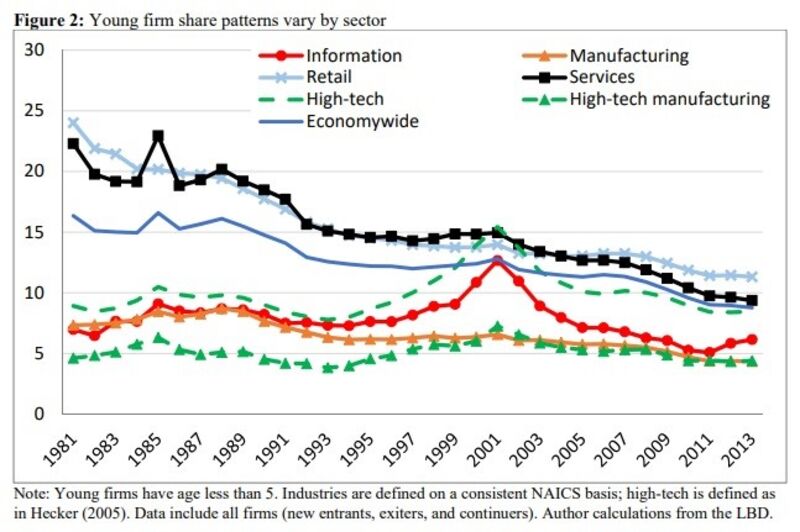
More proof the USA is becoming less capitalistic as it becomes more oligarchicalAmerica’s Startup Scene Is Looking AnemicFewer people are taking the entrepreneurial plunge. , by Noah Smith, June 7, 2018 [Bloomberg, via Naked Capitalism]. 
Graph from a recent paper by economists Ryan Decker, John Haltiwanger, Ron Jarmin and Javier Miranda, National Bureau of Economic Research. 


Monday, June 4, 2018

Hard times coming?


For those of us who believe that energy is a primary need for survival, the collapse of oil prices since 2014 was quite frankly, surreal. How can a globe with a billion light vehicles not continue to need petroleum? The demands for liquid fuels are embedded in the design of our societies. Most people, unfortunately, view the oil giants as these powerful people who can get wars started to defend their interests. Up close, the people who actually get the gasoline to the neighborhood filling station see themselves in a mad, scary scramble to meet this insatiable demand—a demand that will not go away any time soon.

Of course, supply and demand do not always determine price. Lots of crazy stuff happens in the commodity markets so we can have low oil prices while global demand goes up. And high oil prices do not necessarily shrink demand—demand is built in, remember. Yes folks can cut out frivolous consumption but the rest of the demand is considered "inelastic." So high energy prices mostly damage the other folks trading in things that are considered less necessary than energy. So at some time, one of the primary economic laws will kick in—hello $6 a gallon gasoline. And if you run an restaurant, for example, be prepared for fewer customers with less money to spend.

Below is a YouTube of someone who was in charge of getting the crude that the majors convert to the fuels we need. Spent around 40 years at it. His explanation of the supply problem is clear and probably quite accurate.