Sunday, September 30, 2018

Week-end Wrap - September 29, 2018

Week-end Wrap - September 29, 2018
by Tony Wikrent
Economics Action Group, North Carolina Democratic Party Progressive Caucus


Simulcasting The Second International Conference of Modern Monetary Theory (#mmtconf18), Friday-Sunday, Sept 28-30, The New School, New York City [via Naked Capitalism]


[BBC, via Naked Capitalism 9-25-18] 
“Judges in Seattle have decided to quash convictions for marijuana possession for anyone prosecuted in the city between 1996 and 2010. City Attorney Pete Homes asked the court to take the step ‘to right the injustices of a drug war that has primarily targeted people of colour.’ Possession of marijuana became legal in the state of Washington in 2012.”

Can the US win a trade war?
By Marshall Auerback, September 22, 2018 [Asia Times, via Naked Capitalism 9-23-18]

The Democratic Party response to Trump's trade war so far has been straight out of an Economics 101 textbook, or a briefing paper by the Council on Foreign Relations. Unfortunately, this response is basically a defense of the economic status quo, which has been disastrous for the living standards of working class Americans.
....the US president is probably right in his implicit assumption that the US, not China, is likely to come out ahead in its steadily intensifying trade conflict with Beijing – at least in the short term, until China can wean itself off its export-led mercantilist growth model.
Here I think Auerback is wrong: China has already weaned itself "off its export-led mercantilist growth model." Just look at how far advanced is China's high speed rail system or how aggressive is China's program of building new electric power generating capacity -- which includes coal fired power plants as well as renewables. This is an aspect of national economic development most economists and USA policy makers simply do not understand: at some point in a country's economic development, it is exporting goods not because it is following an "export-led mercantilist growth model" but simply because it has become the producer of the best, most advanced, and/or most cost effective machinery and technology. Alexander Hamilton, the first USA Treasury Secretary, who designed the basic structure of the USA economy, understood this thoroughly. This is the reason South Korea remains, after China, the world's largest shipbuilder, or that Toyota is now a larger car maker than General Motors or Ford.
Trump’s goal is to disrupt this “Chimerica” nexus and induce bringing supply chains back to the US. However, one potentially adverse outcome is that this policy may be inflationary, by creating short-term bottlenecks as the flow of cheap Chinese imports is disrupted. Furthermore, a tariff, like a devaluation, is expansionary as it diverts demand from foreign to home producers, thereby further contributing to potential inflation. 
For Trump, this might be a reasonable trade-off. But if the president is successful in securing these objectives, he might well find himself winning a trade battle with China, but losing the inflationary war.
Tuesday, September 25, 2018

Oil bites back


Well, the laws of oilfield "gravity" are finally kicking back in. They are:
  1. In spite of small motor-efficiency gains, the demand for oil continues to soar. Those people in China and India who finally got a nice car are not about to park it in the front yard and look at it.
  2. It has been a long time since the discovery of a major oil field. At some point, maybe soon, demand will significantly outstrip supplies. The scramble will be on.
  3. Fracking was a diversion. It cannot succeed because the energy gathered through fracking barely exceeds the energy it takes to frack. It's not easy to rearrange underground rock formations.
  4. The sanctions on Iran may prove a significant boost to their national prospects. Keep it in the ground. By the time sanctions are lifted, the price of oil may have doubled or more. In real economic terms, the price of oil can only go up.
The position of USA is very precarious. For over a generation, this nation has waged war on the middle-east oil nations. Spilled a LOT of blood in the process. Mostly to prove that oil was forever. Well, it's NOT. And the people who can control the global production of oil come from places where people seethe with anger at the very mention of our name. No one owes us any favors. And even with fracking, we are still net importers of petroleum products.

Now IF we had put this problem—one that was already well-defined by 1973—on a WWII footing as Jimmy Carter suggested when when he called the energy problem "the Moral Equivalent Of War," the coming events would be so much easier to manage. Instead, official Washington took to calling his quite reasonable suggestion MEOW. Oh Jimmuh! you were such a pussy. Carter discovered that rational argumentation just wasn't butch enough.

Sunday, September 23, 2018

Week-end Wrap - September 22, 2018

Week-end Wrap - September 22, 2018
by Tony Wikrent
Economics Action Group, North Carolina Democratic Party Progressive Caucus

The Spider’s Web: Britain’s Second Empire
[Naked Capitalism 9-22-18]
Until I saw this new film on Saturday, I had the following story -- on how the effects of climate change is now causing an increase in global hungry -- as the lead. But I long ago concluded that it is the financial and economic pressure imposed on companies and countries by predatory financiers -- including but not limited to budget austerity -- that is the fundamental obstacle to solving climate change, and most other problems. Thus, the number one task must be confronting the banksters and financial powers that be. The USA was originally founded in opposition to the economics of the British empire, but American School economics has been almost entirely repressed and replaced by its British free trade nemesis. This also corroborates the lead of the Sept 9. wrap, How the City of London created Eurobonds, destroyed the Bretton Woods world financial system and saved crooks, criminals, and dictators from the rule of law.


The theme of the fight between the British and American schools of political economy is whether a national economy should be controlled by the richest economic elites to suit whatever ends they select, or by the people, to promote the General Welfare. You will see echoes of this theme in most of the stories below.

See also Mainstream Economics Has Become a Celebration of the Wealthy Rentier Class, by Michael Hudson.

Global hunger is no longer decreasing, and is now increasing, because of the effects of climate change
By Charles Benavidez, September 19, 2018 [Safehaven.com, via Naked Capitalism 9-20-18]

Sunday, September 16, 2018

Week-end Wrap - September 15, 2018

Week-end Wrap - September 15, 2018
by Tony Wikrent
Economics Action Group, North Carolina Democratic Party Progressive Caucus

“Best Ever” Economy? How much credit does Trump deserve for the current state of the economy?
by Invictus, September 10, 2018 [The Big Picture]
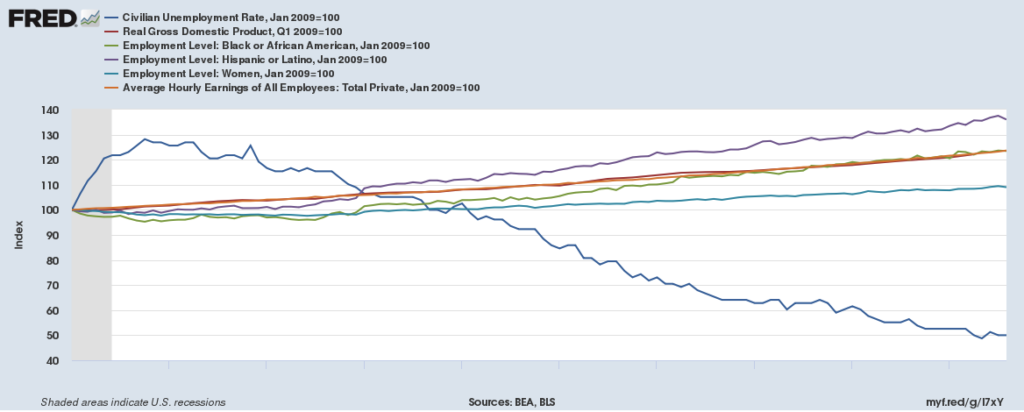
Conservative windbag Eric Bolling cited six economic indicators that purportedly show how great the USA economy is doing under Trump:  Unemployment Rate, GDP, Wage Growth, Number of Blacks Employed, Number of Hispanics Employed, and Number of Women Employed, but provided no graphs nor data.
Well, let’s have a look at all six of the items Eric Bolling chose to highlight — all in one handy chart. The St. Louis Fed’s FRED service let’s us do this very easily. We can index all six metrics to 100 at January 2009, when Obama took office, and see how they’ve been doing since. If there’s been a significant improvement (or even reversal of a undesirable trend) since January 2017, it should be easily visible....

Have a look at this chart — it’s un-doctored, except I hid the x-axis labels showing the years. Can you determine when Trump took office? When his policies went into place? Where the Trump economic surge is? ....
The claim that Trump Economy is all that different from the Obama economy — for Civilian Unemployment, for Employment levels of Blacks or Hispanics or Women, for Real GDP or for nominal hourly wages — is unsupported by the actual BLS and BEA data. For the budget deficit, on the other hand, CBO reportsthe deficit is noticeably wider under Trump than what he inherited from his predecessor, and likely to get even worse.

Tuesday, September 11, 2018

Elevator Speech econ #3—Producer vs Predators


I have been reviewing my old posts based on number of pageviews. The readers of this blog are exceedingly perceptive. I also found a potential post that never got the publish button. Interesting because the "elevator speeches" got significant hits. In fact, they will be included in a minor page redesign.


If you are of the mind that the study of economics should concentrate on the actions within a society that provide for the material needs in life, eventually it becomes clear that the most important distinction in life is that there is an enormous difference between talking about a problem and solving one.  Understand this, and the rest of life is details.

(note about this illustration) I came across Thorstein Veblen's famous distinction between business and industry in 1982 and was just dazzled by the implications.  I was living in the American Midwest where the examples of the difference between industrial genius and financial maneuver were just everywhere.  While collecting all these examples, I discovered that this blinding flash of insight wasn't even Veblen's—it belonged to the agrarian radicals who were trying to solve the problems of settling previously untilled lands.  Veblen's father was a particularly fine example of one of those pioneer agrarian problem-solvers so he came by understanding as a child.  (Sure am glad I discovered this idea via Veblen, however!) For a more detailed explanation of the history of Producer-Predator thought, see Chapter Three of Elegant Technology.

But dividing the world into the problem-solving Producers and the Predators who make things worse by talking things to death while cornering the community's resources is much more than a cute parlor trick.  Turns out that the biggie problems facing the planet such as peak oil and climate change exist because of former problem-solving efforts gone wrong.  ANY meaningful plan to address these enormous dilemmas must understand HOW the Producer Classes solve problems so that our next attempts can yield a better outcome.

This idea that only a more enlightened breed of Producers could ever solve the BIG problems would drive the writing of Elegant Technology.  That's what Elegant Technology is—the social and economic support necessary to train and employ the Producers who can solve things like the end of the Age of Petroleum.

Sunday, September 9, 2018

Week-end Wrap - September 8, 2018

Week-end Wrap - September 8, 2018
by Tony Wikrent
Economics Action Group, North Carolina Democratic Party Progressive Caucus

How the City of London created Eurobonds, destroyed the Bretton Woods world financial system and saved crooks, criminals, and dictators from the rule of law
by Oliver Bullough, September 7, 2018 [The Guardian, via Naked Capitalism 9-8-18]

Bullough is the author of an interesting new book, Moneyland: Why Thieves And Crooks Now Rule The World And How To Take It Back. It appears that Bullough confirms that it was, once again, the British empire, that imposed massive pain on millions of people worldwide. It is always important to recall that in the 19th century, the political economy of Britain was seen to be a hostile competitor to to the political economy of the United States.

Note also that the British have historically specialized in the banking, hiding, and use of dirty money, with the role of the Hong Kong and Shanghai Bank in the 19th century opium trade particularly notorious. The Hong Shang is today HSBC, which has been fined a number of times by USA and other authorities for assisting and directing the laundering of dirty money for a seemingly endless list of shady clients. Among the directors of HSBC is Jonathan Evans, Lord Evans of Weardale, former Director-General of the British Security Service, the United Kingdom's domestic security and counter-intelligence service, proving that the domination of the world's financial system by criminal means is a matter of state policy for the Brits.

The article is an excerpt from the book, and may be a bit of a slog at first, but this is really crucial information for anyone who wants to know who really runs the world, and how.

Wednesday, September 5, 2018

Are the Saudis


In the fall of 1974, I took what was easily my most interesting course at the University of Minnesota. It was named Energy and Public Policy and was taught by the infinitely curious, snoose-using, balding Minnesota-Swede named Dean Abrahamson. He was a Physics Ph.D., medical doctor, and had also collected a degree in public policy from the soon-to-be Humphrey Institute. He had been pursuing the question "just how dangerous are nuclear power plants?" He thought at first it was a physics question, then a medical question, and finally came to the conclusion that it was a collective public policy question. Along the way, he realized that if nuclear power really was too dangerous to use, he would have to know about the competing energy alternatives. Acid rain dominated the environmental news those days and he judged coal burning as a close second to the dangers of fission. But since the Oil Shock of 1973 was fresh in everyone's memory, Dr. Dean spent a lot of time lecturing on middle east oil.

If that wasn't enough, we had a genuine Saudi student in the class. I paid special attention to his remarks. He rigorously defended the Saudi oil embargo and had a pretty legitimate list of grievances against the oil imperialists. He wasn't overly happy about the cultural imperialism that resulted in young Saudi men imitating the pickups, belt buckles, and boots of the Texas / Oklahoma oil guys. And he thought that oil prices were far too low.

Oops. NOW we are talking. Since the Industrial Revolution had produced a million clever things that needed petroleum to run, folks could get really desperate if they got cut off from their sources of energy. In some applications, such as the fuels needed to run the machinery of a harvest, diesel fuel is extremely time-critical. In real-world terms, that fuel is priceless. Before oil shock #1, such diesel fetched about $0.25 at the pump. Because while this fuel is priceless, the farmer wants to pay as little as possible. Our Saudi student may have had no inkling just how valuable oil is to folks who live in cultures where nearly everything has become powered. But he did know that Saudi Arabia deserved a bigger slice of the pie.

The following story tells the tale that the Saudis are still trying to come to grips with their big but dwindling oil deposits. Those who wanted to take Aramco public still thought it was a good idea to trade oil for paper or reprogrammed computer chips. Those who block this move obviously have different thoughts about the value of oil. Personally, I think it would have been insane for the Saudis to take Aramco public.

Sunday, September 2, 2018

Week-end Wrap - September 1, 2018

Week-end Wrap - September 1, 2018
by Tony Wikrent
Economics Action Group, North Carolina Democratic Party Progressive Caucus

The trans-Atlantic elites appear to have settled, in the past few weeks, on their response to Trump's simple minded trade protectionism. The elites' core argument is that protectionist measures threaten the "global value chains" -- the complex web of world suppliers that provide parts and components for almost all manufactured products.

Conspicuously missing from this core argument is the question, "value for whom?". The USA working class did quite well, thank you very much, when USA industrial companies made everything "in house." The most famous example was Ford's River Rouge plant, which old Henry designed and built to swallow ship loads of taconite, coal, limestone and other raw materials at one end, and spew forth each day a gusher of fully assembled automobiles out the other end.

Of course, it was not a bed or roses for the working class. But making everything "in house" gave organized labor a single -- hence very vulnerable -- pressure point to lean on and threaten. Break up the assembly process into a "global value chain" of four or five hundred or more suppliers scattered about the globe, and the United Auto Workers can only make semi- informed guesses as to where is the best place to picket and strike.

Lambert Strether, in his "Water Cooler" each weekday at Naked Capitalism, has done a great job of rounding up news and articles about Trump's trade war. LS's Sept. 1 front page report on the Council of Foreign Relations report was especially excellent, with some pointed comments.

Trade wars won’t fix globalization. Here’s why 
[Council on Foreign Relations, via Naked Capitalism 9-1-18] 

Saturday, September 1, 2018

And a child shall lead them


The wolf also shall dwell with the lamb, and the leopard shall lie down with the kid; and the calf and the young lion and the fatling together; and a little child shall lead them.
Isaiah 11:6 King James Version (KJV)

Most of the scientists I rely on for climate change news are old codgers like myself. They are folks who have devoted their lives to finding the most accurate information their precision instruments can reveal. Great people but there is a bit of "whew, we aren't going to have to deal with the end game ourselves—but folks, it will be really ugly" in their approach. So to read about the young Swedish activist who believes that she has most of her life ahead of her and doesn't want fools to screw up her possibilities, is like breath of fresh air.

I have boldfaced the parts I believe are especially perceptive. There may be hope for the next generation, after all. It is the job of us old codgers to give the young the best roadmap possible for what has, and has not, worked in the past when it comes to social change. And yes, I take this as a mandate. Go Greta!


Thursday, August 30, 2018

Sweden's waste to energy, and other advanced problem-solving


The various schemes to make societies less carbon intensive fall into two categories—conservation of resources, and capture of alternative energy sources. When I wrote Elegant Technology, I was quite enchanted by Sweden's waste disposal system that provided most of the heat necessary to warm their homes during those long dark winters. So it is interesting to see how things have turned out—as seen through the eyes of an Australian documentarian. I am not so enchanted by this waste-to-heat solution as I was 30 years ago—I am pretty much down on fire these days. OTOH, I have not seen a better scheme anywhere else.

Aug 20, 2018


This documentary was done during the run-up to the Copenhagen Climate Change Conference. The most interesting part of this doc is probably the claim that Denmark did not decide to reduce their need for fossil fuels as a reaction to climate change, but as a response to the 1973 oil embargo. This means they have a 45-year head start on most countries—esp.USA.

2009


This is from PBS. It concentrates on Samsø island in Denmark—which has nearly reached the target of complete sustainable energy generation. You will notice there are  tractors in use so they are still importing some petroleum.

Dec 12, 2015

Tuesday, August 28, 2018

Going up the Country


Spent time in Edgar Wisconsin seeing Tony in action. I really like his customers. The majority are probably working farmers or were when they retired. These are the people of my childhood and it is fun to get back into that long-unused social milieu. Since I only interact with these folks rarely, I usually haul out the practices of the Non-Partisan League organizers. They were attempting to politically organize farmers who had a lot of other demands on their time. They were strangers selling a farmer agenda to people who generally agreed that all politicians were crooks. So these were the "rules" of engagement:

1) Realize the farmer you have just met has a bundle of problems—almost all economic. Prices for their products are too low, the cost of their inputs are too high, and the railroads are cleaning up on the traffic both ways. Ect. Discover his story and modify accordingly. Show some empathy.

2) Make sure you cover the social importance of farmers. They are most certainly NOT stupid peasants. If you can grow grain in North Dakota or run a dairy farm in Wisconsin, you can certainly run your own government. A government run by farmers in their own interests is not only possible, but highly desirable. Show genuine interest in how the farmer attempts to solve his particular set of production problems and file them away for future reference.

3) Have a well-thought-out agenda. Explain what a farmer-run government could do to better his economic lot. NPL had a laundry list of things they intended to accomplish including, most importantly, a state-run bank. Amazing how much farmers know about credit problems so this was always an idea that demonstrated daring. And since that bank is still being touted as the runaway success that it is by Ellen Brown to the point where California and LA among a host of others is considering one, the NPL can rightly be considered as this country's most successful progressive movement ever. EVAH!

To anyone who despairs at the rotten state of USA politics, these methods still work. My favorite encounter was with a soon-to-be-retired dairy farmer. He milked 80 cows and sold to, yes, a cheese factory. When I was a child, dairy herds were considered substantial at 40. So he has a lot of work twice a day. His wife is over being a dairy farmer's spouse and wants him to quit. But he claimed that both he and his father plowed back everything in upgrading his farm—lots more than money invested here like pride, effort, planning. This is what we imagine when we hear of the virtues of "family farming." Not many of these folks left. And they are getting old. And if there were still 40% of people farming instead of 2%, I could get elected to high office using the NPL methods exactly the way they used them 100 years ago.

Of course, these methods DO work outside of agriculture. Ask any student about the importance of debt reform. Ask anyone who was left to rot when some Wall Street scam artists bought the town's main factory, looted the pensions, and shipped the machinery to China. Ask someone who got a heart attack and for-profit medicine handed him a $100,000 bill to ensure his heart problems got worse. Ask anyone who despairs at meaningful progress on climate change. And have an agenda that makes sense.
(Pictures)

Sunday, August 26, 2018

Week-end Wrap - August 25, 2018

Week-end Wrap - August 25, 2018
by Tony Wikrent
Economics Action Group, North Carolina Democratic Party Progressive Caucus

We can still avert climate disaster with a “wartime footing” of switching to renewable energy, but neoliberal economics stands in the way 
by Kate Aronoff, August 14 2018 [The Intercept, via Naked Capitalism 8-19-18]
BY SHIFTING TO a “wartime footing” to drive a rapid shift toward renewable energy and electrification, humanity can still avoid the apocalyptic future laid out in the much-discussed “hothouse earth” paper, a lead author of the paper told The Intercept. One of the biggest barriers to averting catastrophe, he said, has more to do with economics than science.... (The actual title of the paper, a commentary published in the Proceedings of the Natural Academy of Sciences, is “Trajectories of the Earth System in the Anthropocene.”)
....Asked what could be done to prevent a hothouse earth scenario, co-author Will Steffen told The Intercept that the “obvious thing we have to do is to get greenhouse gas emissions down as fast as we can. That means that has to be the primary target of policy and economics. You have got to get away from the so-called neoliberal economics.” Instead, he suggests something “more like wartime footing” to roll out renewable energy and dramatically reimagine sectors like transportation and agriculture “at very fast rates.” 
....Contra much of the apocalyptic coverage around “Trajectories,” runaway climate change of the kind described in Steffen and his co-authors’ paper is very likely preventable. The ways to prevent it just happen to go against the economic logic that has dominated the world economy for the last half-decade, to scale back regulations and give major industries free reign. 
....The paper itself put it in fairly direct terms. “The present dominant socioeconomic system,” the authors wrote, “is based on high-carbon economic growth and exploitative resource use. Attempts to modify this system have met with some success locally but little success globally in reducing greenhouse gas emissions or building more effective stewardship of the biosphere. Incremental linear changes to the present socioeconomic system are not enough to stabilize the Earth system; these include changes in behavior, technology and innovation, governance, and values.”

Exclusive: Some Arctic Ground No Longer Freezing—Even in Winter
[National Geographic via Naked Capitalism 8-23-18]


Germany Has Proven the Modern Automobile Must Die
by Emily Atkin, Augiust 21, 2018 [Wired, via Naked Capitalism 8-22-18]
In 2007, the German government set a goal of reducing Germany's greenhouse gas emissions by 40 percent by the year 2020. So far, Germany has reduced its emissions by 27.7 percent. That is one of the most significant reductions in the world, but it now appears Germany will not achieve the goal set in 2007 in the next two years. The major obstacle that has emerged is the reliance on automobiles for transportation and mobility.

Monday, August 20, 2018

Climate Grief


Below is a pretty good description of what the author calls "climate grief"—the crushing realization that everything at all lovely about this world of ours is dying. I can certainly empathize with his feelings although for myself, grief would be a vast improvement over the the feelings that wash over me whenever I allow myself to think deeply about our rapidly changing climate. In no particular order they are:

Naked Terror. When a person grows up on the high prairie, the idea that mother nature is this incredibly beautiful, benevolent, life-sustaining force is tempered by the reality that mom can easily kill you with tornadoes, howling blizzards, sleet, brutal heatwaves, or tennis-ball-sized hail. When I was 16, I nearly froze to death changing a flat tire less than a half mile from our house in North Dakota. Add a few experiences like this together, and the idea that this will all get a lot worse very soon because humanity conducted an arrogant chemistry experiment in the atmosphere is enough to make me very, very afraid.

The wrath of natural laws. Science teaches a bunch of natural laws that work every time, all the time. Raise the temperature of water to 100°C and it will turn to steam. Step off a cliff, and you will fall to the bottom. This is a world where there is no appeal. This is the world of climate science. Pump excessive CO2 into the atmosphere and the planet will get hotter—of this there is no rational debate.

Head-pounding frustration. I have been writing about environmental matters since the 1980s. Almost all of it can still stand close scrutiny. When I think about the vast possibilities of the sustainable society, I can have feelings close to elation. When I consider that very little has been accomplished compared to the problems, the frustration can be overwhelming.

Disgust at useless symbolism. Nothing upsets me quite like a climate change enthusiast who outlines the sordid tales of woe followed by some lame suggestions of raising consciousness and political organizing, or more conferences followed by targets and carbon taxes. This is the biggest calamity ever faced by humans. Most of us in the "developed" world live in societies powered by fossil fuels at every turn. Without them, we have no drinking water, weather-sheltered housing, food, medicine, or mostly anything else. This infrastructure must be redesigned and rebuilt. Since it required hundreds of years to build what we have—building the new world will take a least a few decades. And that's if we immediately embark on an organized crash program.

The builder's perspective. I have been building things since I can remember. Some of my favorite memories are of industrial tours. I can hardly look at at anything without speculating how it was constructed. And what this has taught me is that everything, and I mean everything, is more difficult to build than anyone can possibly imagine without actually doing it. And even if one has carefully planned out all the relevant operations, it always goes much more quickly in one's head than in the real world where real-world problems show up on a daily basis. Of all the reasons for my despair over not accomplishing anything meaningful about climate change, the saddest fact for me that even those with the necessary credentials to build the new sustainable world will take more time than their worst guesses.

Sunday, August 19, 2018

Week-end Wrap - August 18, 2018

Week-end Wrap - August 18, 2018
by Tony Wikrent
Economics Action Group, North Carolina Democratic Party Progressive Caucus


USA Conservatives Calling for New Constitutional Convention to Kill Off the "Welfare State"
by Jamiles Lartey, August 11, 2018 [The Guardian, via Naked Capitalism 8-12-18]
This should be taken very seriously, despite the usual conservative idiocy of equating socialism with a lack of "free dumb." If conservatives, libertarians, and Republicans actually get a convention, they are sure to target the General Welfare mandate for elimination, though they dare not openly talk about it now. Randall G. Holcombe, who served on Governor Jeb Bush's Council of Economic Advisors. in the 2016 campaign, wrote a 1992 article arguing that the major improvement of the Confederate Civil War constitution was the elimination of the General Welfare mandate. They will also enshrine their doctrine of enumerated powers, which has been repeatedly rejected by the Supreme Court until now. They could then proceed at leisure to have the courts, packed with their Federalist Society ideologues, declare programs such as Social Security unconstitutional.
It’s been more than 230 years since America’s last constitutional convention, but there is growing confidence in some conservative circles that the next one is right around the corner – and could spell disaster for entitlement programs like medicare and social security, as well court decisions like Roe v Wade. 
“I think we’re three or four years away,” said the former Oklahoma Senator Tom Coburn on Friday, speaking at the annual convention for American Legislative Exchange Council (Alec) – a powerful rightwing organization that links corporate lobbyists with state lawmakers from across the country. 
Coburn, a veteran Republican lawmaker, now works as a senior adviser for the advocacy group Convention of States, which seeks to use a little known clause in article V of the US constitution to call a constitutional convention for new amendments to dramatically restrict the power of the federal government. 
“We’re in a battle for the future of our country,” Coburn told the assembly of mostly conservative state lawmakers meeting in New Orleans. “We’re either going to become a socialist, Marxist country like western Europe, or we’re going to be free. As far as me and my family and my guns, I’m going to be free."

What you probably don’t know about Social Security
by Alessandra Malito, August 17, 2018 [MarketWatch, via Naked Capitalism]
Social Security works. In fact, in works really well. 
Nancy Altman: The truth about Social Security today is that it works extremely well. It is completely consistent with the founder’s vision and in fact, although some revisionist historians today say the founders wouldn’t recognize it, not only would FDR recognize it today but they’d be shocked that it wasn’t larger and didn’t include Medicare for All, or paid parental leave, or medical leave, because those are all aspects they envisioned. They were very pragmatic, so they wanted to start there. FDR said he didn’t want to start extravagantly because he wanted it to be a success but it was a cornerstone on which to build.

Friday, August 17, 2018

What happens with the new round of sanctions aimed at Russia


Regular readers already know the party line around here is that sanctions have proved very beneficial to the Russian economy because they cut off the country from the worst of the neoliberal economic advice that shows up with integration into the global Washington Consensus institutions. The economics of self-sufficiency has again produced superior results.

One of the details about Russia I learned in 1972 on a tour of Leningrad was that she had within her borders commercial supplies of every element on the periodic table. When I heard that, the thought crossed my mind "if this country could get rid of their economic crackpots, it would be easily the richest country on earth."

Alexander Mercouris presents an informed argument for why Russia is well-prepared for another round of USA sanctions.

Wednesday, August 15, 2018

Is climate change finally going to get proper news coverage?


About ten years ago, I was conversing with a friend whose most interesting characteristic was, IMHO, that he was the only person who had been granted a PH.D in electrical engineering in 1943 from the Massachusetts Institute of Technology. USA was geared up for a major war effort but they also wanted breakthroughs in EE. That he was allowed to finish a degree put him roughly in the same company as the guys who got military deferments to work at Los Alamos. Smartest guy I ever met. Early on that evening, he leaned over and said very seriously, "There is one subject that is so important that every day there should be headlines in 144 pt type in every newspaper in the land. What do you think I am talking about?"

My response of "the only thing I can even think of is climate change" seemed to make him happier. The man is now dead for seven years. And only now do I see that there are a few glimmerings of wider serious interest in the subject. But the conversation, such as it is, is still pretty superficial. This morning I watched Chris Hedges interview none other than James Hansen on climate change. Hedges, ever the divinity student, kept searching for the bad guys, while Hansen pitched carbon taxes and a lawsuit filed in the name of the children who are inheriting our screwed-up atmosphere. While both had somewhat compelling arguments, neither seemed to understand that none of their suggestions would actually move the needle on atmospheric CO2. This was a conversation between a Harvard-educated, Pulitzer-prize-winning former NYT writer and one of USA's great astrophysicists. Too bad they never met my friend.

Below are two samples of what I consider the new awareness spawned by this crazy-hot summer with multiple wildfires including arctic Sweden. We will see what happens. The subject of climate change is just scientific enough so that if someone slept through basic high school chemistry, their judgment must be second-hand—your expert against my expert. In my experience, every climate change denier shows obvious signs of goofing off in science classes—or skipping them entirely. Which means you cannot convince that person with a scientific argument.

Tuesday, August 14, 2018

It's harder than it looks (part...)


Amid the soap opera of Tesla, Musk, and whether the stock market is "properly" valuing the EV car market, it is easy to lose sight of the fact that what Tesla is attempting to accomplish is nothing short of miraculous. Because an electric car can be built by a hard-working shade-tree mechanic, the idea that any established car company should be able to build an EV if they just put their mind to it tends to become a sort of conventional wisdom. Tesla shorts repeat this mantra until big money is involved.

It turns out that an EV is a dramatically different sort of animal because many of the skills required to make an ICE car are simply not relevant. Literally millions of hours have been spent over the years to make a smooth-shifting, reliable, transmission. An EV usually doesn't even need a transmission—or a fuel pump, or a bunch of other things that make cars so complex. But what they do need are reliable batteries—LOTS of them. And the problem of buying enough batteries for a backyard EV conversion do not scale up to the problem of producing thousands of battery packs for long-range vehicles every week.

So all the issues surrounding Tesla's driven, grumpy, charismatic leader are way less important than whether the company can produce enough batteries. And that makes Tesla's boring Nevada gigafactory important enough to (almost) justify its market capitalization—which is higher than GM which makes and sells more than 2.6 million vehicles per year compared to Tesla's goal of 250,000.

Sunday, August 12, 2018

Week-end Wrap - August 11, 2018

Week-end Wrap - August 11, 2018
by Tony Wikrent
Economics Action Group, North Carolina Democratic Party Progressive Caucus

Trump Tax Cuts Having Significant Impact - On Corporate Profits
August 6, 2018 [Yuxing Sun, via Mike Norman Economics]
Latest financial results from Warren Buffet's Berkshire Hathaway:
Net income rose to $12.01 billion, or $7,301 per Class A share, from $4.26 billion, or $2,592 per share, a year earlier. 
Results also reflected a decline in Berkshire's effective income tax rate to 20 percent from 28.9 percent, following last year's cut in the federal corporate tax rate.

Zero Hedge — Ten Bombshell Revelations From Seymour Hersh's New Autobiography
[Zero Hedge, via Mike Norman Economics 8-8-18]
From a recent The Intercept interview and book review — If Hersh were a superhero, this would be his origin story. Two hundred and seventy-four pages after the Chicago anecdote, he describes his coverage of a massive slaughter of Iraqi troops and civilians by the U.S. in 1991 after a ceasefire had ended the Persian Gulf War. America’s indifference to this massacre was, Hersh writes, “a reminder of the Vietnam War’s MGR, for Mere Gook Rule: If it’s a murdered or raped gook, there is no crime.” It was also, he adds, a reminder of something else: “I had learned a domestic version of that rule decades earlier” in Chicago.
“Reporter” demonstrates that Hersh has derived three simple lessons from that rule:
  • The powerful prey mercilessly upon the powerless, up to and including mass murder.
  • The powerful lie constantly about their predations.
  • The natural instinct of the media is to let the powerful get away with it....

Monsanto ordered to pay $289m damages in Roundup cancer trial 
[Newsy, via Naked Capitalism 8-11-18]


Wells Fargo says hundreds of customers lost homes because of computer glitch
[CNN, via Naked Capitalism 8-5-18]

Trump Is Giving Protectionism a Bad Name
by  William G. Moseley, August 9, 2018 [TripleCrisis , via Naked Capitalism 8-9-18].
As a development geographer and an Africanist scholar, I have long been critical of unfettered free trade because of its deleterious economic impacts on African countries. At the behest of the World Bank and the International Monetary Fund, the majority of African countries were essentially forced, because of conditional loan and debt-refinancing requirements, to undergo free market–oriented economic reforms from the early 1980s through the mid-2000s. One by one, these countries reduced tariff barriers, eliminated subsidies, cut back on government expenditures, and emphasized commodity exports. With the possible exception of Ghana, the economy of nearly every African country undertaking these reforms was devastated.

Producer v Predator—a battle of Titans


The news that Elon Musk wants to take Tesla private has provided us with a further confirmation of Veblen's class theories. Musk is such an excellent example of a Producer Class Superstar, we should probably be selling a Musk bobble-head doll around here. And he has just pulled off a production miracle. And honestly, he looks terrible—120 hour workweeks will do this to a now middle-aged man. And so he looks up from that effort and discovers that a bunch of Predators are trying to suck out the energy from Tesla by shorting the stock.

My pioneer forebears discovered this grim reality while trying to farm in Minnesota. It was like going on a camping trip to hell. With small children in tow. Winters featuring -30° temps, summers with incredible heat and swarms of biting insects, the problems of breeding animals and sowing crops, and 100 other similar annoyances. And when you had survived that, you had to deal with crazy shipping fees by a railroad monopoly, crooked grain grading systems, usurious money-lenders, and the corrupt politicians bought by those thieves. The producing classes had to organize politically. In Wisconsin it was LaFollette and the Progressive Republicans, in North Dakota is was the Non-Partisan League, and here in Minnesota, it was the Farmer-Labor Party. In fact, nearly all the prairie farm states had  political movements to protect the interests of the Producing classes.

Musk vs the Wall Street crooks will be a titanic showdown. Wall Street is on at least a 45-year winning streak. Musk has been taunting the shorts for several years. Musk does not have a political movement backing him—in fact what he does know about the Producer-Predator conflicts seem to be self-taught. But Musk has a LOT going for him. He has that ultimate Producer skill—vision and the organizational abilities to turn his visions into reality. That skill is so rare that people who possess it attract followers. And Musk has a bunch of them. Does he have enough to take Tesla private at $420 per share? We will see.

Wednesday, August 8, 2018

Julian Assange to testify before Congress?


Well certainly not in person unless there is an immunity deal.

Assange is to the internet what Luther was to the printing press. These are folks who grasp the implications of spreading the light and are willing to risk some serious privation to do it. Not many of those folks in history.

If congress wants to know the role Assange played in the 2016 US election, a few minutes on YouTube should give plenty information of his position on this question. (It's not like no one has thought to ask him about this before.)


Tuesday, August 7, 2018

Thoughts on the trials of Elon Musk


These days, the most uplifting story concerns the Tesla automotive project. I find it interesting because I have been something of a car nut since grade school. Our next-door neighbor was the local Ford dealer just when Edsel Ford decided to make his company dominant in racing. This was a no-holds-barred land-based space race—the first use of aluminum honeycomb outside of NASA went into Ford's LeMans enduro racers. My neighbor, who was mostly selling trucks and tractors to his farmer customers, would give me the chest-pounding literature of Ford Racing because he found it irrelevant to his business. Then I added to that knowledge base in college working for an auto parts store where I first became aware of the incredible size and complexity of the USA on wheels.

My initial reaction to Musk entering that world was, "Elon baby. Stick to software. Cars are an amazingly difficult and expensive proposition. This a world that eats upstart competition for breakfast." And yet, Tesla still stands as an ongoing concern and its most recent brush with death—the mass production of an affordable EV—seems to be most significant for how much money the "shorts" lost the other day. So what have we learned?

1) There seems to be sufficient expertise in bleeding-edge production techniques so that an upstart can be world-class on its first try. I was pretty sure this could not be done but it was. Tesla has some amazing millwrights.

2) Building electric cars apparently is a lot harder that it looks. The Model S has now been out for 7 years and there is still no realistic competition. Those who were warning, "just wait until Volkswagen (Toyota, the Koreans, etc.) gets serious about EVs, then Musk will fail" have been given a pretty strong demonstration that it was easier for Tesla to solve its production problems than for traditional car makers to overcome their own internal bias towards continuing to make what they already make.

3) Tesla is proving that the switch to EVs is a complex cultural change that relies on software development, direct to customer retailing, and supercharging networks as much as innovative production expertise. The legacy car makers are notoriously deficient in these areas. On the other hand, Tesla's leads on this cultural arena are still quite susceptible to technological diffusion (what they know will soon be common knowledge.)

In other words, stay tuned.

(update 9 AUG 2018)

The shitstorm that Musk created by announcing his desire to take Tesla private is a sight to behold. Musk is hardly the first high-end Producer Class figure to discover that the world of finance is filled with bloodthirsty Predators who do NOT have his, or his company's best interests in mind. To them, he is a cipher whose only interest to them is how much money does he have to rip off.

Here in Minnesota, we had a guy named William Norris who ran a significant computer company called Control Data. During the 60s and 70s, he would get into constant fights with the shareholders. Trust me, Musk is hardly the first to notice that shareholders often get in the way of successful business operations. In fact, Henry Ford once replied to questions about taking Ford public, I would rather take down Rouge brick by brick with my bare hands than let a gang of speculators get their hands on Ford Motor. (or similar) In fact, old Henry had been dead for 9 years before Ford finally went public.

I see the shorts are threatening to sue.