Thursday, March 31, 2016

HAWB 1800s - The Doctrine of High Wages - How America Was Built

The United States was established as a republic, at a point in world history when all other systems of government were monarchies, oligarchies, or some other form of despotism. What, then, are the proper precepts of political economy that a republic should use to organize and structure its economy?

In Securing the Fruits of Labor: The American Concept of Wealth Distribution, 1765-1900,
(Louisiana State University Press, 1998), Oklahoma State University history professor James L. Huston writes:
The republicanism that American leaders came to advocate held sacred the ideals of individual liberty, the equality of the citizens before the law, distrust of governmental power and of political demagogues, simplicity and frugality in the behaviors of the people, and public exhibition of virtue--the willingness of citizens to sacrifice their individual self-interest to obtain the common good. An important economic corollary of republicanism established primarily by Englishman James Harrington (1611-77) during the Puritan Commonwealth was widely acknowledged by American revolutionaries: to endure, a republic had to possess an equal or nearly equal distribution of land wealth among its citizens.
As the United States began to industrialize and urbanize, increasing number of citizens no longer lived and worked on the land, let alone owned land. The great failure of Thomas Jefferson and his Democratic-Republican Party (which later became the Democratic Party) was their inability to conceive of a way in which workers and the propertyless could be just a virtuous as agrarians and pastoralists, and also be accorded a full voice in public affairs. Instead, they sought to stymie and retard the progress of industrialization in the hope of prolonging their idyll of a republic dominated and ruled by agriculturalists.

The problems of that approach should be obvious. To lift propertyless workers to the exalted station of citizens of the republic, while preserving the republican notion of an equitable distribution of wealth, a theory of wage income began to develop which certain American economists came to call, by the last quarter of the nineteenth century, the Doctrine of High Wages:

Tuesday, March 29, 2016

Tesla's raw materials


Those of us who are fans of green technologies must be on guard against sloppy thinking.  It is FAR too easy to ignore the fact that even while making a concerted effort to transition towards energy renewables—easily job one in any plan to save the planet from ourselves—a great deal of the old technologies and their ghastly environmental problems will be necessary to build a better future.

The following illustrates the massive environmental costs necessary to build a Tesla Model S.  Start with the simple problem caused by making something that weighs in at 4647 pounds (2108 kg.).  Assuming fabrication losses of at least 50%, that means this beast requires something on the order of 3.5 tons of raw materials and goodness knows how much energy it takes to process.  Then, because an electric car requires a radically different material set, very little of these material will come from recycling old cars.

So while the Tesla S is a hugely important car, it is obvious cars like this will play a minuscule role in replacing the monster fleets of fuel burners already on the road (250+ million in USA alone).  The new transportation systems would do well to incorporate recycled materials into their designs—something that was obviously NOT done with the model S.

I found the illustration below incredibly interesting—sometimes in the rather insignificant details.  For example, the Tesla doesn't use nearly as many rare earths as one might expect for an all-electric vehicle.  In fact, the only application seems to be for the cabin's electronics.  Apparently you can make a high-performance electric car without rare earth materials but not premium sound system speakers.

Sunday, March 27, 2016

Killing the Host-How Financial Parasites and Debt Destroy the Global Economy, by Michael Hudson


Chris Hedges interview of Michael Hudson, author of Killing the Host—How Financial Parasites and Debt Destroy the Global Economy.


Michael Hudson is one of the best economists in the world. Not just because he is one of the few who actually knows about what used to be known as the American School of political economy, but he has also worked on Wall Street, and somehow came away with his soul intact. If you never read anything else on economics, you must at least read Hudson’s 1993 The Lost Tradition of Biblical Debt Cancellations (87 page pdf file). 

Chris Hedges is a former New York Times correspondent who covered almost every region of the world at one time or another. In November 1989, Hedges was in East Germany, meeting with the leaders of the opposition to Communist rule, the night before the Wall came down. According to Robert Shetterly’s Americans Who Tell the Truth website,
In 2002, [Hedges] was part of a team of reporters for The New York Times who won a Pulitzer Prize for the paper’s coverage of global terrorism. That same year he won an Amnesty International Global Award for Human Rights Journalism.
In 2003, shortly after the war in Iraq began, Hedges was asked to give the commencement address at Rockford College in Rockford, Illinois. He told the graduating class “…we are embarking on an occupation that, if history is any guide, will be as damaging to our souls as it will be to our prestige, power and security.” ... As he spoke, several hundred members of the audience began jeering and booing. His microphone was cut twice.  Two young men rushed the stage to try to prevent him from speaking and Hedges had to cut short his address.  He was escorted off campus by security officials before the diplomas were awarded. This event made national news and he became a lightning rod not only for right wing pundits and commentators, but also mainstream newspapers. The Wall Street Journal ran an editorial which denounced his anti-war stance and the The New York Times issued a formal reprimand, forbidding Hedges to speak about the war.  The reprimand condemned his remarks as undermining the paper’s impartiality. Hedges resigned shortly thereafter….
Hedges has since emerged as one of the most prominent and most unrelenting critics of the American imperialist / corporatist state. Among the many books he has written is The Death of the Liberal Class (2010).

Michael Hudson and Chris Hedges: The Real World Cost of Turning Classical Economics Upside Down

Friday, March 25, 2016

Greider on how Trump could beat Clinton


In 1997, Bill Greider penned what is arguably the finest critique of the whole "free trade" argument.  He called it One World, Ready or Not: The Manic Logic of Global Capitalism. By the time it was published, NAFTA was already four years in the rear-view mirror.  So relying on old-fashioned shoe-leather reporting, he told stories of what was happening to the victims of globalization.  This is a story that virtually no one else was telling in the growing euphoria of the ideological "success" of "free trade"—especially among among the "New Democrats" who were so infatuated with their new Wall Street buddies.

So it is with a bit of wonderment that we see the two most interesting folks running for president are getting traction from finally revisiting the central feature of neoliberalism—liberalized trade rules.  One is a self-described democratic socialist from laid back and sometimes hippie Vermont while the other is a loud and brash real estate player.  They seem to have nothing in common apart from their New York roots and their pronunciation of the word huge—yuuuge.  Yet Greider sees how their combined critique of those disastrous "free trade" deals could begin to rewrite the political narrative.

Greider is arguably the best writer / political prognosticator of his generation.  (He is certainly my favorite.)  So he may right about this.

Tuesday, March 22, 2016

Intel founder Andy Grove passes at age 79


Here is the story from the San Jose Mercury News, the newspaper of record for Silicon Valley. And here is the story from Wired magazine's website.

Rather than replicate their biography of Grove, I would rather point readers to an article Grove wrote in July 2010,  How America Can Create Jobs, in which he ripped into outsourcing and free trade, and asked a fundamental question: "what kind of a society are we going to have if it consists of highly paid people doing high-value-added work—and masses of unemployed?" (below)

It should also be noted that Grove was an immigrant from Hungary. Both the fact that Grove was an immigrant, and that he repudiated free trade, should be rubbed in the faces of Republicans, conservatives, and neo-liberals until they squeal.

A highly entertaining read, which ably contrasts the producer class ethos in conflict with predator class pecuniary culture, set in the context of the birth of the semiconductor industry, is The Tinkerings of Robert Noyce: How the Sun Rose on the Silicon Valley, by Tom Wolfe, in Esquire, December 1983.

Monday, March 21, 2016

Making sense of the Trump phenomenon

Watching the Republican establishment running in circles over their worries about the spectacle that is Donald Trump has literally triggered a spasm of schadenfreude.  The Democrats are predicting the collapse of his campaign and a cakewalk for their candidate—presumably Hillary Clinton.  The Stop Trump movement is pulling out all the stops—including physical disruption of campaign events.

Most interestingly, none of the attacks on Trump seem to have inflicted any damage to his growing political support.  Considering that Howard Dean's presidential ambitions were derailed by repeatedly running his joyous victory shout, one might predict that the barrage of professionally-produced negative ads run against Trump in Florida should have blown him out of the water.  Instead, his polling numbers went up with each new ad drop and he won the Florida primary going away.

Since the professional political pundits seem to have no real explanation for such loyalty beyond their slander of racism, we should probably jump in here with a good round of institutional analysis.
  1. Producers vs Predators.  Once upon a time, the Republican party was a party of Producers.  My mother's side of the family were essentially social democrats with one exception—some of her cousins ran a machine shop in Minneapolis and they were loyal, lifetime Republicans.  My guess is that this strain still exists even after more than 40 years of banksters setting the Republican agenda.  Romney was a bankster and the Producer Republicans hated him.  Trump has stuck his neck out to build something—risking his personal fortune along the way. So even though few write political commentaries about Producers vs Predators, Trump's following seems to have an instinctive feel for these matters.
  2. Producer-politicians are usually pretty clumsy politically.  They usually run afoul of some sort of political correctness.  But as Trump has discovered, his following is not impressed by the arguments of political correctness.
  3. The enforcers of political correctness are merely a slice of the Leisure Class who want to rule by manners.  This method is extremely effective for separating the insiders from the rabble.  And so the Trump-bashers take great joy in pointing out that many of those voting for him are poor and poorly educated.  The Producers would point out that one can lack formal educational credentials and still be highly skilled.  They would also point out that before the massive de-industrialization of USA, they were NOT poor either.
Producers in politics do not have a great track record.  The two engineers who became president—Carter and Hoover—were not especially effective.  Guys like Henry Ford and Ross Perot didn't even win anything.  Hard to get around the fact that politics is a Leisure Class occupation.

Thomas Frank in his article below has discovered that the buffoonishness which is associated with the Trump campaign is mostly a distraction from his very serious arguments attacking the various "free trade" deals that mostly gave away USA industrialization in the name of short-term profits for some really stupid and cynical banksters.  Being a good Democrat, Frank spends a bunch of time reassuring us that he is still politically correct even though he has discovered perfectly logical reasons for why Trump has attracted such a loyal following.

One more thing.  The banksters and their flacks may be able to snuff out the political movements of Trump and Sanders, but until the Producer Classes are properly rewarded for their contribution to the economy and everyone who wants to work has a decent job, the problems they represent will not go away.

Monday, March 14, 2016

Undoing neoliberalism in Russia

When Russia under Gorbachev and then Yeltsin decided to "modernize" their economy, the guys who rushed in to "help" were the neoliberals.  Not surprisingly, their prescriptions mostly centered around massive de-industrialization.  That was the prescription for places like USA and UK, after all, so why not Russia where their industrial infrastructure was in an even more sorry state?  It was difficult to find any Russian industry with a world-class output, went the reasoning, so why not just shut it down and live off the income of the petroleum extraction business?

When the economic sanctions that followed Russia's annexation of Crimea in the spring of 2014 began to bite, Russia discovered that they were importing a lot of goods they had once made for themselves.  So the decision was made to start reversing the process of deindustrialization through import substitution.  This was the primary strategy of economic development in the years after WW II for much of the world.  Japan was the most successful at their planned strategy of import substitution but it worked almost everywhere it was rigorously tried.  The economic "liberals" hated it then and they most certainly hated it in 2014.

So Russia is in the very early stages of their new import substitution strategy and not surprisingly, it has produced mixed results.  Re-industrialization is almost infinitely more difficult than de-industrialization so these things take time.  Worse, Russia has a severe neoliberal hangover from the days when such was the only acceptable worldview.  The most obvious example is the crazy lady running the central bank who believes that usury is the cure for inflation—even inflation caused by externally imposed sanctions.  So the prime rate is still at 11%—a rate mathematically guaranteed to severely hamper or destroy any industrial activity.  That any import substitution is happening at all is mostly a testament to the courage and tenacity of the Russian people.

The neoliberals from places like The Economist have already deemed Russia's strategy for import substitution an utter failure.  No great shock here because such people think that Russia is literally defying the laws of their god.  On the other hand, Hellevig below thinks the project is working out well.

Thursday, March 10, 2016

HAWB 1800s - It was NOT free trade - How America Was Built

During the past two weeks there have been a number of internet postings attempting to understand and explain the popularity of Donald Trump. The most insightful have been by scholars and writers who are willing to look beyond the issue of racism to see the underlying decay of the USA economy. On the Guardian's website March 7, 2015, Thomas Frank, author of What's the Matter with Kansas? How Conservatives Won the Heart of America (2004), The Wrecking Crew: How Conservatives Rule (2008), Pity the Billionaire: The Hard-Times Swindle and the Unlikely Comeback of the Right (2011), and most recently, Listen, Liberal: How the Party of the People Learned to Love Inequality (2016), pointed out that Trump actually does not talk that much about racism. Not compared to what he talks about the most: trade.
It seems to obsess him: the destructive free-trade deals our leaders have made, the many companies that have moved their production facilities to other lands, the phone calls he will make to those companies’ CEOs in order to threaten them with steep tariffs unless they move back to the US.
The fact that working Americans in flyover country are supporting Trump as a way of rejecting economic neo-liberalism and free trade, is even beginning to sink in among conservatives and Republican elites. First Things editor R.R. Reno wrote on March 4, that Trump's appeal has forced Reno to question
very powerful conservative dogma: Our economic problems will be solved by an ever-greater market freedom. This means lower taxes for the rich, those pushing the economy forward. It also means continuing the liberalization of global markets with free trade agreements, as well as de-regulation and the end of government supports for businesses (for example, the Import-Export Bank, subsidies for green power, and other market-distorting initiatives.) In rejecting this dogma, Trump is unique among Republican primary candidates.  
....globalization and ever-freer markets [are] something I’ve long thought is our best option as a nation. I half-recognized the real costs to ordinary people, but I affirmed the homeopathic dogma that still more economic freedom is the best remedy.... In each instance Trump’s successes at the polls have forced me to acknowledge a degree of blindness.
Here, the obvious observation: Those who forget history are doomed to repeat it. Or, history may not repeat, but it rhymes. Whatever. My purpose here is to explain, once again, that "free trade" has never helped a country develop economically. Every country that ever successfully industrialized has used protectionism - i.e., protected its domestic producers and workers from foreign predation.

Monday, March 7, 2016

Remembering Olof Palme


The first book I ever read that I deemed "serious" was Markings by Dag Hammarskjöld—the UN Secretary-General from 1953 until his death / murder.  His airplane had crashed under suspicious circumstances in 1961.  Markings was published in 1963.  I read it in 1965.  I was 16.

I am almost certain I would have never heard about Markings had not my father returned from some Swedish-Lutheran liturgical get-together with tales of the buzz the book had caused in the church colleges.  I am pretty certain my father did not read it.  My mother may have.  The copy I read belonged to my mother's cousin.

Hammarskjöld is an old Viking name—as compared to a peasant name like Larson.  The family has been loyally keeping the Swedish royals out of trouble for several centuries—his father served as Swedish Prime Minister during World War I and was considered a world-class expert in international law.  Dag grew up in Uppsala—Sweden's premiere university town.  He was a smart young man who had every possible educational door opened for him.  The result was spectacular as Hammarskjöld grew into a thoughtful, wise man with profound insights into the human condition.  I reread Markings a few years back and found parts that were still breath-taking.

But even reading Markings did not prepare me for my first exposure to Olaf Palme's Sweden in 1970.  Except for his well publicized criticisms of the USA invasion of Vietnam, I actually knew very little about him at all.  But as I toured that country humming with world-class industry and no slums, I started to get clues of just what it required to become the leader of the Social Democrats of Sweden.  It turned out that Palme was another of those hyper-educated, thoughtful, and brilliant public servants that Sweden could cough up on a regular basis in those days.  Not only did he make great decisions about the operation of his country, he had a sound theoretical basis for his ideas.  The result was that Palme's Sweden became arguably the most imitated and admired country on earth.

Unfortunately, his belief in the intrinsic goodness of human nature did him in.  On a cold February night, Palme and his wife went to the movies unescorted by guards.  He hated the whole security business and ditched it regularly.  It made him an easy target for an assassin.  The crime has never been solved and the list of bad guys with bad motives is long.  But whoever they were, they really took out the right guy.  The Left in Europe has really never recovered.  Sweden has lost much of its unusual character.

Saturday, March 5, 2016

Why Conservatives Can't Govern

With all the attention being given The Donald, I think it is worth remembering that it doesn't really matter who it is, the plain fact is that conservatives are unable to govern. Back in July 2006, Boston College professor Alan Wolfe entertainingly explained why in The Washington Monthly:
Conservatives cannot govern well for the same reason that vegetarians cannot prepare a world-class boeuf bourguignon: If you believe that what you are called upon to do is wrong, you are not likely to do it very well.
The only part I disagree with is where Wolfe writes that Alexander Hamilton was "perhaps America's greatest conservative." Just four paragraphs before, Wolfe approvingly paraphrased Louis Hartz's argument in the 1950s that the United States was born a liberal state. Since few others had as great a hand in forming the USA than Hamilton, the contradiction should be obvious. Was Hamilton somehow a great conservative who helped establish a liberal state? This confusion is sadly typical of most Americans today, who seem not to understand that Hamilton completely demolished and rejected the economic philosophy of Adam Smith.  In fact, as I recently posted, Hamilton championed an economic policy that was most decidedly not conservative: active government intervention in the economy to promote innovation. Contrast this to the constant insistence of conservatives and Republicans that it is government regulation which is stifling innovation. As I am attempting to show in my HAWB series - How America Was Built - almost every single transformative technology in the history of the USA economy has been promoted and funded by government before that technology achieved commercial success.

Monday, February 29, 2016

Micro-lending


In her desperate attempt to escape the labels of "war criminal" and "Wall Street sellout," Hillary Clinton likes to trot out her longtime support for micro-lending.  The story of Muhammad Yunus and the Grameen Bank is pretty well known because it has been featured favorably in the big USA press like CBS.  In their telling, this bank has empowered women to free up their entrepreneurial passions and has brought prosperity to the rural poor of Bangladesh.  Yunus and his bank were even awarded the Nobel Peace Prize in 2006 for the achievement of putting a small smiley-face on neoliberalism.

Under the happy talk of micro-lending, unfortunately, we are still talking about a scheme to drive the poor into debt (as if they don't already have enough problems.)  And while I am certain that the Grameen Bank's rates are better than the rural loan sharks will offer, we are still talking about 20% in 2016.  Considering the prices for commodities are falling which removes income from rural economies, interest rates should be less than 1% (unless the goal is only to enslave people.)  Usury is a vicious business—there are sound reasons why Christianity considered it a sin worse than murder for its first 1500 years.  Happy talk can change the subject but it cannot change the facts—20% loans cannot be repaid with honest enterprise.

Bill Clinton actually took it as a compliment when folks would compare him to Grover Cleveland.  Cleveland was a tool of Wall Street too so the comparison is pretty good.  And for services rendered, the most Predatory of the finance capitalists have made him goofy rich since he left the White House.  Hillary has done all right for herself shilling for the likes of Goldman Sachs so perhaps she aspires to become Grover Cleveland squared.

Thomas Frank over at Harpers has written a fine piece dissecting the latest outburst of Radical Chic.  It is hard to imagine what it must be like to be so rich and out of touch that 20% micro-lending seems like a good idea.  Hillary Clinton, meet Melinda Gates.  You two have SO much in common.

Sunday, February 28, 2016

HAWB 1791-2001 Alexander Hamilton and the Apple I-phone - How America Was Built


In October 2015, I posted HAWB 1791 - Alexander Hamilton rejected Adam Smith. What I am posting today could be titled HAWB 1791 - Alexander Hamilton rejected Adam Smith Part 2. My October 2015 post mostly discussed Hamilton's refutation of Smith's advocacy of free trade. Near the end, I presented Hamilton's argument in favor of direct government intervention in the domestic economy, by excerpting from European Origins of the Economic Ideas of Alexander Hamilton (Arno Press, New York, 1977), by Robert James Parks:
One of the doctrines of the physiocrats which Smith had accepted was that of non-regulation of business, with a neutral policy toward its growth. Let alone, neither encouraged nor discouraged, industry would seek its most useful and profitable employment. Against this hypothesis, Hamilton offered several objections. These were that the supposed tendency of industry to seek its most profitable employment was inhibited by the force of habit, the spirit of imitation, fear of new ventures, the intrinsic hazards of new enterprises, and the unfair competition created by the bounties and subsidies given in competitive nations. Experience teaches that men change habits only slowly and reluctantly. It is the job of government to encourage and speed up change. He argued that capital is cautious, and can only be made venturesome if the government removes some of the risks.
"Experience teaches," Hamilton wrote in Section VII of his December 1791 Report to Congress on the Subject of Manufactures,
that men are often so much governed by what they are accustomed to see and practice, that the simplest and most obvious improvements, in the most ordinary occupations, are adopted with hesitation, reluctance, and by slow gradations…. 
The apprehension of failing in new attempts is, perhaps, a more serious impediment. There are dispositions apt to be attracted by the mere novelty of an undertaking; but these are not always the best calculated to give it success. To this it is of importance that the confidence of cautious, sagacious capitalists, both citizens and foreigners, should be excited. And to inspire this description of persons with confidence, it is essential that they should be made to see in any project which is new—and for that reason alone, if for no other, precarious—the prospect of such a degree of countenance and support from government, as may be capable of overcoming the obstacles inseparable from first experiments.
I have to admit: the idea that it is the role of government is to actually "encourage and speed up change" startled me. It is far outside the confines of what is now accepted discourse in politics and economics. According to Ronald Reagan, whom conservatives like to venerate as the greatest President ever, government is the problem, to be hampered and crippled as much as possible. As Parks points out, this policy of Hamilton--of the government actively prodding the economy forward--puts the lie to the claim that he was a conservative. And of course, the very idea that government is the source of progress is complete anathema to libertarians. But Parks' summary of Hamilton's argument presents us with a very important, even, crucial, point: that the free enterprise system under laissez faire is actually not that innovative and entrepreneurial without the support and nurturing of government. And the numbers back this up: as its economy was deregulated and financialized over the past four decades, the USA economy has become less capital intense (less capitalistic) and less entrepreneurial.


But the idea that the government should encourage and promote change dovetails nicely with my emphasis on the role of science in the political economy of a republic:
....what wealth really is, is the human power of thinking: reason, investigation, hypothesizing, testing, figuring out why things are the way they are -- and then figuring out how that new knowledge can be used to change the way things are.... Without the constant development of new science and technology, any society will become impoverished, and will eventually collapse. Jared Diamond’s book, Collapse: How Societies Choose to Fail or Succeed, examines how societies descend inexorably into collapse when they ignore environmental limitations and mismanage their natural resources. The key point that most readers of Diamond miss is that a society’s environmental limitations are defined only within a fairly specific period of time based on the prevailing technological mode of that society’s economy. Any society that remains stuck in one technological mode will eventually bump up against environmental limitations: what is considered a resource and how much of it is readily available and usable.... So the most important economic activity a society engages in is the pursuit of new scientific and technological knowledge that allows that society's economy to avoid environmental limitations and inefficient misuse of natural resources. This is one of those wonderful, mysterious paradoxes of life: basic scientific research has no measurable immediate payback but nonetheless is THE most important economic activity that occurs in a society.
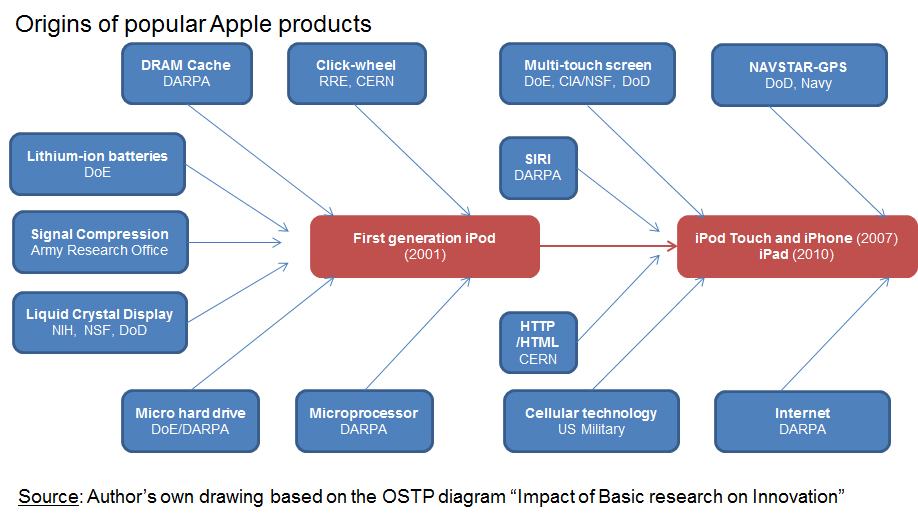
In case you doubt the utility of basic scientific research, consider this graphic from Mariana Mazzucato, professor of the Economics of Innovation at the University of Sussex, and author of the 2013 book, The Entrepreneurial State: Debunking Public vs. Private Sector Myths:


Mazzucato writes in her book:
....Apple was able to ride the wave of massive State investments in the 'revolutionary' technologies that underpinned the iPhone and iPad: the Internet, GPS, touch-screen displays, and communications technologies. Without these publicly funded technologies, there would have been no wave to... surf. 
Even the now-famous SIRI voice recognition and response capability was originated as a government project: In 2000, the Defense Advanced Research Projects Agency contracted with Stanford Research Institute (SRI) to coordinate the efforts of 20 universities (most of them publicly funded) in a project named 'Cognitive Assistant That Learns and Organizes' (CALO). In 2007, SRI began to effort to commercialize CALO by forming SIRI as a venture-backed start-up. In 2010, Apple purchased SIRI outright, to incorporate the CALO technology--originally developed by government--into the iPhone.

I have no doubt that Hamilton understood the connection between the advance of science and technology, and economic growth and development. Later in the Report on Manufactures, Hamilton provided his view of what was meant by the Constitutional mandate to "promote the General Welfare." It is highly significant that he does as he explains why the government has the power to actively promote manufactures.
A question has been made concerning the constitutional right of the Government of the United States to apply this species of encouragement, but there is certainly no good foundation for such a question....

...the power to raise money is plenary and indefinite, and the objects to which it may be appropriated are no less comprehensive than the payment of the public debts, and the providing for the common defence and general welfare. The terms “general welfare” were doubtless intended to signify more than was expressed or imported in those which preceded; otherwise, numerous exigencies incident to the affairs of a nation would have been left without a provision. The phrase is as comprehensive as any that could have been used, because it was not fit that the constitutional authority of the Union to appropriate its revenues should have been restricted within narrower limits than the “general welfare,” and because this necessarily embraces a vast variety of particulars, which are susceptible neither of specification nor of definition.

It is, therefore, of necessity, left to the discretion of the National Legislature to pronounce upon the objects which concern the general welfare, and for which, under that description, an appropriation of money is requisite and proper. And there seems to be no room for a doubt that whatever concerns the general interests of learning, of agriculture, of manufactures, and of commerce, are within the sphere of the national councils, as far as regards an application of money. (Emphasis mine).
Because science and technology is always advancing, it was impossible for Hamilton and the other framers of the Constitution to foresee what a concern for the General Welfare might entail. Indeed, it would have been foolish to even try. Thus, it is "left to the discretion of the National Legislature to pronounce upon the objects which concern the general welfare." For example, it would have made no sense to enact a government program, anytime during the 1800s, to put a man on the moon. Indeed, it would have been seen as "lunacy." But by the 1960s, when the development of metallurgy, material sciences, astrophysics, radio communications, electronics, chemistry, aeronautics, and a host of other scientific and technological fields had advanced far beyond what they were just a few decades previous, it was absolutely fitting and proper that we make a commitment to land men on the moon, and return them safely to earth.

Indeed, as I hope to write in the future, the manned space program was one of the key factors in the development and commercialization of semiconductors and computer chips.

It is only be reclaiming the entire conception of American republican political economy, with the crucial role of science and technology, that we can begin to accurately judge and fully understand just how dangerous and damaging are the anti-science ravings and posturings of conservatives, and the anti-government yowling of libertarians. Yes, they are anti-science and anti-government, but in the full incandescence of history, they are revealed to also be deeply anti-American.

Thursday, February 25, 2016

Upon reflection

Did some serious thinking on my long drive west.  I am very concerned that my big project is not progressing nearly as fast as it should be.  I had this ambitious idea that I could continue posting on this blog while simultaneously producing an instructional video on how to deal with climate change—only from an informed Producer Class perspective (this is harder than it looks which explains why it hasn't been done yet.)  The idea was to still have this active blog to promote the video when finished.  Now I am certain I cannot do both.  It would be a damn shame if I could not complete the video after all the effort sunk into it so far.  So that is where my creative energy must go.

Here is the new schedule for the real-economics blog.  I will still post at least once a week on Monday.  Additionally, I will react to significant shifts in economic news but I will only create a supplemental post when something unusual happens—like some country makes a serious attempt to leave the neoliberal orbit, some breakthrough in green technologies brings a meaningful solution into view, some tax is levied on financial speculation, or some major financial criminal gets sent to prison.  I do not intend to cover the elections.

In addition, Tony promises to post more often in those empty spaces I leave behind.  Since the regular readers enjoy his work as much as I do, this alone should keep the blog alive until the video project is done and we start banging on that drum.

Wish me great concentration and high energy!

Wednesday, February 24, 2016

To the critics of "Bernienomics"

Last Saturday, Tony crafted a brilliant piece on why the collection of mediocrities who have lately so miserably mismanaged the USA (world?) economy were wrong to criticize the economic proposals of Bernie Sanders.  I mean, we find fault with Bernie's proposals around here but it is because we believe they are not nearly large or sweeping enough to cope with the very real and obvious problems facing humanity.  For example—Sanders believes we should spend a $trillion fighting the problems caused by climate change.  We believe the figure should be in the hundreds of $trillions.

So it is not so surprising that we look on the declarations by the protoplasmic failures of recent economic policies, that Sander's ideas are impossible because they are too ambitious, as wrongheaded in the extreme.  And we welcome analysis by others who share these viewpoints.  Today's analysis by Ron Baiman is an excellent example.

Tuesday, February 23, 2016

Russia's crazy central bank policies are creating havoc

To read the western press, Vladimir Putin is pursuing policies that are so far off the charts, he might as well be considered a madman.  And yet, when it comes to economics, his policies are so relentlessly conventional (in the sense of Harvard / U Chicago conventional) that his economy is suffering quite unnecessary self-inflicted wounds.

This makes no sense whatsoever.  Here is a country that is quite boldly taking on the USA military industrial complex and the whole imperial State department.  "Serious" folks are talking about a threat of a new Cold War if not another nuclear standoff.  And yet when it comes to standing up to the banksters and their ideological whack jobs, Putin is a pussy-cat.  To watch his economy careen from one disaster to another, you might wonder if he isn't somehow on the payroll of Goldman Sachs.

This paradox has not gone unnoticed.  Here we see an outsider, Jon Hellevig, and a Russian, Sergey Glasyev, both making significant criticisms of the absurdly bad job Russia's central bank is doing.  But so far, Putin is backing his crazy central banker.  Go figure.

Monday, February 22, 2016

HSBC stays in The City

We are not big fans of the HSBC bank (Hongkong and Shanghai Banking Corporation) around here.  This is an institution that was born in the imperial corruption of the British opium trade in China and they haven't done much to improve their image since.  (Tony included their criminal past in his Who Murdered Capitalism post.)

Recently, HSBC had a chance to move their legal headquarters from London to Hong Kong.  They chose London—largely because of the heavy investment they have made in corrupting the British government over the years.  The City of London is well-known for its "tolerance"  for financial crime.  The HSBC vote of confidence will only further cement this reputation.

The second article is from Reuters which claims that there are some who wish HSBC had moved their headquarters to Hong Kong so it seems there are "reasonable" people who think that it is legitimate competitor for City tolerance for criminality.  That also sounds about right.

The tragedy of allowing such a gang of criminals to make economic decisions for the rest of us is intolerable.

Saturday, February 20, 2016

The debate over Bernie Sanders' economics and five questions by which to judge any economist


The most lively pie fight on the political blogosphere the past two days is over the forecast of the effect of Bernie Sanders’ economic policies by University of Massachusetts-Amherst economist Gerald Friedman. According to Friedman, if Sanders’  policies of free college education, national health care, new infrastructure spending, and increased Social Security benefits were actually implemented, the result would by a eye-popping annual GDP growth rate of 5.3 percent over ten years, with a net increase of 26 million new jobs.

Four former heads of the Council of Economic Advisers, under Presidents Clinton and Obama—Laura D’Andrea Tyson, Christina Romer, Austan Goolsbee, and Alan Krueger—posted a joint letter to Sanders and Friedman, denouncing Friedman’s study for making “extreme claims… that cannot be supported by the economic evidence.”

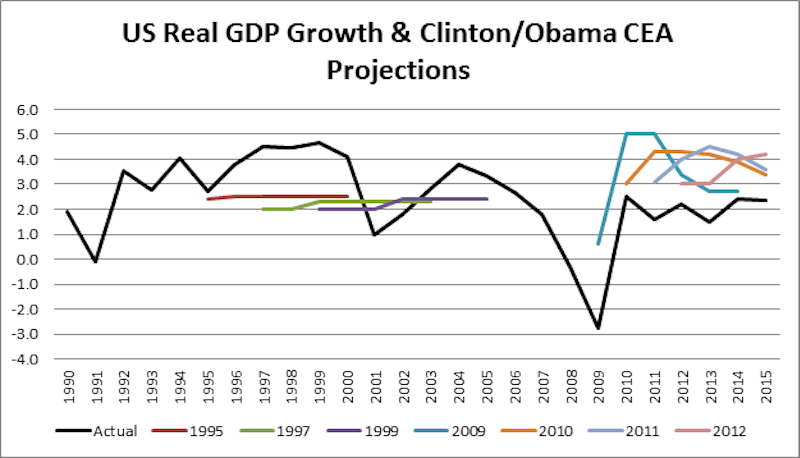
The graph below shows how successful Tyson, Romer, Goolsbee, and Krueger were at doing forecasting themselves. In two words:

NOT VERY.


That graph is taken from David Dayen’s article on today’s website of The New Republic, The Pious Attacks on Bernie Sanders’s “Fuzzy” Economics. It is a relentless smack-down of the honesty and competence of these critics.
For example, the 2010 EROP, overseen by then-Chair Christina Romer, made real GDP projections of 4.3 percent in 2011 and 2012, and 4.2 percent in 2013. This was wildly optimistic. According to Federal Reserve Economic Data, the actual real GDP growth rate in 2011 was 1.6 percent; in 2012, 2.2 percent; and in 2013, 1.5 percent.
And,
Goolsbee’s claim in March 2007, after the housing bubble peaked and foreclosures began to skyrocket, that “the mortgage market has become more perfect, not more irresponsible” is perhaps one of the worst economic arguments of the past several decades.
In my judgement—and I have been writing about economics since the late 1980s—Tyson, Romer, Goolsbee, and Krueger are all failures, with no professional credibility left. Sound harsh? Well, actually, I think the same about almost every professional economist these days. Recall that in October 2009, the Huffington Post revealed that over half of all professional economists in the United States have been paid by the Federal Reserve in some form or another.

Back in the presidency of Franklin Roosevelt, the Fed did not have the stranglehold on the economics profession it has now. Do you agree with Tyson, Romer, Goolsbee, and Krueger that it is outlandish to forecast 26 million new jobs in ten years? Well, try this out for size: in the winter of 1933-34, President Franklin Roosevelt’s Civil Works Administration (CWA), created over four million jobs in just one month

Earlier today, Illinibeatle posted about David Sirota’s little exercise in journalism of tracking the sources of income for Goolsbee and Tyson. Turns out they are doing quite well, thank you very much, in their cozy positions on Wall Street.


Now, this did not sit well with certain Hillary supporters. After all, they have been screaming to high heaven that Hillary has not been significantly influenced by the hundreds of thousands of dollars she has “earned” giving speeches to Wall Street banksters. (Though it must be galling to have it pointed out that this is exactly the same position taken by the conservative majority of the Supreme Court in their infamous Citizens United decision.)

Back in January 2008, when I assessed the economics teams of Edwards, Kucinich, Obama and Clinton (Who will tell Wall Street to shove it?), it was precisely because of Goolsbee’s position as candidate Obama’s top economic adviser that I concluded that if elected President, Obama would most likely surrender to Wall Street and fail to reverse the past four decades’ descent into economic neo-liberlaism, a.k.a. radical conservative “free market” and “free trade” economics.
Looking back at that post right now, I think I called it exactly right:
None of the candidates – Republican or Democrat – are talking about these financial crises, and the economic onslaught they portend…. the next president of the United States is going to be dealing with an economic collapse. The extreme level of economic hardship that will likely result is going to make the population more open to radical solutions…
And I stand by what I forecast then:
Either we demolish the power of Wall Street and dismantle the structure of speculative finance and return to industrial capitalism and a Keynesian goal of full employment and wage growth, or the United States will cease to exist as a free, democratic republic in the next ten to twenty years… There is NO solution to these financial and economic crises within the presently accepted economic belief structure of U.S. elites.
So, the question of who is an economic adviser to which candidate for President, and where that economic adviser derives a livelihood, is not only a legitimate public concern, but is a crucial measure of how fit a particular candidate is, to be the leader of the free world.

Let me suggest that there are a few questions that comprise a short test of whether a particular economic adviser is going to help lead us into further neo-liberal economic deterioration and ruin, or will be a source of ideas and advice that will help us begin to rebuild our deindustrialized and decapitalised economy so that we have the capacity to begin to build the new $359 trillion world economy needed to solve the problem of global climate change.

1) Did this economist foresee the financial crises of 2007-2008?

2) Did this economist foresee that the American Recovery and Reinvestment Act of 2009 (the “Obama Stimulus”) of $831 billion was woefully inadequate?

3) Does this economist recognize and accept the conclusions of the scientists and engineers who have “worked the numbers” on solving global climate change, that we need hundreds of trillions of dollars of new investment in clean energy and transportation systems over the next couple decades?

4) Does this economist recognize that the single most important power of the global elite straining to protect the status quo at this time, is that elite’s monopoly over the creation and allocation of money and credit?

5) Did this economist oppose NAFTA and other free trade agreements, and warn that they would create a “race to the bottom”?

The answers to these questions, in my opinion, will easily peg any particular economic adviser as competent, or incompetent.

I am pretty sure that Tyson, Romer, Goolsbee, and Krueger failed all five of these questions. But, from the amount of echo-chamber posting of their attack on Friedman’s study, there are apparently a lot of people out there, who like to think they are liberal and progressive, but who don’t have a clue about how to judge economic competence and policies.

Thursday, February 18, 2016

Has the Fed screwed up once too often?

Today's treat is Michael Hudson being interviewed by a Finnish journalist on that most important of subjects, the Federal Reserve.  The most obvious fact about Fed policy moves is that while they can quite easily slow down the economy by committing industrial sabotage, they have absolutely no mechanism for getting it going again.  Some of those assets these neoliberals so gleefully destroyed took decades to build and yet those ubër-fools seem to believe that lower interest rates to the banks (and not the real economy) will actually fix things (or so they say.)

The fatal flaw in their reasoning is that because the Fed is the banker's bank, they believe that if the banks and the stock market is flourishing, they have done their job well.  The rest of us do not even exist for their calculations.  Which is too bad because we do socially and economically important things and if we don't thrive, eventually they don't thrive.  So now we see the Fed in policy meltdown because their belief in magic has failed them just as their irresponsible financing of de-industrialization has exploded in their faces.  35 years of wrecking things has taken its toll.

Wednesday, February 17, 2016

Iceland jails their banksters

Easily the worst effect of not prosecuting financial crime is that it sends the message that there are different rules for banksters than for the rest of human enterprise.  Personally, I am not hopeful that the pirates of finance can be rehabilitated—scams are all they really know and nothing else will be so profitable.  But it is socially unacceptable to send some kid to prison for 5 years for knocking over a gas station while letting off million-dollar fraudsters off with a symbolic fine.  And yet this has been the rule since the 2008 financial meltdown.  Only Iceland, it seems, has been an exception.

Tuesday, February 16, 2016

Well, that was interesting—notes from an adventurous road trip

I made it home—something that is never guaranteed when taking road trips in winter.  They are usually doable but are often the sort of adventure that was a lot more fun at 25.  This one turned out to be no exception.

As late as last Friday (5FEB), I was having serious doubts about this trip.  The primary reason for this venture was to share the Denver Superbowl experience with an old college roommate.  As such, it was an act of pure whimsey—and I am not a whimsical person.  The arguments against this trip included cost, the possibility of driving in hazardous weather, and the very real possibility that I was going to a celebration where everyone would be angry about the outcome—the Broncos were betting underdogs and have a history of choking in the big game.  They lost to the Redskins 42-10 in 1988 and to the 49ers 55-10 two year later.

On the other hand, this was an opportunity not to be missed.  My "home" team the Vikings suck so bad, they could replace gravity.  So my rooting interest goes to Green Bay and Denver because over the years, they have shown themselves to be very good at playing an extremely complex game.  It's just better for my heart to have my small rooting interests directed at teams that at least understand the game.  Besides, my old college roommate and I are now in our late 60s and such an opportunity might not come again in our lifetimes.

The Broncos have the ultimate home-field advantage—altitude.  Do the math.  The ball behaves differently in thin air and reduced gravity, and so do human lungs.  It is a far more effective to train at altitude and play at sea level than the other way around.  The difference between winning and losing at the pro level is tiny and usually less than the difference caused by altitude.  So the Broncos have run up impressive won-loss records over the years to the delight of their crazy-loyal fans.  Then they go to the Superbowl and lose 55-10 because as a small-market team in the hinterlands, they have had coaches who have gone all conventional wisdom in the big game—so the high-flying tactics from their mile-high base camp don't even come into play.

The current coach is a former backup Bronco quarterback to one of the great players at that position and current GM, John Elway.  Apparently they got along swimmingly as players and seem to be on the same page as management.  Because of the fact that current quarterback, Peyton Manning, is a LONG way past his prime, there was little option but to go conservative and hope for a few breaks.  This time, they got them and the Broncos led from beginning to end.  The people at my party were very, VERY happy.

On Tuesday, a reported million people showed up for the victory parade.  Actually, I have no notion of how they count these things and they would have probably reported 90,000 if it had been an anti-war rally, but it was enough to make watching it on the local TV a good choice.  The hazard there was listening to the on-air talent try to make winning a football game into a demonstration of civic virtue.  Folks in fly-over land like to do this—Packer fans are notorious for this behavior as well.

While in Denver, I also wanted to check out their new sociological experiment—legal recreational pot.  Apparently, Colorado law leaves a lot of discretion to the counties and Denver decided to go all Libertarian and let a thousand small businesses bloom.  The result is that streets like Colfax Ave. have at least one little boutique-sized shop every two blocks or so.  Most sell both medical and recreational pot with medical prices lower and following different rules.  For example, someone with a medical card can legally purchase two oz. (56 grams) a DAY. Since a regular recreational user could easily consume less than 5 grams a month, this is a very generous amount.

The boutiques sold approximately 20 varieties of pot.  I heard rumors of big shops but I had insufficient time or curiosity to check them out.  Because of security concerns, a sales clerk is assigned each customer which after a lifetime of self-directed shopping, was pleasantly different.  Denver has been a center of a hippy culture since the late 1960s and that culture is well represented in the boutiques.  Starting with the names.  I went to one called "Kind Love."  Seriously.  The sales people I met were 25-50 yo women who had the manners of staff at a nice Colorado restaurant.

The rules for out-of-state tourists are much tighter—no more than 7 grams per day can be purchased.  There seemed to be much apologizing for the discrimination against outsiders.  The explanation was that surrounding states were not happy about Colorado becoming a pot export center.  So the rules for tourists with out-of-state IDs assume in-state consumption.  But it's plenty generous and tourism is booming—largely because of legal pot.

Colorado is the future mostly because the tax revenue legal pot has generated will be envied by every revenue-starved state and municipality in the land.  And for all the scare-mongering, legal pot has produced very few actual social problems and has eliminated a bunch of others.

All good things must end and on Thursday, I headed back to Minnesota.  This time I hoped to cut the 900-mile (1448 km) drive in half by visiting an old St Paul neighbor who has retired to South Dakota.  This meant leaving the freeway at North Platte for a drive north to central SD.  11 miles (18 km) south of Valentine Nebraska, my car sputtered and died.  It was daylight and in the low 50s so it wasn't dangerous but I had no cell phone service so getting help meant waiting for a good samaritan.  Soon a couple of young men in a large pick-up stopped to help.  They had the right cell service so we called the roadside assistance # on the back of my insurance card and arranged a tow.  The question was where to tow it to.  My samaritans suggested the Ford dealer, but when we got there, they politely informed me that they did not want to fix a crippled 20 yo Lexus LS.  The tow truck driver suggested an independent mechanic described as "political" who seemed willing to try to help get me back on the road.

Sure enough, when we got to the garage, Rush Limbaugh was blaring on the radio.  But the owner walked out with his computer reader, performed a few tests, and declared that the fuel pump had failed.  He could get a new one over-nighted from Denver and promised to have my car running by 5 pm on Saturday.  My friend from South Dakota came to rescue me so I had a place to stay for two nights.

Saturday afternoon, we headed back to Valentine but when we arrived, our mechanic did not have the car running.  In fact, he had not found the way to remove the old fuel pump and he had been working for several hours on the problem.  He also had some paid-for tech service on the line to advise him how to remove the fuel tank because the pump was inside.  Unfortunately, the advice was wrong.  So the decision was made to try going through the back seat.  My friend and I used to fix our own cars in our younger days so we were able to help him remove the seat, which being a Lexus, was more complicated than it needed to be.  But sure enough, when we figured how to remove the cushions, there was a round door and behind it, the access to the fuel pump.

The last thing our mechanic needed at this point was anyone watching him so we went to eat at the nearby McDonalds and kill some time.  Eventually we went to check on progress and while the car was not yet running, he was putting it back together.  I took over the job of reassembling the trunk and the real mechanic went back to getting the motor running.  We both wanted this job DONE!  He wanted to go home, and I wanted to beat some bad weather moving into SE South Dakota / SW Minnesota.  I figured I had it beat if I left at 5 pm.  But it was now past 8 pm and I am getting really nervous.  But soon my car was running.  I paid my very fair bill, shook the man's hand, and headed out into the night.  485 miles later I was home.

It is difficult to overstate just how good a mechanic Bob from Valentine Nebraska really was.  He correctly diagnosed the problem in a car he had never seen or worked on in less than ten minutes  He persisted in figuring out a problem even when his tech support failed him.  He didn't break any of the expensive parts holding the car together.  And two hours after I left his shop, I was blasting along I-90 at the speed limit of 80 mph (129 kph) into a 35 mph (56 kph) quartering crosswind.  Valentine Nebraska is very fortunate to have a man so richly endowed with Producer Class virtue.  I may have found the man's politics odious, but since I cannot imagine a successful society without plenty of people just like him, the question then becomes—how does one get such a man into a political coalition without destroying his Producer Class sensibilities?

The band of snow I was fearing had indeed arrived over SE South Dakota.  And about a hour before Sioux Falls, the snow showers started.  But the road was too cold for anything to stick and the wind was sweeping it quite effectively.  Soon after crossing into Minnesota, the snow showers were replaced by a classic ground blizzard as the snow already on the ground was whipped into a froth.  Fortunately, the roads were empty and the sides visible and I was driving the road through the towns of my childhood.  Astonishingly, I still remembered it even in swirling snow.  By 3 am, I was through the snow bands, the temperatures had dropped to 11°F (-11°C), and the winds had calmed to nothing.  Suddenly I noticed how tired I was but the roads were now completely familiar and by 4:30 am, I was home.  It took a couple of hours to unpack and shower and a couple more before the adrenaline wore off enough to sleep.

I still haven't caught up on my sleep but soon.  There's some interesting stuff going on and even short adventures provide new insights.  So I will have some new energy for this blog and my other BIG project.

Glad to be back.

Tuesday, February 9, 2016

On the road

Hoping, among other things, to get some new perspectives.  Will still try to post this week but nothing is promised.