by Tony Wikrent
Economics Action Group, North Carolina Democratic Party Progressive Caucus
Strategic Political Economy
The End of Economic Growth? Unintended Consequences of a Declining Population (PDF)
Charles I. Jones, [Empty Planet, via Naked Capitalism 1-8-20]

“Americans’ happiness is correlated with spending on public goods”
[The Baffler, via Naked Capitalism 1-9-20]
by Barry Ritholtz, January 10, 2020 [Torsten Sløk, Deutsche Bank Securities, via The Big Picture]

“Increasing the minimum wage can reduce suicide rates, study finds”
Charles I. Jones, [Empty Planet, via Naked Capitalism 1-8-20]
To sustain a constant population requires a total fertility rate slightly greater than 2
in order to compensate for mortality. The graph shows that high income countries
as a whole, as well as the U.S. and China individually, have been substantially below
2 in recent years. According to the U.N.’s World Population Prospects 2019, the total
fertility rate in the most recent data is 1.8 for the United States, 1.7 for China and for
High Income Countries on average, 1.6 for Germany, 1.4 for Japan, and 1.3 for Italy
and Spain. In other words, fertility rates in the rich countries of the world are already
consistent with negative long-run population growth: women are having fewer than
two children throughout much of the developed world.

“Americans’ happiness is correlated with spending on public goods”
[Boing Boing, via Naked Capitalism 1-9-20]
“Baylor University political scientist Patrick Flavin’s forthcoming study in Social Science Research finds that people in states with higher public goods spending (on ‘libraries, parks, highways, natural resources and police protection’) report higher levels of happiness. It’s not clear whether they are happier because they have better services, or whether people who choose to live in places where they don’t have to pay for their neighbors’ kids’ education, parks, etc, are selfish, miserable f*cks.”
The Carnage of Establishment Neoliberal Economics
Afternoon of the Pawnbrokers: Home again in post-crash, subprime Indiana[The Baffler, via Naked Capitalism 1-9-20]
....the pawnbroker is not much of an appraiser. Mostly he is conditioned by his market: he knows strictly about the goods pawned by certain clients in a given area. Even the pawnbroker’s infamous haggle has little to do with the value of the good in question; it is much more about gauging the client’s intentions. Above all else, the broker needs to decide, on sight or by consulting his ledger, whether the client will return to collect his property. If he does not, the pawnbroker does not get the loan back with that usurious fee; maybe the item will later sell, but that’s not nearly as profitable as if the client redeems it and then somewhere down the road pawns it again. So instead of a storehouse of knowledge about the history of goods, the pawnbroker carries a mental index of the local poor: their problems, complaints, justifications, excuses, and the way they make their money. With this index, he tries to predict a poor person’s rate of redemption.US Households: Half Spend More Than They Earn
A pawnbroker’s mental index of the poor is also his burden. It’s a state of misery wherein the technics of usury persistently butt against the vicissitudes of poverty. The truth was, even if most of our clients knew the rules of the game, they were too desperate to play it... Too many times a day, a client would pop up to the desk, addled and for all the world alone, grasping a half-dozen Blu-ray discs, seeking a loan for “gas money to get home.”
....Ten years later, I can hardly see through my rage: rage at the unpunished hubris of those heisters, crapulous with greed, who hijacked the zeppelin of the economy and crashed it into those of us living below, whether we were in a hedge-fund-owned trailer park or a McMansional subdivision or, in my case, a rent-stabilized Brooklyn apartment building. Still, I found the same subprime manipulations, the same moral hazard disguised as honorable lending, carried out by a family of pawnbrokers who professed to hate the bankers most of all. There is no cultural divide between the coastal financial elite and the petty usurers in flyover states; there is only the capitalism of small differences, the scalability of exploitation. The operations are the same.
by Barry Ritholtz, January 10, 2020 [Torsten Sløk, Deutsche Bank Securities, via The Big Picture]

“Increasing the minimum wage can reduce suicide rates, study finds”
[Global News, via Naked Capitalism 1-10-20]
“A study published Tuesday in the Journal of Epidemiology & Community Health examined the link between minimum wage increases and suicide rates among various groups across the U.S., between 1990 and 2015. For every dollar added to the minimum wage, suicide rates among people with a high school education or less dropped by 3.4 to 5.9 per cent, the authors found. The effects were more pronounced during periods of high unemployment.”What is private equity, and why is it killing everything you love?
[Vox, via The Big Picture 1-7-20]
Even an industry-friendly study out of the University of Chicago found that employment shrinks by 4.4 percent two years after companies are bought by private equity, and worker wages fall by 1.7 percent. The type of company matters as well — employment shrinks by 13 percent when a publicly traded company is bought by private equity, but it increases by the same percentage if the company is already private.Private Equity: “Dairy Giant Borden Files for Bankruptcy Protection”
[New York Times, via Naked Capitalism 1-9-20]
“‘The biggest cause, if you dial it back, is a circumstance where we have debt that is inappropriately sized for the company,’ [Borden’s chief executive, Tony Sarsam] said… After making a number of acquisitions in the late 1980s, the company entered a turbulent period resulting in its 1995 sale, for $2 billion, to the private-equity giant KKR [Kohlberg Kravis and Roberts]. Over the next decade, the company was slowly whittled down, with many of its divisions and brands sold off, Borden said in the filing.”Lambert Strether adds, "I’m sure KKR made out just fine, though. As they do."
The IRS Tried to Crack Down on Rich People Using an “Abusive” Tax Deduction. It Hasn’t Gone So Well.
[ProPublica, via Naked Capitalism 1-11-20]
[The Conversation, via Naked Capitalism 1-7-20]
Two Years Later: What Has Trump’s Tax Law Delivered?
[Capital & Main, via Naked Capitalism 1-7-20]
[Capital & Main, via Naked Capitalism 1-7-20]

[Atlantic, via The Big Picture 1-9-20]
One study found that college graduates earn nearly twice as much as their peers without a college degree. But what if those earnings are no longer translating into financial security and long-term prosperity? A new study by researchers at the Federal Reserve Bank of St. Louis suggests that might be the case. College still boosts graduates’ earnings, but it does little for their wealth... And, as a general point, the college earnings and wealth premiums—meaning how much more a person with a college diploma makes and owns than an otherwise similar person—are large. But upon close examination, terrifying generational and demographic trends emerge....
The second potential factor involves Wall Street’s financial engineering. Younger folks have come of age during an era of consumer debt, with banks more than happy to load customers up with credit cards, car loans, and so on. Those debts then get subtracted from the value of families’ assets when determining their net worth, helping to explain the Millennials’ crummy wealth accumulation. “The leveraging of college-graduate balance sheets over time is entirely consistent with the progressive weakening of their overall financial positions that we identified—even while the college and postgraduate income premiums remained intact,” the authors write.
Finally—most obvious, and perhaps most important—is the cost of college and graduate school itself. The price of consumer goods has increased by a factor of four since the late 1970s. College costs have increased by a factor of 14, the study notes.‘The People With the Least Resources Are Now Shouldering the Greatest Burden’
[FAIR, via Naked Capitalism 1-8-20]
New Year in Los Angeles
[Immigrants as a weapon 1-2-20]
Pam Martens and Russ Martens, January 6, 2020 [Wall Street On Parade]
Stock Exposure Has Exploded at JPMorgan’s Federally-Insured Bank to $2.4 Trillion
Pam Martens and Russ Martens, January 7, 2020 [Wall Street On Parade]
Should banks expect cyberattacks from Iran?
Laura Tyson, Lenny Mendonca [Project Syndicate, via Naked Capitalism 1-8-20]
Kinda weird for a Soviet immigrant like me to realize that you fled one failing society only to end up in a society that was also entering an accelerated phase of decline and degradation....
Just across the 101, the infamous MacArthur Park looks like a refugee camp that itself had been destroyed in a hurricane. There’s debris and trash and human waste spread around everywhere. Walking on Sunset Boulevard last night, it seemed like five out of four people on were homeless — wandering around in a haze, begging, sleeping on the sidewalks.
It’s sad and brutal. There are camps everywhere. Under underpasses, onramps, off-ramps, sidewalks, and unclaimed suburban corners.... Everyone here agrees it’s bad and everyone is embarrassed by it. But nothing’s really being done. LA’s been throwing hundreds of millions of dollars at the problem, only to see homelessness grow by something like 15 or 20 percent a year here. Donald Trump’s people have been talking up his plans to resettle California’s homeless into camps far outside of Los Angeles. He wants deal with the issue by criminalizing rockbottom poverty and hiding it. My guess is that his plan will be received warmly here in liberal, anti-Trump California — even if people will be too embarrassed to admit it. Even the “progressive” cities like Berkeley have been out front in waging a legal war to push homelessness out of sight....
Looking around, I gotta say that these decades have not been kind to the America Way of Life. In the time that we’ve been here, just about everything’s gotten worse — more billionaires, more pollution and environmental collapse, more inequality, more wage theft, more energy consumption, more garbage production, more wars, more privatization, more school shootings, more poverty, and of course much much more homelessness. With every year the pitch of the decline has gotten steeper and steeper and it feels like we’re now in free fall. There’s systemic failure and stagnation on every level, papered-over with lies and self-deception. Hell, even basic things like recycling turned out to be a failure and a petro-industry consumerist scam.
It’s strange for a Soviet immigrant like me to realize how rotten everything is around here. My Cold War immigrant story should have been about a bright young man being saved from a grim fate under Soviet authoritarianism, living out his life in a dynamic and prosperous free society. There should have been a classic Hollywood ending. But the script is different under late stage American neoliberalism. Turns out that my family fled one failed society only to once again end up in a society that was just beginning to enter an accelerated phase of stagnation and collapse. We had escaped the tail end of one disaster only to be caught up in the start of an even bigger unfolding catastrophe.
Predatory Finance
Federal Reserve Admits It Pumped More than $6 Trillion to Wall Street in Recent Six Week PeriodPam Martens and Russ Martens, January 6, 2020 [Wall Street On Parade]
Stock Exposure Has Exploded at JPMorgan’s Federally-Insured Bank to $2.4 Trillion
Pam Martens and Russ Martens, January 7, 2020 [Wall Street On Parade]
Should banks expect cyberattacks from Iran?
[American Banker, via Naked Capitalism 1-9-20]
Restoring balance to the economy
Making Stakeholder Capitalism a RealityLaura Tyson, Lenny Mendonca [Project Syndicate, via Naked Capitalism 1-8-20]
History of the two-day weekend offers lessons for today’s calls for a four-day week
[FAIR, via Naked Capitalism 1-7-20]
Economics in the real world
A look inside the factory around which the modern world turns
[The Economy, via Naked Capitalism 1-6-20]
A brief description of the production process at Taiwan Semiconductor Manufacturing Company, with no mention whatsoever that semiconductors and semiconductor manufacturing were invented in the USA by government funded programs in the 1950s and 1960s.
A brief description of the production process at Taiwan Semiconductor Manufacturing Company, with no mention whatsoever that semiconductors and semiconductor manufacturing were invented in the USA by government funded programs in the 1950s and 1960s.
With up to 90% of the market for the third-party manufacture of advanced chips, tsmc dominates the production of the infrastructure on which the modern world relies by manipulating matter with a precision no other company can match.
That unique capability makes tsmc important in a way that goes far beyond the commercial. Vital to the advanced industries of both the United States and China, its unmatched capabilities in the realm of the nanoscule have implications at the highest levels of geopolitics....\
And then you need the machinery with which to impose the digital expression of that final design—the core—onto the silicon of the wafer. Fab 18 does this with light, as the industry has for decades. But to get that light it requires bus-sized machines built by a Dutch company called asml.
In each machine a microscopic fleck of molten tin is dropped in front of a laser beam powerful enough to cut metal 50m times a second. The atoms of tin are instantaneously heated to 1mºC, which smashes their outer electrons from their nuclei. Interactions between the newly free electrons and the atomic nuclei pump out what is called “extreme ultraviolet” light with wavelengths of just 13.5nm.
Mirrors made by Zeiss, a German company, focus that light onto the waiting silicon wafer. Just before it arrives at the wafer the light hits a mask which protects some parts of the wafer and leaves others exposed. The exposed sections are eaten away, leaving the structure of the transistors beneath the masked areas.
Matt Stoller [Big, via Naked Capitalism 1-8-20]
Last week I wrote about how the Trump administration, spurred by Senator Marco Rubio, has begun to organize an industrial policy, which is to say government officials financing specific industries explicitly and directly. There’s a lot to say about industrial policy both positive and negative, and I will be saying a lot more. But today I’m going to make a very simple point about the main political problem in America, and across the West. We don’t value making things, and so increasingly we’ve lost the ability to make things.... I wrote about this last year.
The list of products and commodities companies say they can no longer make in America is long. Nylon products, optical scanners, consumer robotics, electronics, all types of clothing, specialty chemicals…
And the arguments were always the same, which is that we can’t do things in the U.S., and if we try, consumer prices will go up and prevent Americans from getting the [insert important thing] they depend on. The head of the American Bridal & Prom Industry Association said, “we can't make wedding gowns and prom dresses in the United States.” The entire labor force for doing so, and even things like beads for hand-sown adjustments, are now in China. “It’s impossible… We can't even get the materials in this country to make this clothing.”
As I noted, “from prom dresses to point of sale terminals, the argument from American distributors is pretty much always the same. The ecosystem of production doesn’t exist in the U.S. anymore and it would be too expensive to bring it back.”For tech-weary Midwest farmers, 40-year-old tractors now a hot commodity
...the point here is ... whether we as a society value the ability to produce things. We certainly used to. We could make fantastic airplanes and invent a host of wonderful technologically sophisticated products to improve our lives. And yet today, our book distributors tell us we can’t even print books. There are a lot of reason for that, but the main one is that we have elevated the rights of financiers over the rights of workers, engineers, farmers, artists and businesspeople.
[Star Tribune, January 5, 2020]
[Bloomberg, via Mike Norman Economics 1-8-20]
“Seaweed ‘forests’ can help fight climate change”
[Twitter below, via Naked Capitalism 1-6-20]
Barry Ritholtz, January 7, 2020 [The Big Picture]
Polarization in Media / Twittersphere
Barry Ritholtz, January 5, 2020 [The Big Picture]

Bonfire of Vanities: How the Left’s Gave Up on it’s Great, Timeless Projects for Political Correctness, Twitter Wars, and Narcissism (and That Cost it a Future)
[War on the Rocks, January 10, 2020]
Tractors manufactured in the late 1970s and 1980s are some of the hottest items in farm auctions across the Midwest these days — and it’s not because they’re antiques. Cost-conscious farmers are looking for bargains, and tractors from that era are well-built and totally functional, and aren’t as complicated or expensive to repair as more recent models that run on sophisticated software....
The cheaper repairs for an older tractor mean their life cycle can be extended. A new motor or transmission may cost $10,000 to $15,000, and then a tractor could be good for another 10 or 15 years.
Folland has two Versatile 875s manufactured in the early 1980s in Winnipeg and bought a John Deere 4440 last year with 9,000 hours on it, expecting to get another 5,000 hours out of it before he has to make a major repair.
“An expensive repair would be $15,000 to $20,000, but you’re still well below the cost of buying a new tractor that’s $150,000 to $250,000. It’s still a fraction of the cost,” Folland said. “That’s why these models are so popular. They’ve stood the test of time, well built, easy to fix, and it’s easy to get parts.”
He also said the modifications to newer diesel engines on tractors can cause mechanical problems, and the carbon footprint of an older tractor can be mitigated by using biodiesel, which is produced from soybeans grown in Minnesota and extends the life of an engine because it includes better lubricants than conventional diesel fuel.
Climate and environmental crises
Australia’s leaders unmoved on climate action after devastating bushfires
[Reuters, via Naked Capitalism 1-8-20]
An ‘absolutely seminal moment’: climate change opinion shifting in face of fires
Sydney Morning Herald, via Naked Capitalism 1-11-20]
Kevin W on Naked Capitalism: “You only needed half the country to burn down to get people to think about changing their minds.”
Worst Drought in 40 Years Looms Over the Struggling Thai Economy
[Bloomberg, via Naked Capitalism 1-10-20]
[Reuters, via Naked Capitalism 1-8-20]
An ‘absolutely seminal moment’: climate change opinion shifting in face of fires
Sydney Morning Herald, via Naked Capitalism 1-11-20]
Kevin W on Naked Capitalism: “You only needed half the country to burn down to get people to think about changing their minds.”
Worst Drought in 40 Years Looms Over the Struggling Thai Economy
[Bloomberg, via Naked Capitalism 1-10-20]
Lambert Strether: “Check out the photos of the Mekong River.”
How the oil industry has spent billions to control the climate change conversation
[Guardian, via Naked Capitalism 1-9-20]
“Double Environmental Injustice — Climate Change, Hurricane Dorian, and the Bahamas”
How the oil industry has spent billions to control the climate change conversation
[Guardian, via Naked Capitalism 1-9-20]
“Double Environmental Injustice — Climate Change, Hurricane Dorian, and the Bahamas”
[New England Journal of Medicine, via Naked Capitalism 1-9-20]
“Climate-change–driven hurricanes tend to inflict two types of environmental injustice. One is that socioeconomically disadvantaged and racial or ethnic minority populations experience disproportionate harm, loss, and life changes. The increased severity of climate-change–related storms portends a worsening impact on marginalized people that can exacerbate preexisting health gaps and social inequities. As Dorian moved over the northwest Bahamas, for instance, the most severe destruction affected thousands dwelling in shantytowns on Great Abaco Island. Many of those affected were undocumented migrants…. [A]fter Hurricane Maria, many rural, disadvantaged Puerto Rican municipalities struggled without electricity for as long as a year. The death toll rose steadily into the thousands, as frail, elderly, and chronically ill people died preventable deaths. Disparities in health, as measured by multiple indicators, were magnified. At a more fundamental level of environmental injustice, the contribution of island-based populations to global carbon emissions is negligible.”Going 100% Green Will Pay For Itself in Seven Years, Study Finds
[Bloomberg, via Mike Norman Economics 1-8-20]
A Stanford University professor whose research helped underpin the U.S. Democrats’ Green New Deal says phasing out fossil fuels and running the entire world on clean energy would pay for itself in under seven years.
It would cost $73 trillion to revamp power grids, transportation, manufacturing and other systems to run on wind, solar and hydro power, including enough storage capacity to keep the lights on overnight, Mark Jacobson said in a study published Friday in the journal One Earth. But that would be offset by annual savings of almost $11 trillion, the report found.
“Seaweed ‘forests’ can help fight climate change”
[National Geographic, via Naked Capitalism 1-9-20]
“[A] new study that for the first time quantifies the global capacity of large-scale seaweed farming to offset terrestrial carbon emissions and maps areas of the ocean suitable for macroalgae cultivation…. Farming seaweed in just 3.8 percent of the federal waters off the California coast—that’s 0.065 percent of the global ocean suitable for growing macroalgae—could neutralize emissions from the state’s $50 billion agriculture industry, according to the paper published Thursday in the journal Current Biology.”
Health Care Crisis
“US Healthcare Industry Creating an Endless Shitstorm of Money-Grubbing Bureaucracy and Paperwork, Study Finds”
[Vice, via Naked Capitalism 1-9-20]
“Capitalist though [(?)] it may be, the U.S. healthcare industry is a bureaucratic, inefficient and unnecessarily complicated mess, which has created a highly lucrative paper-pushing industry that is unnecessarily costing already-broke Americans hundreds of billions of dollars a year, according to a new study published this week in the Annals of Internal Medicine.“Woman Finds A Genius Way To Reduce ER Bills By Itemizing Them And People Are Saying That It Works”
The healthcare industry’s bureaucratic administrative costs set Americans back $812 billion in 2017, or just under $2,500 per person. Another way to think about those numbers: 34 percent of all U.S. costs related to ‘doctor visits, hospitals, long-term care and health insurance’ essentially came from paperwork, according to the analysis, which was performed by researchers at Harvard Medical School, the City University of New York at Hunter College, and the University of Ottawa.”
[Bored Panda, via Naked Capitalism 1-8-20]
“While those who have insurance are not always made to pay full price, the uninsured people suffer the most. This prompts people to look for a way to reduce their bills. After TikTok user shaunnaburns3 told people to ask hospitals for itemized bills once they are faced with a hefty charge for a trip to the ER, people decided to put that to the test. Luckily, for some people, this tip actually worked and helped save them hundreds of dollars.”“Congress’ health agenda barrels toward 2020 buzz saw”
[Politico, via Naked Capitalism 1-8-20]
“Doctor Patient Unity — a dark money group largely funded by two private equity-backed physician staffing companies — was the most prominent of the outside groups to spend heavily to influence the surprise billing debate, dropping more than $53 million on ads over the last half of 2019 to attack a leading surprise billing fix, according to Advertising Analytics.”
[Twitter below, via Naked Capitalism 1-6-20]


Cost of tooth removal with anesthesia in SF: $1k (w/ no insurance)
Cost in Paris: $80 (in certain hospitals)
Round trip SF <> Paris: $300 (Norwegian Air)
Average cost / night in Paris: $100
So, spend $1k in SF, or $580 in France, including a weekend in Paris :)
Cost in Paris: $80 (in certain hospitals)
Round trip SF <> Paris: $300 (Norwegian Air)
Average cost / night in Paris: $100
So, spend $1k in SF, or $580 in France, including a weekend in Paris :)
[Ars Technica, via Naked Capitalism 1-6-20]
Information Age Dystopia
CES Gadget Show: Surveillance is in – and in a big way
[AP, via Naked Capitalism 1-8-20]
Portland officials highlight potential uses of face-scanning technology
Portland officials highlight potential uses of face-scanning technology
[Portland Press-Herald, via Naked Capitalism 1-8-20]
Disinformation For Hire: How A New Breed Of PR Firms Is Selling Lies Online
Disinformation For Hire: How A New Breed Of PR Firms Is Selling Lies Online
[Buzzfeed, via Naked Capitalism 1-8-20]
Disrupting mainstream politics
Bernie, Donald, and the Promise of Populism
William Greider, September 21, 2015 [The Nation, via Real Economics 9-24-15]
But Goodwyn insisted that ordinary people, though discouraged from active citizenship, have essential knowledge—knowledge they haven’t learned from books or newspapers. Their knowledge is crucial for balanced self-government. Because ordinary Americans, regardless of status or education, know things the authorities did not teach them. They frequently know things that contradict the governing experts, and they learn them before elected representatives do.
Where do people get this distinctive knowledge? From life itself, as Goodwyn explained. Of course, people are fallible and prone to error, false enthusiasm, and fears. But so are elected politicians. So are the corporate CEOs and investment bankers, including the ones who led the country over a cliff in 2008 and crashed the middle class.
The popular anger exploding in the run-up to 2016 baffled press and political leaders. They would not have been surprised if they had listened more respectfully to the broad ranks of citizens during the past three decades. Working people knew the “American dream” was falling apart. They knew because it was happening to them. They told their stories in great detail to anyone who would listen (as a young reporter I heard those stories from auto workers, steel workers, machinists, debt-burdened families, and other victims, trying to hang on and losing the struggle).
With brave exceptions, politicians in both parties turned their backs on the cries of distress. Learned economists assured political leaders that what working people saw happening in their neighborhoods wasn’t the real story. Over time, they predicted, prosperity would reach everyone and people would agree that deindustrialization was a good thing, a necessary evolution in the economy. It didn’t happen, and neither party has come clean on its failure.
I think that’s where the anger comes from. There is widespread feeling across ideological and partisan divides not only that government failed to ensure economic prosperity and security but also that both political parties denied or ignored what average working stiffs knew and were trying to tell the politicians. Many believe they were betrayed, that the politicians lied.
Modern government lost its sense of balance and credibility for many reasons, but partly because authorities distanced themselves from the common-sense and popular knowledge of ordinary Americans. This disconnect permeates government and politics, and it’s not always due to corporate greed or corruption. Sometimes, it is due to plain ignorance.“Sanders’ Proposals Are The Largest Middle Class Tax-Cuts in US History”
[Medium, via Naked Capitalism 1-7-20]
“Medicare for All can be phrased as a tax cut that saves the average American family at least $10,000 a year. Not to mention the compound gains that families will enjoy if they no longer need to assist their children with college tuition. And for those of you wondering whether these tax cuts will be completely offset by the tax hikes needed to pay for the programs themselves, fear not. Free college tuition costs less than half a percent of US GDP, that’s a mere $80 Billion a year and is paid for in its entirety by taxing Wall Street day trading and speculation. The working and middle class will pay zero in taxes for making public college tuition free.None of the Above
Barry Ritholtz, January 7, 2020 [The Big Picture]
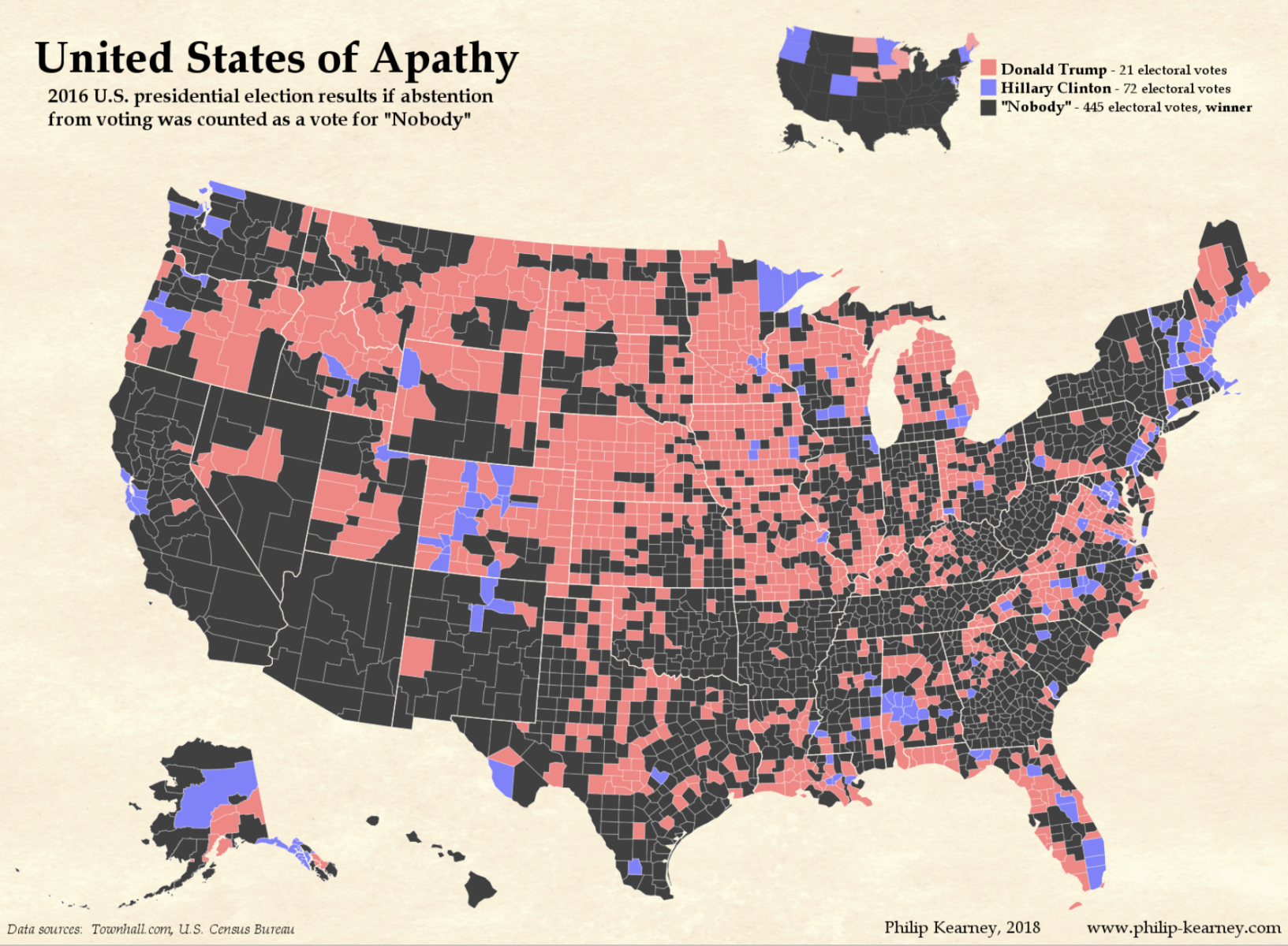
The chart nearby shows this on a county-by-county basis. Looking only at vote totals, the final percentages of votes are something like this:
2016 Presidential Elections: Vote Percentages (total)
- 44.0% Eligible But Did Not Vote
- 28.6% Clinton
- 27.4% Trump
If we look at the election on that basis, the electoral college would look very different:
2016 Presidential Elections: Electoral College, including None of the Above
- Nobody: 445 Electoral votes
- Clinton: 72 Electoral votes
- Trump: 21 Electoral votes
Polarization in Media / Twittersphere
Barry Ritholtz, January 5, 2020 [The Big Picture]
What is most intriguing about this is not the Left/Right divide, but the differentials within the Left and the Right:
The Left is dominated by Center Left, with the Far Left a single digit fringe.
The Right is different, it is dominated by the Far Right, ranging 17% to 50%. The Center Right is far smaller and less influential, ranging from 11% to 14.

Adam Levitin [American Prospect, via Naked Capitalism 1-11-20]
[Eudaimonia, via The Big Picture 1-5-20]
Swamp fever: Don’t blame Trump for the rise of right-wing conspiracy theories. The GOP helped cultivate them — until they took over.
Swamp fever: Don’t blame Trump for the rise of right-wing conspiracy theories. The GOP helped cultivate them — until they took over.
[Washington Post, via The Big Picture 1-5-20]
But in truth, the stew of “alternative facts” has been simmering for more than half a century on the right fringe. The GOP had endless opportunities across the decades to banish these theories — about scheming bureaucrats, Jews, the Federal Reserve, the United Nations — and its leaders often saw them as absurd. But they were also useful, helping to rally support from an aggrieved government-hating base. So the party’s mandarins allowed them to fester and grow until they spread from the toxic fringe to the mainstream, which they have finally overtaken. It’s no wonder someone who embraced those ideas would become successful; Trump validates notions that his voters have long believed, ideas that the party refused to condemn and failed to repudiate.
Trump, then, isn’t what caused these conspiracy theories. He’s what happens when nobody stands in their way.
Iran
A New Middle East “made in Iran” is about to be born
[Elijah Magnier, via Naked Capitalism January 10, 2020]
Targeting a base with thousands of officers and soldiers from hundreds of kilometres away and deliberately avoiding human casualties shows incredible self-confidence in Iran’s manufacture of their own missiles. Iran has shown the strength and technical ability to bomb the most powerful US base in Iraq with precision missiles and has now twice shown mercy by not killing US servicemen....
The Iranian hit on the Ayn al-Assad military base exposed the weakness of the most sophisticated radar and interception missiles in the US arsenal. President Trump has long bragged about these tools like the “best in the world”. But the US defence system at the Iraqi-US base in al-Anbar (west of Iraq) was incapable of intercepting one of the 13 ballistic missiles launched. The consequences of this single act are devastating both to the US armament industry and to US foreign policy in the Middle East.
This strike has shown US allies in the region that the hundreds of billions of dollars they have invested in US weapons are an insufficient defence against Iran. These countries now recognize they have no real deterrence against an Iranian attack. This realisation will push the traditional enemies of Iran in the Middle East to bypass their differences and take the road to Tehran to regain good ties with the “Islamic Republic”. It should not be excluded that many countries would be tempted to buy Iranian precision missiles that must be much cheaper than the expensive US manufactured ones.
....The lesson learned from the Iranian bombing is that Iran is ready to bomb and hit back US targets with great accuracy. Therefore, bombing Iran is off the table.A Guide to Getting Real on Iran
[War on the Rocks, January 10, 2020]
To respond to a crisis, any crisis, whether it be a civil war in Syria or Russia’s invasion of Ukraine, there is a tendency to default to three recent staples of American power: cruise missiles, special operations forces, and economic sanctions. This policy default comes about precisely because these three entail minimal risk to American forces, or because military deployments can be hidden and not directly sanctioned by vote in Congress. Absent being able to stomach true risk — sanctioning the use of force that may get large numbers of Americans killed — the United States confines itself to a carefully scripted set of tools that just aren’t that scary, and politicians can escape blame for any outcome — as recent tensions with Iran have demonstrated. It is a neat trick to pretend to be serious and thoughtful without actually being either....
Iran took care to minimize the chance of killing Americans, but still chose to launch the most ballistic missiles at American forces since Saddam Hussein in the two Gulf Wars, lofting on a ballistic trajectory tons of high explosive that fell into the center of a military base in Iraq famous for its American contingent. This was a demonstration of Iran’s stand-off capabilities. It could have been much worse than a demonstration, but it is still an undesired outcome — and requires thinking about how to convince Iran, politically, not to fire them again. Iran will not give up these assets, and has instead indicated that it will use them to coerce the United States and its regional allies if threatened....
The Trump administration removed Iran’s assurance that its behavior would be rewarded and resorted to a policy of all sticks and no carrots. This, in turn, has incentivized Iranian escalatory actions to impose a cost on the United States, focused first on its regional allies, and now extended to include strikes on American forces with ballistic missiles. This is the definition of escalation, if one stops and thinks about how things have shifted over the past 612 days since the United States withdrew from the multi-lateral nuclear deal. The U.S. military has been hit with ballistic missiles, troops are in lockdown, and the effort to defeat Islamic State has deteriorated because of it. The National Security Strategy remains unimplemented, as finite assets have had to be sent to a region where there is no great power, only Iran. And, inside the Middle East, the United States has firmly established through action and deed that it will not respond if Iran attacks its partners and will only take limited action if an American is killed.
The United States does not need more sanctions. It needs a roadmap to remove them, and to stick to that roadmap to engage Iran on comprehensive security talks. These talks would be iterative, painful, and prone to failure, with ups and downs and only incremental progress. They would also break the status quo and require political courage to begin, largely because the likelihood of failure is so high. However, this would place the risk for failure on the civilians who make policy, and not the military personnel who are tasked with carrying it out. As of now, that risk calculus is inverted, with the military being asked to shelter in place for hours on end, without adequate defenses, for a policy choice made during an election campaign.
There is little hope the Trump administration will make these calculations. It will likely instead default to sanctions and missile threats, not realizing that these tools are not working, and in a few months — when faced with the same deadlock — both sides will have an incentive to escalate again.
[New Republic, via Naked Capitalism 1-10-20]
Christians United for Israel, and a couple of its allies: Mike Pence and Mike Pompeo, who just happen to hold high positions in the Trump administration.
Christians United for Israel, and a couple of its allies: Mike Pence and Mike Pompeo, who just happen to hold high positions in the Trump administration.