Sunday, December 8, 2019

Week-end Wrap – Political Economy – December 8, 2019

Week-end Wrap – Political Economy – December 8, 2019
by Tony Wikrent
Economics Action Group, North Carolina Democratic Party Progressive Caucus

Strategic Political Economy

Reforming Rigged Capitalism
Barry Ritholtz, December 4, 2019 [The Big Picture]
Notable here is the original source: The Financial Times of London, for a century and a half the voice of the financiers of the City of London. The Financial Times is simply inaccessible behind a paywall, but Ritholtz provides a summary of highlights:
• US and UK have succumbed to demagogy. These long-stable democracies are also the most unequal of the western high-income countries. This is no coincidence;
• Rentier capitalism, weakened competition, feeble productivity growth, high inequality and, not coincidentally, an increasingly degraded democracy is is an unstable.
• US markets have become less competitive: concentration is high, leaders are entrenched and profit rates are excessive.
• Unit cost of financial intermediation has not fallen in the US over 140 years, despite technological advances
• The narrow focus on maximizing shareholder value has exacerbated the bad side-effects;
• Money in politics has damaged the idea of one person one vote. Money buys politicians, turns nations into plutocracies, not democracies. Our democracies need refurbishing.
• Finally, In­equality is corrosive.

How money laundering is poisoning American democracy
[Financial Times, via The Big Picture 12-1-19]
 In one of Mr Trump’s towers in Florida, more than 80 per cent of its units are owned by shell companies. The US has 10 times more shell companies than the next 41 jurisdictions combined, according to the World Bank.
NRA, Russia and Trump: How 'dark money' is poisoning American democracy
[CNBC 2-15-18]
One such report found that since Trump secured the Republican nomination in 2016, the fraction of anonymous purchases of his properties through shell companies has "skyrocketed" from 4 to 70 percent.
Here’s what happened when a charity gave $1,000 each to poor households in Kenya
[WeForum, via Naked Capitalism 12-5-19]
The charity gave a total of $10 million to 328 villages. Each of 10,500 households that qualified – by having a thatched-roof home – received $1,000, paid in three transfers.

The total paid out equaled around 75% of mean annual household expenditure in the region.... Economists from Berkeley, Princeton, and the University of California, San Diego analyzed a total of 653 villages. They carried out monthly surveys over 2.5 years, looking at 61 local markets. And they found many people benefitted from the cash – not only those who received it, but people in nearby villages, too.

In fact, every $1 of cash delivered generated $2.60 in additional spending or income in the area, the researchers say.
Freedom Is Meaningless Under Insurmountable Debt
[Atlantic, via Naked Capitalism 12-1-19]
Facing eviction, she took out a loan. She signed over the title to her family’s 2004 Ford F-150 as collateral and agreed to an annual interest rate of 300 percent... Her payment history shows her trying to keep up. Over 13 months, she gave more than a quarter of her take-home pay to the lender—$5,617—on a loan of $1,971. But the lender applied less than $2 of that to the loan principal; the rest vaporized in fees and interest.... 
As the historian Eric Foner and others have described, the Reconstruction Congress adopted a core view of the new Republican Party: that central to freedom is the right to enjoy the fruits of one’s own labor....

In 1867, Congress expressly recognized that it was possible to agree to work and still be enslaved. With its Anti-Peonage Act, Congress outlawed debt peonage—contracts that force someone to labor in order to pay off a debt, whether it is “voluntary” or not.

This and other laws reveal how the Reconstruction Congress saw the labor part of freedom as “not just the right to participate in the market, but the right to participate in a way that frees you from undue coercion,” says Rebecca Zietlow, a founder of the Thirteenth Amendment Project, a group of scholars exploring the history and “untapped potential” of the amendment.... 
As the Thirteenth Amendment scholar Lea VanderVelde writes: "What is the difference between owning a man and owning his services,” if his services—his labor—are all he has? How different is it, truly, to hold and force a woman to work until she pays off her debt, from garnishing the wages of a woman who cannot keep up with a loan at 300 percent interest? 
To be sure, this modern form of debt peonage doesn’t restrain one’s body—one’s physical freedom to move from place to place. But in the eyes of Howe and his fellow Republicans, its power is over something fundamental to liberty: the right to one’s future income.
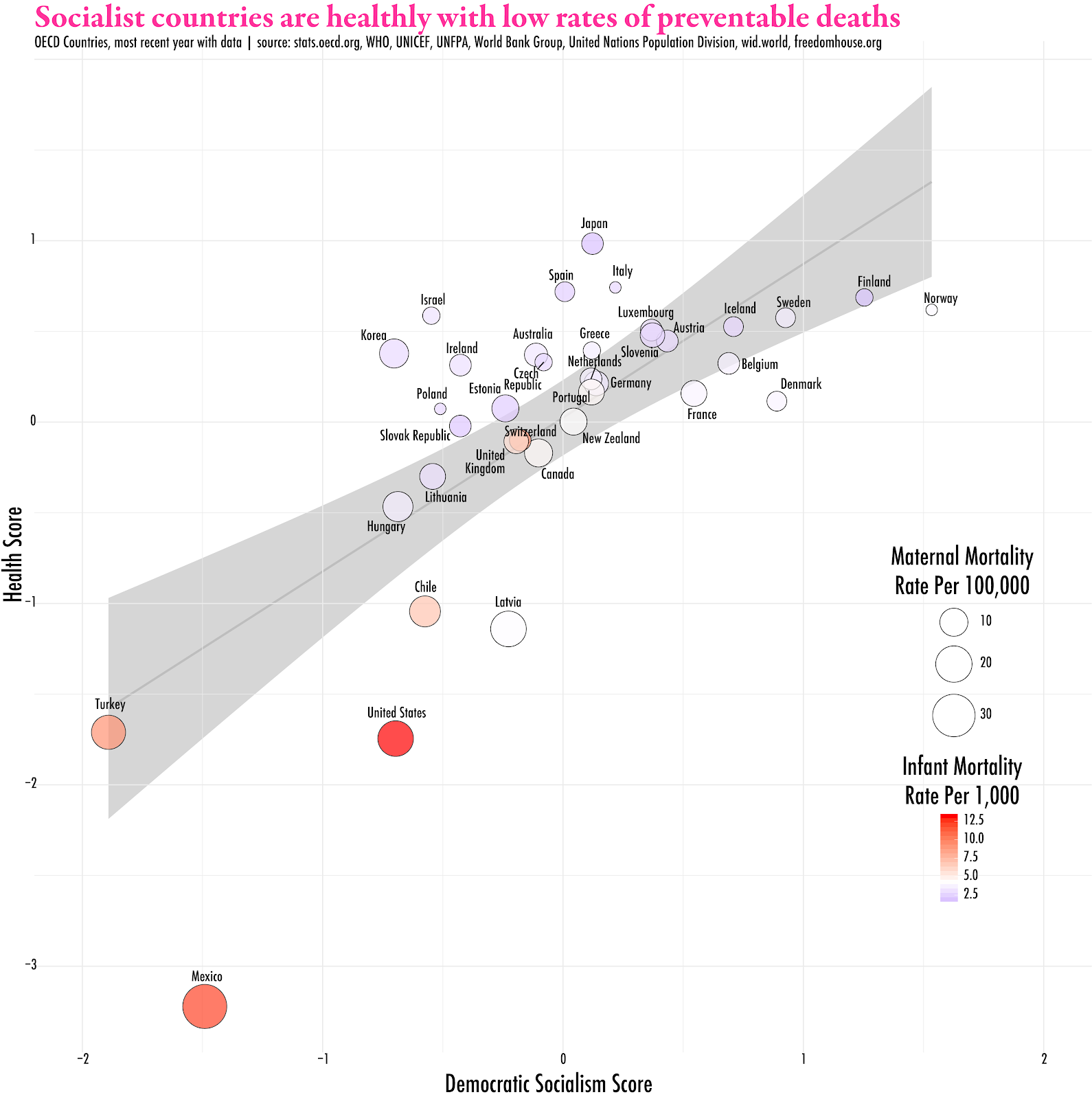
The Data Show That Socialism Works
[Current Affairs]
....inspired by Nathanial Lewis’s “scale of socialism,” I used data from the Organisation for Economic Co-operation and Development (OECD), the World Inequality Database, and Freedom House to build a “Democratic Socialism Score” for a variety of countries. Due to the limits of their databases, I could only score 36 countries. I would love to apply this score to all countries, but the data limits can’t be avoided.

The score derives from four components, with each made up of several subcomponents. The “State Ownership Score” combines data on the market value of State-Owned Enterprises relative to the overall economy, the share of government financial assets as a percentage of GDP, and the share of total public wealth as a share of total overall wealth. The “Public Goods and Welfare Score” combines government expenditures on welfare transfers, education, housing, etc. as a share of GDP. The “Democracy Score” simply comes from Freedom House’s “Freedom Ratings.” And the “Union Score” combines the percent of the workforce who are members of unions and the percent who are covered by collectively bargained contracts. To appropriately average these scores into a single overall score, I converted them into “standardized t-scores.”

The Carnage of Establishment Neoliberal Economics

Our workforce is dying faster than any other wealthy country, study shows 
[USA Today, via Naked Capitalism 12-3-19]
....new study by researchers at Virginia Commonwealth University [shows] that mortality rates for U.S. adults ages 25-64 continue to increase, driving down the general population’s life expectancy for at least three consecutive years. 
The report, “Life Expectancy and Mortality Rates in the United States, 1959-2017,’’ was published Tuesday in the Journal of the American Medical Association. The study paints a bleak picture of a workforce plagued by drug overdoses, suicides and organ-system diseases while grappling with economic stresses....
  • Between 1999 and 2017, midlife mortality from drug overdoses spiked by 386.5%.
  • In that same age group and time period, deaths from hypertensive diseases increased by 78.9%, and those linked to obesity by 114%.
  • Suicides rose by 38% and climbed 55.9% among those ages 55-64.
Median US Homebuyers Age in 1981 was 31. Today it is 47.
[Deutsche Bank Securities, via The Big Picture 12-5-19]

“The WTO’s trade dispute appeal system could end on Dec. 10. Here’s what you need to know.” [Washington Post, via Naked Capitalism 12-3-19] 
“On Dec. 10, the World Trade Organization appeals tribunal, the Appellate Body, won’t have enough members left to rule on trade disputes between countries. That’s a problem, given ongoing trade wars between the United States, China, and Europe, and some 60 cases pending before the WTO. Without a functioning Appellate Body, countries can block progress on disputes between the organization’s 164 members simply by filing an appeal. How did we get to this point? The U.S. government has blocked all new appointments to the Appellate Body, to protest what it claims to be “persistent overreaching” by Appellate Body members in their rulings.
It's maddening that Trump is doing this and outflanking Democratic Party leaders who are unwilling or unable to admit that free trade as been a disaster for average Americans. There were a number of people in 2016 who warned that on economic issues such as trade, Trump would devastate Clinton was running to the left of her on economic issues. Remember he promised to preserve intact Social Security and Medicare? 

Less than a year after abandoning HQ2 in New York City, Amazon says it’s opening a new 1,500-employee office in NYC 
[Business Insider, via Naked Capitalism 12-4-19]

[The Hill, via Naked Capitalism 12-4-19]

Economics in the real world

[USA Today, via Naked Capitalism 12-4-19]

Climate and environmental crises

“Poor Potato Crops Could Lead to a North American French Fry Shortage” 
[Smithsonian, via Naked Capitalism 12-4-19]
“The trouble started in October, when cold and wet conditions left potato growing regions covered in frost. Farmers in Alberta and Ohio were able to salvage and store some of their crops, but farmers in other areas, like Manitoba, North Dakota and Minnesota, had no choice but to give up on their beleaguered potatoes. Back in November, the United States Department of Agriculture predicted that production outputs from the country’s top nine potato producing states will fall 6.1 percent in 2019. Crops were down three percent in the autumn season alone, which, according to the United Potato Growers of Canada, ‘is one of the lowest crops on record.'”
[New York Times, via The Big Picture 12-5-19]
...climate change is encroaching on their treehouse paradise. Hurricane Irma in 2017 blew out their screens and pushed water through the windows. Each high tide brings the saltwater a little bit closer, killing the palm trees under the deck and popping the wooden slats off the boardwalk. The couple used to fly down from Long Island in a Cessna, until one day the runway at the island’s airport was underwater. 
“What’s government for? They’re supposed to protect your property,” Mr. Silverman said from behind the wheel of his shallow skiff boat on a recent afternoon.
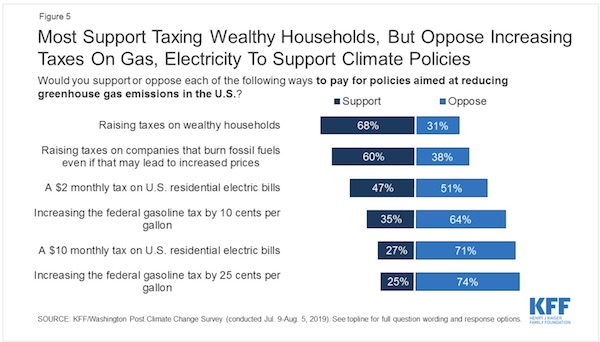
“The Kaiser Family Foundation/Washington Post Climate Change Survey” 
[Kaiser Family Foundation, via Naked Capitalism 12-5-19] 
“The poll finds that eight in ten U.S. adults believe that human activity is causing changes to the world’s climate, and two-thirds think the U.S. government is doing too little to reduce greenhouse gas emissions. Yet while many see climate change as an urgent issue, most are not discussing it often with their family and friends, and most are not willing to make personal sacrifices such as paying higher taxes at the gas pump or on their electric bills.”

[The Conversation, via Naked Capitalism 12-5-19]

Coal Power Becoming ‘Uninsurable’ As Firms Refuse Cover 
[Guardian, via Naked Capitalism 12-3-19]

“Nitrogen crisis from jam-packed livestock operations has ‘paralyzed’ Dutch economy” 
[Science, via Naked Capitalism 12-6-19] 
“Last week, Dutch farmers across the country parked their tractors along highways in the third such protest since October, when they jammed traffic while driving en masse to The Hague, the nation’s center of government. They are protesting a Dutch high court decision that in May suspended permits for construction projects that pollute the atmosphere with nitrogen compounds and harm nature reserves. The freeze has stalled the expansion of dairy, pig, and poultry farms—major sources of nitrogen in the form of ammonia from animal waste. Also blocked are plans for new homes, roads, and airport runways, because construction machinery emits nitrogen oxides. All told, the shutdown puts some €14 billion worth of projects in jeopardy, according to ABN AMRO Bank. ‘It has really paralyzed the country,’ says Jeroen Candel, a political scientist at Wageningen University and Research.'”
[Nature, via Naked Capitalism 12-6-19]

Creating new economic potential - science and technology

Electrification of vehicles triggering big changes in auto industry
[Wall Street Journal, via Naked Capitalism 12-6-19]
“The electrification of vehicles is triggering bigger changes in automotive supply chains. General Motors Co. and South Korea’s LG Chem plan to jointly build a $2.3 billion battery-cell factory in Ohio… the latest example of how auto makers are plowing big money into technology that is transforming the sector.... “Consultancy AlixPartners LP says auto makers are gearing up to spend $225 billion over the next few years to develop new electric vehicles and are partnering with and investing in battery makers to help provide the power.”

Sunday, December 1, 2019

Week-end Wrap – Political Economy – December 1, 2019

Week-end Wrap – Political Economy – December 1, 2019
by Tony Wikrent
Economics Action Group, North Carolina Democratic Party Progressive Caucus

Strategic Political Economy

The Failure of Liberal Politics: Canadian interview of political philosopher Michael Sandel
"The rise of right wing populism represents the failure of liberal and progressive politics," says Harvard political philosopher Michael Sandel. He joins The Agenda to diagnose the failure of liberal politics, the decline of civic life, and what liberals need to know in the age of anger and populism.
From the transcript:
SANDEL: Two decades ago when I wrote the book that you just generously quoted from, I got a lot of resistance from my liberal and progressive friends who thought I was worrying unnecessarily, that liberalism was more or less intact, and that the embrace by liberalism of the global economy and even market mechanisms would be a way to avoid controversy in politics, a way of avoiding the contentiousness that arises when we engage in morally robust questions in public life. i thought that was a mistake. I thought that was hollowing out public discourse, creating a kind of vacuum that was dangerous. And so we see. 
INTERVIEWER: Somebody filled the vacuum. 
SANDEL: Yes. And not only in the U.S., but with the rise of right wing kind of ultra nationalist populism in many European countries, I think we see this vacuum being filled. People sensed that after three to four decades of a kind of base that markets would decide tough public questions for us, democratic citizens are impatient with too empty a public discourse. They want politics to be about big things and also about values, about moral questions, about justice and inequality and what it means to be a citizen. And when liberal and progressive voices fail to offer that kind of politics, when they became largely technocratic in their approach, that vacuum was filled by narrow, intolerant voices and the kind of strident nationalism we see today.

Sunday, November 24, 2019

Week-end Wrap – Political Economy – November 24, 2019

Week-end Wrap – Political Economy – November 24, 2019
by Tony Wikrent
Economics Action Group, North Carolina Democratic Party Progressive Caucus

Strategic Political Economy

Mike Pompeo scorns the law because powerful men like him never have to follow it
Robert Fisk [Independent, via Naked Capitalism 11-22-19]

Dylan Ratigan: The Super Rich Have No Country. 
[YouTube, via Naked Capitalism 11-22-19]
“This is a 2 hour tour de force nailing down the failures of the media and Democrats on the GFC. Great explanation of the whole GFC too.”
[Common Dreams, via Naked Capitalism 11-22-19]

The Carnage of Establishment Neoliberal Economics

[Atlantic, via Naked Capitalism 11-21-19]
“A passion for affordability” became one of the company’s new, unloved slogans, as did “Less family, more team.” It was enough to drive the white-collar engineering union, which had historically functioned as a professional debating society, into acting more like organized labor. “We weren’t fighting against Boeing,” one union leader told me of the 40-day strike that shut down production in 2000. “We were fighting to save Boeing.”

....Stonecipher, who promptly affirmed: “When people say I changed the culture of Boeing, that was the intent, so that it’s run like a business rather than a great engineering firm.” A General Electric alum, he built a virtual replica of GE’s famed Crotonville leadership center for Boeing managers to cycle through....

The company that once didn’t speak finance was now, at the top, losing its ability to converse in engineering... It wasn’t just technical knowledge that was lost, Aboulafia said. “It was the ability to comfortably interact with an engineer who in turn feels comfortable telling you their reservations, versus calling a manager [more than] 1,500 miles away who you know has a reputation for wanting to take your pension away. It’s a very different dynamic. As a recipe for disempowering engineers in particular, you couldn’t come up with a better format.” ....
“If in fact there’s a reverse takeover, with the McDonnell ethos permeating Boeing, then Boeing is doomed to mediocrity,” the business scholar Jim Collins told me back in 2000. “There’s one thing that made Boeing really great all the way along. They always understood that they were an engineering-driven company, not a financially driven company . If they’re no longer honoring that as their central mission, then over time they’ll just become another company.”

Sunday, November 17, 2019

Week-end Wrap – Political Economy – November 17, 2019

Week-end Wrap – Political Economy – November 17, 2019
by Tony Wikrent
Economics Action Group, North Carolina Democratic Party Progressive Caucus

Strategic Political Economy

Senate Democrats Join GOP to Back ‘Automatic Austerity’ Bill That Would Gut Social Programs, Hamstring Bold Policies [Common Dreams., via Naked Capitalism 11-15-19]
I include this here because the next link directly addresses the persistence of economic austerity as a policy idea, despite it having failed repeatedly, and causing misery for untold millions of people.
A handful of Senate Democrats joined forces with Republicans last week to advance sweeping budget legislation that would establish an "automatic deficit-reduction process" that could trigger trillions of dollars in cuts to Medicare, Medicaid, food stamps, and other social programs—and potentially hobble the agenda of the next president. 
The Bipartisan Congressional Budget Reform Act (S.2765), authored by Sens. Sheldon Whitehouse (D-R.I.) and Mike Enzi (R-Wyo.), passed out of the Senate Budget Committee on November 6. The legislation is co-sponsored by five members of the Senate Democratic caucus: Whitehouse, Mark Warner (Va.), Tim Kaine (Va.), Chris Coons (Del.), and Angus King (I-Maine).
Lambert Strether added: "I really can’t think of a worse characterization for austerity proponents than “deficit scold,” though for some reason liberal Democrats like it. “Deficit scolds” are slaves to the ideas of long-dead economists and have caused a lot of suffering and death. They’re vicious sociopaths, not scolds."

Against Economics
David Graeber [New York Review of Books]
This is one of the best indictments of mainstream economic thinking I have seen in years, and I urge a full and attentive reading of it. In the excerpt below, note the role of John Locke, after whom the big Art Pope- and Koch-funded conservative propaganda outfit in North Carolina, the Locke Foundation, is named.
In England, the pattern was set in 1696, just after the creation of the Bank of England, with an argument over wartime inflation between Treasury Secretary William Lowndes, Sir Isaac Newton (then warden of the mint), and the philosopher John Locke. Newton had agreed with the Treasury that silver coins had to be officially devalued to prevent a deflationary collapse; Locke took an extreme monetarist position, arguing that the government should be limited to guaranteeing the value of property (including coins) and that tinkering would confuse investors and defraud creditors. Locke won. The result was deflationary collapse. A sharp tightening of the money supply created an abrupt economic contraction that threw hundreds of thousands out of work and created mass penury, riots, and hunger. The government quickly moved to moderate the policy (first by allowing banks to monetize government war debts in the form of bank notes, and eventually by moving off the silver standard entirely), but in its official rhetoric, Locke’s small-government, pro-creditor, hard-money ideology became the grounds of all further political debate. 
According to Skidelsky, the pattern was to repeat itself again and again, in 1797, the 1840s, the 1890s, and, ultimately, the late 1970s and early 1980s, with Thatcher and Reagan’s (in each case brief) adoption of monetarism. Always we see the same sequence of events:
  1. The government adopts hard-money policies as a matter of principle.
  2. Disaster ensues.
  3. The government quietly abandons hard-money policies.
  4. The economy recovers.
  5. Hard-money philosophy nonetheless becomes, or is reinforced as, simple universal common sense.
How was it possible to justify such a remarkable string of failures? Here a lot of the blame, according to Skidelsky, can be laid at the feet of the Scottish philosopher David Hume.

Friday, November 15, 2019

Against Economics - Graeber Review of Skidelsky

Thorstein Veblen was unusual as an economist, because, among other things, he was also an anthropologist. David Graeber is a professor of anthropology at the London School of Economics. Much like Veblen, Graeber has become a major irritant for mainstream economists. His 2011 book, book Debt: The First 5,000 Years relentlessly annihilated a basic assumption of modern economics: that the earliest economic systems were based on barter. 
The new issue of New York Review of Book, features a review by Graeber of Money and Government: The Past and Future of Economics, the new book by Robert Skidelsky, the heterodox British lord who wrote a widely celebrated if little read three-volume biography of John Maynard Keynes. Graeber's review is one of the best critiques of mainstream economics I can recall. 
Another basic assumption of  mainstream economics is that resources are scarce. I've not seen many people attacking this, though there are a few Marxists who have noted that this assumption is used to justify the worst effects of economic inequality, including penury and even starvation. The American School economists such as Henry Carey and Friedrich List emphatically rejected this assumption, and argued that the crucial consideration of economics was increasing the productive power of labor: the creation of science and technology, and the diffusion of scientific and technological knowledge. Graeber touches on this when he writes 
"Keynes himself was staunchly anti-Communist, but largely because he felt that capitalism was more likely to drive rapid technological advance that would largely eliminate the need for material labor. He wished for full employment not because he thought work was good, but because he ultimately wished to do away with work, envisioning a society in which technology would render human labor obsolete. In other words, he assumed that the ground was always shifting under the analysts’ feet; the object of any social science was inherently unstable." 
And when he writes "If an “economy” is to be defined as the means by which a human population provides itself with its material needs," Graeber is directly, if unknowingly, attacking this assumption of scarcity. 
Without the constant development of new science and technology, any society will become impoverished, and will eventually collapse. Jared Diamond’s book, Collapse: How Societies Choose to Fail or Succeed, examines how societies descend inexorably into collapse when they ignore environmental limitations and mismanage their natural resources. The key point that most readers of Diamond miss is that a society’s environmental limitations are defined only within a fairly specific period of time based on the prevailing technological mode of that society’s economy. Any society that remains stuck in one technological mode will eventually bump up against environmental limitations: what is considered a resource and how much of it is readily available and usable. All an economy really is, is how a society organizes itself to procure and process raw materials (natural resources) to create and distribute what is needed to sustain and reproduce human life. Modern mainstream economics had veered so far from reality at so many points, that I frankly cannot decide where to begin attacking. Fortunately, Graeber has delivered a superlative attack on the economics discipline -- and in clear, concise language. 

Against Economics
by David Graeber

Review of Money and Government: The Past and Future of Economics
by Robert Skidelsky
Yale University Press, 492 pp., $35.00

There is a growing feeling, among those who have the responsibility of managing large economies, that the discipline of economics is no longer fit for purpose. It is beginning to look like a science designed to solve problems that no longer exist.
A good example is the obsession with inflation. Economists still teach their students that the primary economic role of government—many would insist, its only really proper economic role—is to guarantee price stability. We must be constantly vigilant over the dangers of inflation. For governments to simply print money is therefore inherently sinful. If, however, inflation is kept at bay through the coordinated action of government and central bankers, the market should find its “natural rate of unemployment,” and investors, taking advantage of clear price signals, should be able to ensure healthy growth. These assumptions came with the monetarism of the 1980s, the idea that government should restrict itself to managing the money supply, and by the 1990s had come to be accepted as such elementary common sense that pretty much all political debate had to set out from a ritual acknowledgment of the perils of government spending. This continues to be the case, despite the fact that, since the 2008 recession, central banks have been printing money frantically in an attempt to create inflation and compel the rich to do something useful with their money, and have been largely unsuccessful in both endeavors.
We now live in a different economic universe than we did before the crash. Falling unemployment no longer drives up wages. Printing money does not cause inflation. Yet the language of public debate, and the wisdom conveyed in economic textbooks, remain almost entirely unchanged.
One expects a certain institutional lag. Mainstream economists nowadays might not be particularly good at predicting financial crashes, facilitating general prosperity, or coming up with models for preventing climate change, but when it comes to establishing themselves in positions of intellectual authority, unaffected by such failings, their success is unparalleled. One would have to look at the history of religions to find anything like it. To this day, economics continues to be taught not as a story of arguments—not, like any other social science, as a welter of often warring theoretical perspectives—but rather as something more like physics, the gradual realization of universal, unimpeachable mathematical truths. “Heterodox” theories of economics do, of course, exist (institutionalist, Marxist, feminist, “Austrian,” post-Keynesian…), but their exponents have been almost completely locked out of what are considered “serious” departments, and even outright rebellions by economics students (from the post-autistic economics movement in France to post-crash economics in Britain) have largely failed to force them into the core curriculum.
As a result, heterodox economists continue to be treated as just a step or two away from crackpots, despite the fact that they often have a much better record of predicting real-world economic events. What’s more, the basic psychological assumptions on which mainstream (neoclassical) economics is based—though they have long since been disproved by actual psychologists—have colonized the rest of the academy, and have had a profound impact on popular understandings of the world.
Nowhere is this divide between public debate and economic reality more dramatic than in Britain, which is perhaps why it appears to be the first country where something is beginning to crack. It was center-left New Labour that presided over the pre-crash bubble, and voters’ throw-the-bastards-out reaction brought a series of Conservative governments that soon discovered that a rhetoric of austerity—the Churchillian evocation of common sacrifice for the public good—played well with the British public, allowing them to win broad popular acceptance for policies designed to pare down what little remained of the British welfare state and redistribute resources upward, toward the rich. “There is no magic money tree,” as Theresa May put it during the snap election of 2017—virtually the only memorable line from one of the most lackluster campaigns in British history. The phrase has been repeated endlessly in the media, whenever someone asks why the UK is the only country in Western Europe that charges university tuition, or whether it is really necessary to have quite so many people sleeping on the streets.
The truly extraordinary thing about May’s phrase is that it isn’t true. There are plenty of magic money trees in Britain, as there are in any developed economy. They are called “banks.” Since modern money is simply credit, banks can and do create money literally out of nothing, simply by making loans. Almost all of the money circulating in Britain at the moment is bank-created in this way. Not only is the public largely unaware of this, but a recent survey by the British research group Positive Money discovered that an astounding 85 percent of members of Parliament had no idea where money really came from (most appeared to be under the impression that it was produced by the Royal Mint).
Economists, for obvious reasons, can’t be completely oblivious to the role of banks, but they have spent much of the twentieth century arguing about what actually happens when someone applies for a loan. One school insists that banks transfer existing funds from their reserves, another that they produce new money, but only on the basis of a multiplier effect (so that your car loan can still be seen as ultimately rooted in some retired grandmother’s pension fund). Only a minority—mostly heterodox economists, post-Keynesians, and modern money theorists—uphold what is called the “credit creation theory of banking”: that bankers simply wave a magic wand and make the money appear, secure in the confidence that even if they hand a client a credit for $1 million, ultimately the recipient will put it back in the bank again, so that, across the system as a whole, credits and debts will cancel out. Rather than loans being based in deposits, in this view, deposits themselves were the result of loans.
The one thing it never seemed to occur to anyone to do was to get a job at a bank, and find out what actually happens when someone asks to borrow money. In 2014 a German economist named Richard Werner did exactly that, and discovered that, in fact, loan officers do not check their existing funds, reserves, or anything else. They simply create money out of thin air, or, as he preferred to put it, “fairy dust.” [Jon posted the Werner study here in January 2015: Creating money out of thin air. Tony posted about it at DailyKos a few days later, then posted here some of the reactions, which quite fully confirm the points Graeber makers below about the unquestioning acceptance of the professional class of the neoliberal ideology of money creation: Creating Money Out of Thin Air and Trained Incapacity.]
That year also appears to have been when elements in Britain’s notoriously independent civil service decided that enough was enough. The question of money creation became a critical bone of contention. The overwhelming majority of even mainstream economists in the UK had long since rejected austerity as counterproductive (which, predictably, had almost no impact on public debate). But at a certain point, demanding that the technocrats charged with running the system base all policy decisions on false assumptions about something as elementary as the nature of money becomes a little like demanding that architects proceed on the understanding that the square root of 47 is actually π. Architects are aware that buildings would start falling down. People would die.
Before long, the Bank of England (the British equivalent of the Federal Reserve, whose economists are most free to speak their minds since they are not formally part of the government) rolled out an elaborate official report called “Money Creation in the Modern Economy,” replete with videos and animations, making the same point: existing economics textbooks, and particularly the reigning monetarist orthodoxy, are wrong. The heterodox economists are right. Private banks create money. Central banks like the Bank of England create money as well, but monetarists are entirely wrong to insist that their proper function is to control the money supply. In fact, central banks do not in any sense control the money supply; their main function is to set the interest rate—to determine how much private banks can charge for the money they create. Almost all public debate on these subjects is therefore based on false premises. For example, if what the Bank of England was saying were true, government borrowing didn’t divert funds from the private sector; it created entirely new money that had not existed before.
One might have imagined that such an admission would create something of a splash, and in certain restricted circles, it did. Central banks in Norway, Switzerland, and Germany quickly put out similar papers. Back in the UK, the immediate media response was simply silence. The Bank of England report has never, to my knowledge, been so much as mentioned on the BBC or any other TV news outlet. Newspaper columnists continued to write as if monetarism was self-evidently correct. Politicians continued to be grilled about where they would find the cash for social programs. It was as if a kind of entente cordiale had been established, in which the technocrats would be allowed to live in one theoretical universe, while politicians and news commentators would continue to exist in an entirely different one.
Still, there are signs that this arrangement is temporary. England—and the Bank of England in particular—prides itself on being a bellwether for global economic trends. Monetarism itself got its launch into intellectual respectability in the 1970s after having been embraced by Bank of England economists. From there it was ultimately adopted by the insurgent Thatcher regime, and only after that by Ronald Reagan in the United States, and it was subsequently exported almost everywhere else.
It is possible that a similar pattern is reproducing itself today. In 2015, a year after the appearance of the Bank of England report, the Labour Party for the first time allowed open elections for its leadership, and the left wing of the party, under Jeremy Corbyn and now shadow chancellor of the exchequer John McDonnell, took hold of the reins of power. At the time, the Labour left were considered even more marginal extremists than was Thatcher’s wing of the Conservative Party in 1975; it is also (despite the media’s constant efforts to paint them as unreconstructed 1970s socialists) the only major political group in the UK that has been open to new economic ideas. While pretty much the entire political establishment has been spending most of its time these last few years screaming at one another about Brexit, McDonnell’s office—and Labour youth support groups—have been holding workshops and floating policy initiatives on everything from a four-day workweek and universal basic income to a Green Industrial Revolution and “Fully Automated Luxury Communism,” and inviting heterodox economists to take part in popular education initiatives aimed at transforming conceptions of how the economy really works. Corbynism has faced near-histrionic opposition from virtually all sectors of the political establishment, but it would be unwise to ignore the possibility that something historic is afoot.
One sign that something historically new has indeed appeared is if scholars begin reading the past in a new light. Accordingly, one of the most significant books to come out of the UK in recent years would have to be Robert Skidelsky’s Money and Government: The Past and Future of Economics. Ostensibly an attempt to answer the question of why mainstream economics rendered itself so useless in the years immediately before and after the crisis of 2008, it is really an attempt to retell the history of the economic discipline through a consideration of the two things—money and government—that most economists least like to talk about.

Skidelsky is well positioned to tell this story. He embodies a uniquely English type: the gentle maverick, so firmly ensconced in the establishment that it never occurs to him that he might not be able to say exactly what he thinks, and whose views are tolerated by the rest of the establishment precisely for that reason. Born in Manchuria, trained at Oxford, professor of political economy at Warwick, Skidelsky is best known as the author of the definitive, three-volume biography of John Maynard Keynes, and has for the last three decades sat in the House of Lords as Baron of Tilton, affiliated at different times with a variety of political parties, and sometimes none at all. During the early Blair years, he was a Conservative, and even served as opposition spokesman on economic matters in the upper chamber; currently he’s a cross-bench independent, broadly aligned with left Labour. In other words, he follows his own flag. Usually, it’s an interesting flag. Over the last several years, Skidelsky has been taking advantage of his position in the world’s most elite legislative body to hold a series of high-level seminars on the reformation of the economic discipline; this book is, in a sense, the first major product of these endeavors.

What it reveals is an endless war between two broad theoretical perspectives in which the same side always seems to win—for reasons that rarely have anything to do with either theoretical sophistication or greater predictive power. The crux of the argument always seems to turn on the nature of money. Is money best conceived of as a physical commodity, a precious substance used to facilitate exchange, or is it better to see money primarily as a credit, a bookkeeping method or circulating IOU—in any case, a social arrangement? This is an argument that has been going on in some form for thousands of years. What we call “money” is always a mixture of both, and, as I myself noted in Debt (2011), the center of gravity between the two tends to shift back and forth over time. In the Middle Ages everyday transactions across Eurasia were typically conducted by means of credit, and money was assumed to be an abstraction. It was the rise of global European empires in the sixteenth and seventeenth centuries, and the corresponding flood of gold and silver looted from the Americas, that really shifted perceptions. Historically, the feeling that bullion actually is money tends to mark periods of generalized violence, mass slavery, and predatory standing armies—which for most of the world was precisely how the Spanish, Portuguese, Dutch, French, and British empires were experienced. One important theoretical innovation that these new bullion-based theories of money allowed was, as Skidelsky notes, what has come to be called the quantity theory of money (usually referred to in textbooks—since economists take endless delight in abbreviations—as QTM).
The QTM argument was first put forward by a French lawyer named Jean Bodin, during a debate over the cause of the sharp, destablizing price inflation that immediately followed the Iberian conquest of the Americas. Bodin argued that the inflation was a simple matter of supply and demand: the enormous influx of gold and silver from the Spanish colonies was cheapening the value of money in Europe. The basic principle would no doubt have seemed a matter of common sense to anyone with experience of commerce at the time, but it turns out to have been based on a series of false assumptions. For one thing, most of the gold and silver extracted from Mexico and Peru did not end up in Europe at all, and certainly wasn’t coined into money. Most of it was transported directly to China and India (to buy spices, silks, calicoes, and other “oriental luxuries”), and insofar as it had inflationary effects back home, it was on the basis of speculative bonds of one sort or another. This almost always turns out to be true when QTM is applied: it seems self-evident, but only if you leave most of the critical factors out.
In the case of the sixteenth-century price inflation, for instance, once one takes account of credit, hoarding, and speculation—not to mention increased rates of economic activity, investment in new technology, and wage levels (which, in turn, have a lot to do with the relative power of workers and employers, creditors and debtors)—it becomes impossible to say for certain which is the deciding factor: whether the money supply drives prices, or prices drive the money supply. Technically, this comes down to a choice between what are called exogenous and endogenous theories of money. Should money be treated as an outside factor, like all those Spanish dubloons supposedly sweeping into Antwerp, Dublin, and Genoa in the days of Philip II, or should it be imagined primarily as a product of economic activity itself, mined, minted, and put into circulation, or more often, created as credit instruments such as loans, in order to meet a demand—which would, of course, mean that the roots of inflation lie elsewhere?
To put it bluntly: QTM is obviously wrong. Doubling the amount of gold in a country will have no effect on the price of cheese if you give all the gold to rich people and they just bury it in their yards, or use it to make gold-plated submarines (this is, incidentally, why quantitative easing, the strategy of buying long-term government bonds to put money into circulation, did not work either). What actually matters is spending.
Nonetheless, from Bodin’s time to the present, almost every time there was a major policy debate, the QTM advocates won. In England, the pattern was set in 1696, just after the creation of the Bank of England, with an argument over wartime inflation between Treasury Secretary William Lowndes, Sir Isaac Newton (then warden of the mint), and the philosopher John Locke. Newton had agreed with the Treasury that silver coins had to be officially devalued to prevent a deflationary collapse; Locke took an extreme monetarist position, arguing that the government should be limited to guaranteeing the value of property (including coins) and that tinkering would confuse investors and defraud creditors. Locke won. The result was deflationary collapse. A sharp tightening of the money supply created an abrupt economic contraction that threw hundreds of thousands out of work and created mass penury, riots, and hunger. The government quickly moved to moderate the policy (first by allowing banks to monetize government war debts in the form of bank notes, and eventually by moving off the silver standard entirely), but in its official rhetoric, Locke’s small-government, pro-creditor, hard-money ideology became the grounds of all further political debate.
According to Skidelsky, the pattern was to repeat itself again and again, in 1797, the 1840s, the 1890s, and, ultimately, the late 1970s and early 1980s, with Thatcher and Reagan’s (in each case brief) adoption of monetarism. Always we see the same sequence of events:
(1) The government adopts hard-money policies as a matter of principle.
(2) Disaster ensues.
(3) The government quietly abandons hard-money policies.
(4) The economy recovers.
(5) Hard-money philosophy nonetheless becomes, or is reinforced as, simple universal common sense.
How was it possible to justify such a remarkable string of failures? Here a lot of the blame, according to Skidelsky, can be laid at the feet of the Scottish philosopher David Hume. An early advocate of QTM, Hume was also the first to introduce the notion that short-term shocks—such as Locke produced—would create long-term benefits if they had the effect of unleashing the self-regulating powers of the market:
Ever since Hume, economists have distinguished between the short-run and the long-run effects of economic change, including the effects of policy interventions. The distinction has served to protect the theory of equilibrium, by enabling it to be stated in a form which took some account of reality. In economics, the short-run now typically stands for the period during which a market (or an economy of markets) temporarily deviates from its long-term equilibrium position under the impact of some “shock,” like a pendulum temporarily dislodged from a position of rest. This way of thinking suggests that governments should leave it to markets to discover their natural equilibrium positions. Government interventions to “correct” deviations will only add extra layers of delusion to the original one.
There is a logical flaw to any such theory: there’s no possible way to disprove it. The premise that markets will always right themselves in the end can only be tested if one has a commonly agreed definition of when the “end” is; but for economists, that definition turns out to be “however long it takes to reach a point where I can say the economy has returned to equilibrium.” (In the same way, statements like “the barbarians always win in the end” or “truth always prevails” cannot be proved wrong, since in practice they just mean “whenever barbarians win, or truth prevails, I shall declare the story over.”)
At this point, all the pieces were in place: tight-money policies (which benefited creditors and the wealthy) could be justified as “harsh medicine” to clear up price-signals so the market could return to a healthy state of long-run balance. In describing how all this came about, Skidelsky is providing us with a worthy extension of a history Karl Polanyi first began to map out in the 1940s: the story of how supposedly self-regulating national markets were the product of careful social engineering. Part of that involved creating government policies self-consciously designed to inspire resentment of “big government.” Skidelsky writes:
A crucial innovation was income tax, first levied in 1814, and renewed by [Prime Minister Robert] Peel in 1842. By 1911–14, this had become the principal source of government revenue. Income tax had the double benefit of giving the British state a secure revenue base, and aligning voters’ interests with cheap government, since only direct taxpayers had the vote…. “Fiscal probity,” under Gladstone, “became the new morality.”
In fact, there’s absolutely no reason a modern state should fund itself primarily by appropriating a proportion of each citizen’s earnings. There are plenty of other ways to go about it. Many—such as land, wealth, commercial, or consumer taxes (any of which can be made more or less progressive)—are considerably more efficient, since creating a bureaucratic apparatus capable of monitoring citizens’ personal affairs to the degree required by an income tax system is itself enormously expensive. But this misses the real point: income tax is supposed to be intrusive and exasperating. It is meant to feel at least a little bit unfair. Like so much of classical liberalism (and contemporary neoliberalism), it is an ingenious political sleight of hand—an expansion of the bureaucratic state that also allows its leaders to pretend to advocate for small government.
The one major exception to this pattern was the mid-twentieth century, what has come to be remembered as the Keynesian age. It was a period in which those running capitalist democracies, spooked by the Russian Revolution and the prospect of the mass rebellion of their own working classes, allowed unprecedented levels of redistribution—which, in turn, led to the most generalized material prosperity in human history. The story of the Keynesian revolution of the 1930s, and the neoclassical counterrevolution of the 1970s, has been told innumerable times, but Skidelsky gives the reader a fresh sense of the underlying conflict.

Keynes himself was staunchly anti-Communist, but largely because he felt that capitalism was more likely to drive rapid technological advance that would largely eliminate the need for material labor. He wished for full employment not because he thought work was good, but because he ultimately wished to do away with work, envisioning a society in which technology would render human labor obsolete. In other words, he assumed that the ground was always shifting under the analysts’ feet; the object of any social science was inherently unstable. Max Weber, for similar reasons, argued that it would never be possible for social scientists to come up with anything remotely like the laws of physics, because by the time they had come anywhere near to gathering enough information, society itself, and what analysts felt was important to know about it, would have changed so much that the information would be irrelevant. Keynes’s opponents, on the other hand, were determined to root their arguments in just such universal principles.
It’s difficult for outsiders to see what was really at stake here, because the argument has come to be recounted as a technical dispute between the roles of micro- and macroeconomics. Keynesians insisted that the former is appropriate to studying the behavior of individual households or firms, trying to optimize their advantage in the marketplace, but that as soon as one begins to look at national economies, one is moving to an entirely different level of complexity, where different sorts of laws apply. Just as it is impossible to understand the mating habits of an aardvark by analyzing all the chemical reactions in their cells, so patterns of trade, investment, or the fluctuations of interest or employment rates were not simply the aggregate of all the microtransactions that seemed to make them up. The patterns had, as philosophers of science would put it, “emergent properties.” Obviously, it was necessary to understand the micro level (just as it was necessary to understand the chemicals that made up the aardvark) to have any chance of understand the macro, but that was not, in itself, enough.
The counterrevolutionaries, starting with Keynes’s old rival Friedrich Hayek at the LSE and the various luminaries who joined him in the Mont Pelerin Society, took aim directly at this notion that national economies are anything more than the sum of their parts. Politically, Skidelsky notes, this was due to a hostility to the very idea of statecraft (and, in a broader sense, of any collective good). National economies could indeed be reduced to the aggregate effect of millions of individual decisions, and, therefore, every element of macroeconomics had to be systematically “micro-founded.”
One reason this was such a radical position was that it was taken at exactly the same moment that microeconomics itself was completing a profound transformation—one that had begun with the marginal revolution of the late nineteenth century—from a technique for understanding how those operating on the market make decisions to a general philosophy of human life. It was able to do so, remarkably enough, by proposing a series of assumptions that even economists themselves were happy to admit were not really true: let us posit, they said, purely rational actors motivated exclusively by self-interest, who know exactly what they want and never change their minds, and have complete access to all relevant pricing information. This allowed them to make precise, predictive equations of exactly how individuals should be expected to act.
Surely there’s nothing wrong with creating simplified models. Arguably, this is how any science of human affairs has to proceed. But an empirical science then goes on to test those models against what people actually do, and adjust them accordingly. This is precisely what economists did not do. Instead, they discovered that, if one encased those models in mathematical formulae completely impenetrable to the noninitiate, it would be possible to create a universe in which those premises could never be refuted. (“All actors are engaged in the maximization of utility. What is utility? Whatever it is that an actor appears to be maximizing.”) The mathematical equations allowed economists to plausibly claim theirs was the only branch of social theory that had advanced to anything like a predictive science (even if most of their successful predictions were of the behavior of people who had themselves been trained in economic theory).
This allowed Homo economicus to invade the rest of the academy, so that by the 1950s and 1960s almost every scholarly discipline in the business of preparing young people for positions of power (political science, international relations, etc.) had adopted some variant of “rational choice theory” culled, ultimately, from microeconomics. By the 1980s and 1990s, it had reached a point where even the heads of art foundations or charitable organizations would not be considered fully qualified if they were not at least broadly familiar with a “science” of human affairs that started from the assumption that humans were fundamentally selfish and greedy.
These, then, were the “microfoundations” to which the neoclassical reformers demanded macroeconomics be returned. Here they were able to take advantage of certain undeniable weaknesses in Keynesian formulations, above all its inability to explain 1970s stagflation, to brush away the remaining Keynesian superstructure and return to the same hard-money, small-government policies that had been dominant in the nineteenth century. The familiar pattern ensued. Monetarism didn’t work; in the UK and then the US, such policies were quickly abandoned. But ideologically, the intervention was so effective that even when “new Keynesians” like Joseph Stiglitz or Paul Krugman returned to dominate the argument about macroeconomics, they still felt obliged to maintain the new microfoundations.
The problem, as Skidelsky emphasizes, is that if your initial assumptions are absurd, multiplying them a thousandfold will hardly make them less so. Or, as he puts it, rather less gently, “lunatic premises lead to mad conclusions”:
The efficient market hypothesis (EMH), made popular by Eugene Fama…is the application of rational expectations to financial markets. The rational expectations hypothesis (REH) says that agents optimally utilize all available information about the economy and policy instantly to adjust their expectations….
Thus, in the words of Fama,…“In an efficient market, competition among the many intelligent participants leads to a situation where…the actual price of a security will be a good estimate of its intrinsic value.” [Skidelsky’s italics]
In other words, we were obliged to pretend that markets could not, by definition, be wrong—if in the 1980s the land on which the Imperial compound in Tokyo was built, for example, was valued higher than that of all the land in New York City, then that would have to be because that was what it was actually worth. If there are deviations, they are purely random, “stochastic” and therefore unpredictable, temporary, and, ultimately, insignificant. In any case, rational actors will quickly step in to sweep up any undervalued stocks. Skidelsky drily remarks:
There is a paradox here. On the one hand, the theory says that there is no point in trying to profit from speculation, because shares are always correctly priced and their movements cannot be predicted. But on the other hand, if investors did not try to profit, the market would not be efficient because there would be no self-correcting mechanism….
Secondly, if shares are always correctly priced, bubbles and crises cannot be generated by the market….
This attitude leached into policy: “government officials, starting with [Federal Reserve Chairman] Alan Greenspan, were unwilling to burst the bubble precisely because they were unwilling to even judge that it was a bubble.” The EMH made the identification of bubbles impossible because it ruled them out a priori.
If there is an answer to the queen’s famous question of why no one saw the crash coming, this would be it.
At this point, we have come full circle. After such a catastrophic embarrassment, orthodox economists fell back on their strong suit—academic politics and institutional power. In the UK, one of the first moves of the new Conservative-Liberal Democratic Coalition in 2010 was to reform the higher education system by tripling tuition and instituting an American-style regime of student loans. Common sense might have suggested that if the education system was performing successfully (for all its foibles, the British university system was considered one of the best in the world), while the financial system was operating so badly that it had nearly destroyed the global economy, the sensible thing might be to reform the financial system to be a bit more like the educational system, rather than the other way around. An aggressive effort to do the opposite could only be an ideological move. It was a full-on assault on the very idea that knowledge could be anything other than an economic good.
Similar moves were made to solidify control over the institutional structure. The BBC, a once proudly independent body, under the Tories has increasingly come to resemble a state broadcasting network, their political commentators often reciting almost verbatim the latest talking points of the ruling party—which, at least economically, were premised on the very theories that had just been discredited. Political debate simply assumed that the usual “harsh medicine” and Gladstonian “fiscal probity” were the only solution; at the same time, the Bank of England began printing money like mad and, effectively, handing it out to the one percent in an unsuccessful attempt to kick-start inflation. The practical results were, to put it mildly, uninspiring. Even at the height of the eventual recovery, in the fifth-richest country in the world, something like one British citizen in twelve experienced hunger, up to and including going entire days without food. If an “economy” is to be defined as the means by which a human population provides itself with its material needs, the British economy is increasingly dysfunctional. Frenetic efforts on the part of the British political class to change the subject (Brexit) can hardly go on forever. Eventually, real issues will have to be addressed.
Economic theory as it exists increasingly resembles a shed full of broken tools. This is not to say there are no useful insights here, but fundamentally the existing discipline is designed to solve another century’s problems. The problem of how to determine the optimal distribution of work and resources to create high levels of economic growth is simply not the same problem we are now facing: i.e., how to deal with increasing technological productivity, decreasing real demand for labor, and the effective management of care work, without also destroying the Earth. This demands a different science. The “microfoundations” of current economics are precisely what is standing in the way of this. Any new, viable science will either have to draw on the accumulated knowledge of feminism, behavioral economics, psychology, and even anthropology to come up with theories based on how people actually behave, or once again embrace the notion of emergent levels of complexity—or, most likely, both.
Intellectually, this won’t be easy. Politically, it will be even more difficult. Breaking through neoclassical economics’ lock on major institutions, and its near-theological hold over the media—not to mention all the subtle ways it has come to define our conceptions of human motivations and the horizons of human possibility—is a daunting prospect. Presumably, some kind of shock would be required. What might it take? Another 2008-style collapse? Some radical political shift in a major world government? A global youth rebellion? However it will come about, books like this—and quite possibly this book—will play a crucial part.

Sunday, November 10, 2019

Week-end Wrap – Political Economy – November 10, 2019

Week-end Wrap – Political Economy – November 10, 2019
by Tony Wikrent
Economics Action Group, North Carolina Democratic Party Progressive Caucus

Strategic Political Economy

Yanis Varoufakis – Capitalism, Democracy and Europe
[Brave New Europe, via Naked Capitalism 11-7-19]
The first two decades after World War II were the Golden Era of capitalism for a very simple reason: Franklin Roosevelt’s New Deal was projected onto the rest of the West under the Bretton Woods system. It was a remarkable, though imperfect, system, a kind of enlightenment without socialism. Structures to restrain financial capital were put into place. Banks could not do as they pleased; that’s why bankers hated the Bretton Woods system. Recall that Roosevelt banned bankers from attending the Bretton Woods conference and subjected them to reserve controls and rules against shifting money across international borders. 
The result of the Bretton Woods system was a remarkable reduction in inequality concurrent with steady growth, low unemployment, and next to zero inflation.
Note that this  "Golden Era of capitalism" is never discussed in the same way by conservatives and libertarians, because of their ideological hostility to Roosevelt and the New Deal. 

The Carnage of Establishment Neoliberal Economics

The World Has Gone Mad and the System Is Broken
Ray Dalio [LinkedIn, via Naked Capitalism 11-6-19]
Money is free for those who are creditworthy because the investors who are giving it to them are willing to get back less than they give. More specifically investors lending to those who are creditworthy will accept very low or negative interest rates and won’t require having their principal paid back for the foreseeable future. They are doing this because they have an enormous amount of money to invest that has been, and continues to be, pushed on them by central banks that are buying financial assets in their futile attempts to push economic activity and inflation up. The reason that this money that is being pushed on investors isn’t pushing growth and inflation much higher is that the investors who are getting it want to invest it rather than spend it. This dynamic is creating a “pushing on a string” dynamic.... 
At the same time as money is essentially free for those who have money and creditworthiness, it is essentially unavailable to those who don’t have money and creditworthiness, which contributes to the rising wealth, opportunity, and political gaps. Also contributing to these gaps are the technological advances that investors and the entrepreneurs that I previously mentioned are excited by in the ways I described, and that also replace workers with machines. Because the “trickle-down” process of having money at the top trickle down to workers and others by improving their earnings and creditworthiness is not working, the system of making capitalism work well for most people is broken.

This set of circumstances is unsustainable and certainly can no longer be pushed as it has been pushed since 2008. That is why I believe that the world is approaching a big paradigm shift.
Given the pent-up demand to create and build what the world needs to exit the era of fossil fuels, this situation is insane.

Sunday, November 3, 2019

Week-end Wrap – Political Economy – November 2, 2019

Week-end Wrap – Political Economy – November 2, 2019
by Tony Wikrent
Economics Action Group, North Carolina Democratic Party Progressive Caucus

Strategic Political Economy

Neoliberalism Tells Us We’re Selfish Souls – How Can We Promote Other Identities?  
[Open Democracy, via Naked Capitalism 11-1-19]
“Economics is the method: the object is to change the soul.” Understanding why Thatcher said this is central to understanding the neoliberal project, and how we might move beyond it. Carys Hughes and Jim Cranshaw’s opening article poses a crucial challenge to the left in this respect. It is too easy to tell ourselves a story about the long reign of neoliberalism that is peopled solely with all-powerful elites imposing their will on the oppressed masses. It is much harder to confront seriously the ways in which neoliberalism has manufactured popular consent for its policies. 
The left needs to acknowledge that aspects of the neoliberal agenda have been overwhelmingly popular: it has successfully tapped into people’s instincts about the kind of life they want to lead, and wrapped these instincts up in a compelling narrative about how we should see ourselves and other people. We need a coherent strategy for replacing this narrative with one that actively reconstructs our collective self-image – turning us into empowered citizens participating in communities of mutual care, rather than selfish property-owning individuals competing in markets.... 
In thinking about how we do this, it’s instructive to look at the ways in which neoliberal attempts to reshape our identities have succeeded – and the ways they have failed. While Right to Buy might have been successful in identifying people as home-owners and stigmatising social housing, this has not bled through into wider support for private ownership. Although public ownership did become taboo among the political classes for a generation – far outside the political ‘common sense’ – polls consistently showed that this was not matched by a fall in public support for the idea. On some level – perhaps because of the poor performance of privatised entities – people continued to identify as citizens with a right to public services, rather than as consumers of privatised services. The continued overwhelming attachment to a public NHS is the epitome of this tendency. This is partly what made it possible for Corbyn’s Labour to rehabilitate the concept of public ownership, as the 2017 Labour manifesto’s proposals for public ownership of railways and water – dismissed as ludicrous by the political establishment – proved overwhelmingly popular.
USA and many other countries claim to be republics. Neoliberalism is a direct attack on the basic principles of republicanism. From the chapter "Republicanism," from Gordon Wood's 1969 Bancroft Prize winning book, Creation of the American Republic, 1776-1787:

Sunday, October 27, 2019

Week-end Wrap – Political Economy – October 26, 2019

Week-end Wrap – Political Economy – October 26, 2019
by Tony Wikrent
North Carolina Democratic Party Progressive Caucus

Strategic Political Economy

U.S. Military Could Collapse Within 20 Years Due to Climate Change, Report Commissioned By Pentagon Says[Vice, via The Big Picture 10-25-19]

“For the first time, workers are paying a higher tax rate than investors and owners” 
[Washington Post, via Naked Capitalism 10-24-19] 
“Most Americans have to work to earn a living. But the rich are different: They get most of their income not from labor but from what they own — companies, stocks, real estate and the like. These income-generating assets are what economists call capital. And because capital is heavily concentrated among the rich, the U.S. government taxed earnings derived from capital at a higher rate than earnings made through labor for the entirety of the 20th century. But that’s no longer the case, according to economists Emmanuel Saez and Gabriel Zucman of the University of California at Berkeley. In their new book, “The Triumph of Injustice,” they present data showing that in 2018, labor income was taxed at a higher rate than capital income for the first time in modern U.S. history.”
This could be the formal marker for when USA ceased being a republic and became a plutocracy, but I would argue for the Citizens United decision by the Supreme Court instead. 

The CBO Just Handed Us Two Trillion Dollars
[J.W. Mason, via Naked Capitalism 10-25-19]
In their most recent 10-year budget and economic forecast, the CBO made a big change, reducing their long-run forecast of the interest rate on government bonds by almost a full percentage point, from 3.7 to 2.9. (See Table 2.6 here.)

Most directly, the new, lower interest rate reduces expected debt payments over the next decade by $2.2 trillion.
I have no doubt that Trump and the Republicans will use this to push the line that the Trump tax cuts worked to grow the economy and pay for themselves. 

Sunday, October 20, 2019

Week-end Wrap – Political Economy – October 19, 2019

Week-end Wrap – Political Economy – October 19, 2019
by Tony Wikrent
North Carolina Democratic Party Progressive Caucus

Strategic Political Economy

[Wired, via The Big Picture 10-19-19]
....Mazzucato, an Italian-American economist who had spent decades researching the economics of innovation and the high tech industry, decided to look deeper into the early history of some of the world’s most innovative companies. The development of Google’s search algorithm, for instance, had been supported by a grant from the National Science Foundation, a US public grant-awarding body. Electric car company Tesla initially struggled to secure investment until it received a $465 million (£380 million) loan from the US Department of Energy. In fact, three companies founded by Elon Musk — Tesla, SolarCity and SpaceX — had jointly benefited from nearly $4.9 billion (£3.9bn) in public support of various kinds. Many other well-known US startups had been funded by the Small Business Innovation Research programme, a public venture capital fund. “It wasn’t just early research, it was also applied research, early stage finance, strategic procurement,” she says. “The more I looked, the more I realised: state investment is everywhere.” 
Mazzucato included her findings in a 150-page pamphlet she submitted to UK policy think tank Demos. It was distributed to thousands of policymakers, and received coverage in daily newspapers. “It was obvious that it had touched a nerve,” she says. “The more I thought about it, the more I wanted to go straight to the core of the myths about innovation.” She decided to dissect the product that symbolised Silicon Valley’s engineering prowess: the iPhone. 
Mazzucato traced the provenance of every technology that made the iPhone. The HTTP protocol, of course, had been developed by British scientist Tim Berners-Lee and implemented on the computers at CERN, in Geneva. The internet began as a network of computers called Arpanet, funded by the US Department of Defense (DoD) in the 60s to solve the problem of satellite communication. The DoD was also behind the development of GPS during the 70s, initially to determine the location of military equipment. The hard disk drive, microprocessors, memory chips and LCD display had also been funded by the DoD. Siri was the outcome of a Stanford Research Institute project to develop a virtual assistant for military staff, commissioned by the Defense Advanced Research Projects Agency (DARPA). The touchscreen was the result of graduate research at the University of Delaware, funded by the National Science Foundation and the CIA.
See also my HAWB series: How America Was Built. List of previous posts is at the bottom of this story on NASA aerodynamicist Richard Whitcomb

Sunday, October 13, 2019

Week-end Wrap – Political Economy – October 12, 2019

Week-end Wrap – Political Economy – October 12, 2019
by Tony Wikrent
Economics Action Group, North Carolina Democratic Party Progressive Caucus

Strategic Political Economy

The Census Fails to Count 100 Million People as Living in Poverty
Jerri-Lynn Scofield, via Naked Capitalism 10-7-19]

The climate crisis and the failure of economics: Why our economic model fails to explain how we got here on climate.
Jared Bernstein  Oct 11, 2019, via Naked Capitalism 10-11-19]

Historic step forward: Gov. Gavin Newsom signs the Public Banking Act into California law!
[Public Banking Institite 10-5-19]
Victory in California! Gov. Gavin Newsom’s signature has made AB 857 — the grassroots-generated, people-powered Public Banking Act — the law in California. The California Public Banking Alliance has been tireless in educating legislators, drafting language, and generating massive statewide public support. The strong leadership of the bill's co-authors, Assemblymembers Miguel Santiago and David Chiu, generated 19 co-sponsors and support from several committee chairs, clearly demonstrating that the will of the people is behind banks that serve the public interest.... 
California gets it rolling [podcast]
As global climate strikes continue around the world this week, California has passed breakthrough legislation that sanctions municipal public banks to serve as public administration entities, a development with wide repercussions across the country. We talk with a couple of the citizen leaders, Marc Armstrong and Susan Harman, who were pivotal drivers of the effort, and what they think it means for the movement. Then Ellen speaks with an author and former US Treasury economist, Richard C. Cook, about why the extractive domination of private banks over the totality of civic life must be taken down if we wish to have an economy that works for all. Finally, we have another talk with Bank of North Dakota historian Mike Jacobs about why that bank has managed to avoid corruption and remain a robust example of why banks should be owned by the people.

Sunday, October 6, 2019

Week-end Wrap – Political Economy – October 5, 2019

Week-end Wrap – Political Economy – October 5, 2019
by Tony Wikrent
Economics Action Group, North Carolina Democratic Party Progressive Caucus

Strategic Political Economy

How Bill Clinton and American Financiers Armed China
Matt Stoller [BIG, via Naked Capitalism 10-2-19]
A must-read for all the details of the policy follies of the past four decades, and for the quotes from speeches at the time by such elites as Larry Summers.
Chinese power today is a result of a large number of incidents similar to this one, the wholesale transfer of knowhow, technology, and physical stuff from American communities to Chinese ones. And the confused politics of China is a result of the failure of the many policymaking elites who participated in such rancid episodes, and are embarrassed about it. As we peer at an ascendant and dangerous China, it makes sense to look back at how Clinton thought about the world, and why he would engage in such a foolish strategy. 
Broadly speaking, there were two catastrophic decisions Clinton made in 1993 that ended up eroding the long-term American defense posture. The first was to radically break from the post-World War II trading system. This system was organized around free trade of goods and services among democratic nations, along with somewhat restricted financial capital flows. He did this by passing NAFTA, by bailing out Mexico and thus American banks, by creating the World Trade Organization, and by opening up the United States to China as deep commercial partners. 
The Clinton framework gutted the ability of U.S. policymakers to protect industrial power, and empowered Wall Street and foreign officials to force the U.S. to export its industrial base abroad, in particular to China. The radicalism of the choice was in the intertwining of the U.S. industrial base with an autocratic strategic competitor. During the Cold War, we had never relied on the USSR for key inputs, and basically didn’t trade with them. Now, we would deeply integrate our technology and manufacturing with an enemy (and yes, the Chinese leaders saw and currently still see us as enemies). 
The second choice was to reorganize the American defense industrial base, ripping out contracting rules and consolidating power into the hands of a small group of defense giants. In the early 1990s, as part of the ‘reinventing government’ initiative, the Clinton team sought to radically empower private contractors in the government procurement process....  
The empowering of finance friendly giant contractors bent the bureaucracies towards only seeing global capital flows, not the flow of stuff or the ability to produce. This was already how most Clinton administration officials saw the world. They just assumed, wrongly, that stuff moves around the world without friction, and that American corporations operate in a magic fairy tale where practical problems are solved by finance and this thing called ‘the free market.’ In their Goldman, McKinsey and Boston Consulting Group-ified haze of elitist disdain for actually making and doing real things, they didn’t notice or care that the Chinese Communist Party was centralizing production in China. They just assumed that Chinese production was ‘the free market’ at work, instead of a carefully state-sponsored effort by Chinese bureaucrats to build strategic military and economic power.