
As someone who has been preaching that the most useful way to understand modern economies is to examine the difference between Producers and Predators, it is always good to see that someone else has come to largely the same conclusion through by a different path. In this case, the man's name is Mike Norman who runs an interesting blog that occasionally sends me readers. Here he describes Predator finance capitalism in a way that could have come straight out of Elegant Technology yet his blog does not exist to promote an engineering / Producer alternative. In fact he markets lessons in Forex Trading.
Tuesday, March 11, 2014
Monday, March 10, 2014
Will liquid metal electrical storage actually work?
Electrical storage is one of the two game changers in any scheme to power a society with renewables (the other is figuring out how to transmit electricity over long distances with minimal power loss.) Because storage is SO important, lots of folks are spending time and effort to figure out ways to do it. Some ideas sound more plausible than others but we won't actually know until something works. This is a Producer Class activity—only results matter.
The following idea sounds plausible enough so Bill Gates has invested in it.
The following idea sounds plausible enough so Bill Gates has invested in it.
Sunday, March 9, 2014
Another green success story
Eigg, a Scottish island, has figured out how to power itself with renewables. What it has in common with other successful experiments is that it is a small community where the decision-making loop is much easier to manage, it has almost no installed technology to displace, and it has obvious environmental clues as to how to proceed—in this case a lot of wind.
We all should be so fortunate.
We all should be so fortunate.
Ukraine—the problems only escalate
Even though I find the sabre-rattling profoundly depressing, the Ukrainian crises seriously demands attention here at real-economics. There are a wide assortment of non-economic issues that are driving the conflict including the historical animosities between Russia and Ukraine and a lot of Cold War baggage that seems not to have gone away in spite of the collapse of the Warsaw Pact in 1991. But the economic reasons are just overwhelming. These include:
- The bill for energy owed to Russia / Gazprom. One of the sweeteners Putin / Russia offered the Ukraine to turn down a closer alliance with the EU was a discount for natural gas. The Gazprom people were probably not at all happy about this and so are probably relieved that all their customers will be charged the same market prices.
- The energy pipelines that crisscross the region. Reader JL sent a link that explains all the various interests involved. Anyone who argues that most of the world's conflicts involve some aspect of the "awl bidnuss" are rarely completely wrong
- Ukraine owes western banks $15 Billion. These loans are teetering on default. In a world where the Fed pumps $65 Billion / month to stave off the collapse of a hopelessly corrupt banking system, $15 Billion barely rises to the level of a rounding error. But as the chief bad guy / philosopher king of the grasshoppers argues in A Bug's Life when asked why it is so important to take the ant's food (impose structural adjustments), Hopper points out to the other grasshoppers how greatly the ants outnumber them and is afraid that they will eventually stand up against them, which is why this is more about keeping the ants in line than taking their food.
Saturday, March 8, 2014


Friday, March 7, 2014
Forget the 1%
The following essay is funny, clever, and spot on. The mega-rich of this world have long since forgotten even how to do anything useful and so their "contributions" to the real economy are usually negative. Alt thinks the solution is to just ignore the mega-rich. Let them have their competitions in uselessness and status emulation because quite frankly, the rest of cannot afford to be aggressively useless and even if we could, most of us would actually choose to live useful lives.
My only friendly amendment to this piece would be to remind everyone that the useless can also be damaging. So we cannot actually ignore the 1% ALL the time. Sometimes, we must act to prevent the harm to the real economy that they can cause and pass rules to prevent this from happening.
My only friendly amendment to this piece would be to remind everyone that the useless can also be damaging. So we cannot actually ignore the 1% ALL the time. Sometimes, we must act to prevent the harm to the real economy that they can cause and pass rules to prevent this from happening.
Thursday, March 6, 2014
The Inflation Obsession
On 25 FEB 2014, I created a post about how newly released Fed minutes from 2008 had demonstrated conclusively that the Fed governors barely noticed the oncoming catastrophe that would soon threaten the global economy and instead discussed their inflation worries because that is who they are and what they do.
Now Paul Krugman weighs in on the same subject and comes roughly to the same conclusions. The boy's going to become an Institutionalist yet! None of this would be important except that Krugman has become the goto guy for most Liberals on any economic discussion. This is actually pretty amazing since Krugman was awarded John Bates Clark Medal in 1992, given biannually by the American Economic Association to the economist under 40 who has made the most important contributions to (conservative / reactionary) economics. Clark himself started out as a Christian German Socialist but during the 1880s became this hopeless reactionary. Thorstein Veblen would spend most of his career taking aim at Clark's newfound nonsense—especially his theory of marginal utility (and doing a fine job of it, thank you very much.) So for a Clark winner to evolve into something that resembles an Institutionalist is remarkable considering Veblen pretty much invented Institutional Analysis.
I would also point out to Mr. Krugman that this inflation obsession at the Fed level is at least partially caused by the same obsession at our universities. Krugman has been at Princeton for quite awhile now and I haven't noticed Princeton grads more balanced in their economic concerns. He's been writing for the NYT for years and that paper is still obsessed with the arguments for "sound" money. So Mr. Krugman doesn't have to go very far to find influential folks in the economic debates who are certainly no better than the Fed Governors.
Now Paul Krugman weighs in on the same subject and comes roughly to the same conclusions. The boy's going to become an Institutionalist yet! None of this would be important except that Krugman has become the goto guy for most Liberals on any economic discussion. This is actually pretty amazing since Krugman was awarded John Bates Clark Medal in 1992, given biannually by the American Economic Association to the economist under 40 who has made the most important contributions to (conservative / reactionary) economics. Clark himself started out as a Christian German Socialist but during the 1880s became this hopeless reactionary. Thorstein Veblen would spend most of his career taking aim at Clark's newfound nonsense—especially his theory of marginal utility (and doing a fine job of it, thank you very much.) So for a Clark winner to evolve into something that resembles an Institutionalist is remarkable considering Veblen pretty much invented Institutional Analysis.
I would also point out to Mr. Krugman that this inflation obsession at the Fed level is at least partially caused by the same obsession at our universities. Krugman has been at Princeton for quite awhile now and I haven't noticed Princeton grads more balanced in their economic concerns. He's been writing for the NYT for years and that paper is still obsessed with the arguments for "sound" money. So Mr. Krugman doesn't have to go very far to find influential folks in the economic debates who are certainly no better than the Fed Governors.
Wednesday, March 5, 2014
EU initiative aims to rebuild solidarity
In 1989, I was fortunate enough to meet an Estonian living in Helsinki who was trying to figure out a way to organize a movement that would result in the removal of Soviet influences from his country—especially the puppet government. This man had a wide assortment of reasons for wanting them out but the essential reason was pretty clear. "In the 1930s, we had roughly the same standard of living as Sweden," he said and went on to describe why he thought Estonia should be able to equal Sweden economically again. Since I had spent the 1980s witnessing (and writing about) the deliberate dismantling of the sort of capitalism that had made USA, Western Europe, and Sweden so rich, I suggested he might just have to wait awhile and the Western living standards would return to his level.
I think of him every once in a while. The good news was that Estonia did rid itself of much of the influence of USSR / Russia. The bad news was was that neoliberalism was coming into full flower about that time and poor Estonia soon found herself in an economic shit hole from which she has been unable to extricate herself. As Michael Hudson put it in 2012, "The Baltic countries of Latvia, Estonia and Lithuania already have been plunged so deeply into debt that their populations are emigrating to find work and flee debt-burdened real estate."
Yesterday, I saw an interesting post at the DW site that immediately reminded me of my Estonian acquaintance and a story he told to illustrate why he wanted those damn Russian / Commies out of his country. It involved an Estonian farm that had been collectivized post WW II. The new managers had been chosen for their political correctness and not their experience in agriculture so not surprisingly, the yields immediately began to fall. This happened in spite of (because of?) the fact that the managers were religiously applying their best Marxist understanding to the problems of growing food. Finally, the zealots come to the "stunning" conclusion that what they really needed was some fertilizer. So they applied to the appropriate agency to get some—only to be told that they were on a three-year waiting list. Yet one spring day, the collective farm was informed that they were going to get their shipment of fertilizer. Unfortunately, it wasn't going to arrive until planting was done. Not the best time, but...
The train arrives with the fertilizer. Unfortunately, the folks unloading it didn't really know what it was so they piled it up on the ground and before the collective could claim it, it got rained on and the granular powder turns into a big crusty blob. It could be reclaimed by smashing it into powder again and letting it dry but this required a lot of labor that was unfortunately trying to plant the crops out at the farm. Soon the fertilizer pile gets rained on again. This time it is beyond reclaiming. So the fertilizer they had waited three years to get didn't actually make it to the fields. The output of the farm not only did not go up, it went down again.
The agricultural bureaucrats up the line were not amused. They didn't actually know what had happened but they did know that they had sent scarce fertilizer to a farm and the yields had not gone up. So they dispatched folks to find out how this could be. For some reason they weren't terribly interested in the fertilizer-in-the-rain story because what they were looking for were signs that the folks on the collective farm weren't ideologically pure enough. But the farm's managers were indeed gung-ho Marxists so the investigation concluded that the farm's workers (who, remember, didn't cause any of the problems) were suffering from "alienation" (an official Marxist disease.)
The senior bureaucrats went back to headquarters and came up with recommendations. Surprisingly, they did not recommend supplying fertilizers in winter months, training rail workers how to handle expensive fertilizers, or building waterproof storage facilities to keep the shipment until the farm could pick it up. Oh, no, no, no! The diagnosis was "alienation" so the prescription would be cultural uplift. So the good workers at the collective farm were treated to a performance by one of the minor ballet companies from nearby Leningrad. Not surprisingly, this did not raise yields.
I was assured that this story was absolutely true. And now we see that the EU is going to try to placate people whose lives have been destroyed by the EU's economic mismanagement with—wait for it—cultural renewal. Apparently, stupid Leisure Class bureaucrats we have with us always. I should warn these dunderheads that I once met a man who was so furious with people like them, he seemed perfectly willing to die to get them out of his life and country.
I think of him every once in a while. The good news was that Estonia did rid itself of much of the influence of USSR / Russia. The bad news was was that neoliberalism was coming into full flower about that time and poor Estonia soon found herself in an economic shit hole from which she has been unable to extricate herself. As Michael Hudson put it in 2012, "The Baltic countries of Latvia, Estonia and Lithuania already have been plunged so deeply into debt that their populations are emigrating to find work and flee debt-burdened real estate."
Yesterday, I saw an interesting post at the DW site that immediately reminded me of my Estonian acquaintance and a story he told to illustrate why he wanted those damn Russian / Commies out of his country. It involved an Estonian farm that had been collectivized post WW II. The new managers had been chosen for their political correctness and not their experience in agriculture so not surprisingly, the yields immediately began to fall. This happened in spite of (because of?) the fact that the managers were religiously applying their best Marxist understanding to the problems of growing food. Finally, the zealots come to the "stunning" conclusion that what they really needed was some fertilizer. So they applied to the appropriate agency to get some—only to be told that they were on a three-year waiting list. Yet one spring day, the collective farm was informed that they were going to get their shipment of fertilizer. Unfortunately, it wasn't going to arrive until planting was done. Not the best time, but...
The train arrives with the fertilizer. Unfortunately, the folks unloading it didn't really know what it was so they piled it up on the ground and before the collective could claim it, it got rained on and the granular powder turns into a big crusty blob. It could be reclaimed by smashing it into powder again and letting it dry but this required a lot of labor that was unfortunately trying to plant the crops out at the farm. Soon the fertilizer pile gets rained on again. This time it is beyond reclaiming. So the fertilizer they had waited three years to get didn't actually make it to the fields. The output of the farm not only did not go up, it went down again.
The agricultural bureaucrats up the line were not amused. They didn't actually know what had happened but they did know that they had sent scarce fertilizer to a farm and the yields had not gone up. So they dispatched folks to find out how this could be. For some reason they weren't terribly interested in the fertilizer-in-the-rain story because what they were looking for were signs that the folks on the collective farm weren't ideologically pure enough. But the farm's managers were indeed gung-ho Marxists so the investigation concluded that the farm's workers (who, remember, didn't cause any of the problems) were suffering from "alienation" (an official Marxist disease.)
The senior bureaucrats went back to headquarters and came up with recommendations. Surprisingly, they did not recommend supplying fertilizers in winter months, training rail workers how to handle expensive fertilizers, or building waterproof storage facilities to keep the shipment until the farm could pick it up. Oh, no, no, no! The diagnosis was "alienation" so the prescription would be cultural uplift. So the good workers at the collective farm were treated to a performance by one of the minor ballet companies from nearby Leningrad. Not surprisingly, this did not raise yields.
I was assured that this story was absolutely true. And now we see that the EU is going to try to placate people whose lives have been destroyed by the EU's economic mismanagement with—wait for it—cultural renewal. Apparently, stupid Leisure Class bureaucrats we have with us always. I should warn these dunderheads that I once met a man who was so furious with people like them, he seemed perfectly willing to die to get them out of his life and country.
Tuesday, March 4, 2014
Escobar—Carnival in Crimea
Leave it to Pepe Escobar over at Asia Times to write one of the better analysis of the goings-on in Ukraine. This is not so surprising as over the years he has specialized in writing about the arrogant prima donnas that like to think they run the world. In short, he is a world-class observer of the habits and rituals of the Leisure Classes. And like Veblen the original, he can be very funny at times because any accurate description of the Leisure Classes will eventually have to come to grips with the fact that they are usually ridiculous. It is REALLY hard to top John Kerry sternly scolding Putin "in the 21st century, you just don't invade other countries without provocation" for Leisure Class silliness. Around the world, people are turning to each other in amazement wondering if it is actually possible that the USA Secretary of State hasn't heard of Iraq.
So while the clowns play geopolitical chess, the facts on the ground keep grinding away. Ukraine is in crying need of an environmental makeover because her greatest asset, the black farmland, has been misused since at least Stalin and her extractive / industrial ventures are some of the filthiest on the planet. Add to this sad mix is the fact that anyone with any real influence is probably an utterly corrupt kleptocrat who long ago sold his soul to the Predatory philosophies of neoliberalism. Of course, with neoliberalism comes crushing debts that are used as an excuse to destroy anything that could ever resemble progress.
Of course, this could easily stop being ridiculously funny if the chest-pounders in USA get their way and use this very small dispute to get themselves a real shooting war. So far, this seems unlikely as even überhawk John McCain says USA has no military options. Unfortunately there are plenty other hawks who are willing to stir up war fever against Russia. As someone who grew up during the Cold War, I have a good idea of just how ugly this can get.
So while the clowns play geopolitical chess, the facts on the ground keep grinding away. Ukraine is in crying need of an environmental makeover because her greatest asset, the black farmland, has been misused since at least Stalin and her extractive / industrial ventures are some of the filthiest on the planet. Add to this sad mix is the fact that anyone with any real influence is probably an utterly corrupt kleptocrat who long ago sold his soul to the Predatory philosophies of neoliberalism. Of course, with neoliberalism comes crushing debts that are used as an excuse to destroy anything that could ever resemble progress.
Of course, this could easily stop being ridiculously funny if the chest-pounders in USA get their way and use this very small dispute to get themselves a real shooting war. So far, this seems unlikely as even überhawk John McCain says USA has no military options. Unfortunately there are plenty other hawks who are willing to stir up war fever against Russia. As someone who grew up during the Cold War, I have a good idea of just how ugly this can get.
Monday, March 3, 2014
Japan's post-Fukushima energy plan
Of course, no one could have seen THIS coming. Japan has 48 nuclear reactors that were producing power until shut down in the wake of the Fukushima meltdown. The shut-down was a result of this burst of never-again idealism that postulated that Japan could get along on electricity provided by a combination of fossil-fuel plants and renewables. But fossil fuels are polluting and expensive—which led to rare-for-Japan trade deficits, while renewables are still mostly in the design stages. And there aren't a lot of obvious choices for renewables. For example, off-shore wind turbines will be very expensive because the waters get deep very quickly of her coasts.
So there they are with these power plants that were working not so very long ago combined with bad choices for replacement. I'm surprised they didn't restart them sooner. And IF this shutdown time has been used to maintain and bring all these plants up to some shiny new standards, a second Fukushima will be very unlikely. Industrial progress has always depended on learning from your mistakes. And even IF Japan has some crafty scheme for going to renewables, building the new infrastructure will require power. Besides, a nuclear power plant that is operating is probably no more dangerous than one sitting idle with a skeleton crew.
So there they are with these power plants that were working not so very long ago combined with bad choices for replacement. I'm surprised they didn't restart them sooner. And IF this shutdown time has been used to maintain and bring all these plants up to some shiny new standards, a second Fukushima will be very unlikely. Industrial progress has always depended on learning from your mistakes. And even IF Japan has some crafty scheme for going to renewables, building the new infrastructure will require power. Besides, a nuclear power plant that is operating is probably no more dangerous than one sitting idle with a skeleton crew.
Sunday, March 2, 2014
Musk, Tesla and electrical storage
Elon Musk is probably not the untrammeled genius he and everyone else thinks he is (example—some of his space ventures are mathematically insane) but most of the time, this man actually rates his status as a visionary (example—his idea to make an electric car that is so cool, it becomes an object of status emulation.) And it has been quite enjoyable to watch his thinking evolve as he struggles to make his Tesla S even more desirable.
The S was made possible because of its lithium-ion battery pack's ability to store more electricity than with previous battery designs. His problem is that lithium-ion batteries are expensive which prices the S out of the range of at least 97% of the population. Since the price of those batteries is largely determined by its chemistry and radical improvements in battery chemistry do not appear on the near horizon, Musk has decided to attack the problem the old-fashioned way—vertical integration combined with economies-of-scale production techniques. He is calling his new production facility a Gigafactory.
The possibility of cheaper lithium-ion batteries has put Musk in touch with some other visionaries like Tom Leyden of Grid Storage Systems who hopes to produce stand-alone solar cell / battery arrays to power homes, etc. So Musk looks into the possibility and realizes that if such systems became affordable, the energy utilities would lose many (if not most) of their customers. Frankly, I think Musk is getting WAY ahead of himself here but he IS addressing an interesting topic—How does new technology replace existing technology if the existing technology is owned by economically entrenched interests that do NOT want change?
The S was made possible because of its lithium-ion battery pack's ability to store more electricity than with previous battery designs. His problem is that lithium-ion batteries are expensive which prices the S out of the range of at least 97% of the population. Since the price of those batteries is largely determined by its chemistry and radical improvements in battery chemistry do not appear on the near horizon, Musk has decided to attack the problem the old-fashioned way—vertical integration combined with economies-of-scale production techniques. He is calling his new production facility a Gigafactory.
The possibility of cheaper lithium-ion batteries has put Musk in touch with some other visionaries like Tom Leyden of Grid Storage Systems who hopes to produce stand-alone solar cell / battery arrays to power homes, etc. So Musk looks into the possibility and realizes that if such systems became affordable, the energy utilities would lose many (if not most) of their customers. Frankly, I think Musk is getting WAY ahead of himself here but he IS addressing an interesting topic—How does new technology replace existing technology if the existing technology is owned by economically entrenched interests that do NOT want change?
Saturday, March 1, 2014

Friday, February 28, 2014
My $0.02 on the situation in Ukraine
I am a long way from the Ukraine and what I know about the situation there is gleaned from three sources, the Internet, history books, and stories told to me in my childhood.
From 4 to 15, I lived in a town that had been settled by German-speaking farmers who had fled Russia between 1874 and 1885 for an assortment of reasons. There were thousands of such people who settled in western Minnesota and the Dakotas. In my case, these people were also Mennonites who seriously objected to Tsar Alexander's breaking of the promise that their sons would not be drafted into the Russian imperial army. This made for an interesting moral dilemma. On one hand, Mennonites are strict pacifists and have been since 1534 so even during the crazy-time of the Cold War in the 1950s-early 60s, the official teaching was to condemn the extremely prevalent and intrusive war-mongering that was in the air we breathed in USA. On the other hand, recent historical memory had taught them that the Russians were extremely evil people and the proof lay in their treatment of farmers. I was in fifth grade (1959) when I heard an old man describe what Stalin had done to Ukrainian agriculture in the name of a madman's crackpot economic theories. This was a fresh memory for him.
So when Ukrainians claim to me that they have significant historical reasons to hate and mistrust Russians, I hear them—mostly because I first heard those stories as a boy when they truly frightened me. But the facts on the ground are clear. The Ukrainians and Russians share so many interests that are so important, all the historical hatreds combined are utterly trivial by comparison. Both share weather patterns, for goodness sakes. I am certain that even without the historical atrocities, both Russians and Ukrainians are damn sick of each other. Yes, neighbors can be that way. But there are big fish to fry—example, both countries have to adopt better economic ideas to cope with the requirement of converting their societies to ones that start far fewer fires.
If there is one thing those great farmers that those crazy Russians ran off could tell the angry bomb-throwers during this mess it is this, "The #1 requirement for prosperity is peace!" To which I would add, it is FAR easier to mend relations with a neighbor that it will be to climb out of whatever economic hole you will fall into if you get involved with the EU or IMF.
From 4 to 15, I lived in a town that had been settled by German-speaking farmers who had fled Russia between 1874 and 1885 for an assortment of reasons. There were thousands of such people who settled in western Minnesota and the Dakotas. In my case, these people were also Mennonites who seriously objected to Tsar Alexander's breaking of the promise that their sons would not be drafted into the Russian imperial army. This made for an interesting moral dilemma. On one hand, Mennonites are strict pacifists and have been since 1534 so even during the crazy-time of the Cold War in the 1950s-early 60s, the official teaching was to condemn the extremely prevalent and intrusive war-mongering that was in the air we breathed in USA. On the other hand, recent historical memory had taught them that the Russians were extremely evil people and the proof lay in their treatment of farmers. I was in fifth grade (1959) when I heard an old man describe what Stalin had done to Ukrainian agriculture in the name of a madman's crackpot economic theories. This was a fresh memory for him.
So when Ukrainians claim to me that they have significant historical reasons to hate and mistrust Russians, I hear them—mostly because I first heard those stories as a boy when they truly frightened me. But the facts on the ground are clear. The Ukrainians and Russians share so many interests that are so important, all the historical hatreds combined are utterly trivial by comparison. Both share weather patterns, for goodness sakes. I am certain that even without the historical atrocities, both Russians and Ukrainians are damn sick of each other. Yes, neighbors can be that way. But there are big fish to fry—example, both countries have to adopt better economic ideas to cope with the requirement of converting their societies to ones that start far fewer fires.
If there is one thing those great farmers that those crazy Russians ran off could tell the angry bomb-throwers during this mess it is this, "The #1 requirement for prosperity is peace!" To which I would add, it is FAR easier to mend relations with a neighbor that it will be to climb out of whatever economic hole you will fall into if you get involved with the EU or IMF.
Beijing's smog
One of the big advantages that the Germans have in coping with environmental problems is that somehow their environmentalists largely escaped the crackpot label. (This is also true of any of the countries that have made great efforts to make their living habits as environmentally benign as possible—Scandinavia, Holland, Iberia, etc.) It makes a BIG difference when your environmental strategy includes inventing new equipment. If you manufacture a green product that must solve a problem as claimed, you are held to FAR higher standards than if your idea of environmental action is organizing conferences and "raising awareness." These areas of the world have the most successful environmental organization because they have created a culture which teaches that environmentalism must ultimately be a useful activity.
Which brings us to China. Beijing has developed a nasty winter-time smog problem. It has advanced beyond the annoying-dirty-smelly stage to bordering on dangerous. The direction of winter winds has been known for centuries and yet they sited dozens of coal-fired plants upwind from a city with millions of people. And virtually all that smog is being generated by brand-new equipment. One can only wonder, "What the hell were they thinking?" I don't actually know the answer but let me guess.
The folks who design and build coal-fired plants had a bunch of new orders. They thought, "Where we build these things is not our decision to make, it is our job to create a structure that turns coal into electricity." The real estate interests based their thinking on who was able to assemble plant-sized parcels in a very crowded country. The politicians who approved this were thinking, "If I bring electricity to my constituents, they will build statues to me in public squares." Anyone who had questioned the wisdom of building these coal-burning plants upwind would have become like Dr. Stockmann in Ibsen's play, An Enemy of the People. Being an enemy of the people was bad enough in 19th century Norway but is was much worse during China's Great Leap Forward when the big idea was community steel mills. Social pressure is an awesome force.
So because no one asked basic questions out of fear of social rejection, China has a bunch of brand-new power plants she cannot run without destroying the health of the citizens of her capital city. This catastrophe was caused by cultural flaws—the kind of flaws that cause you to believe that wind doesn't always blow smoke down-wind or doubt that with enough smoke, you really CAN choke a city.
Which brings us to China. Beijing has developed a nasty winter-time smog problem. It has advanced beyond the annoying-dirty-smelly stage to bordering on dangerous. The direction of winter winds has been known for centuries and yet they sited dozens of coal-fired plants upwind from a city with millions of people. And virtually all that smog is being generated by brand-new equipment. One can only wonder, "What the hell were they thinking?" I don't actually know the answer but let me guess.
The folks who design and build coal-fired plants had a bunch of new orders. They thought, "Where we build these things is not our decision to make, it is our job to create a structure that turns coal into electricity." The real estate interests based their thinking on who was able to assemble plant-sized parcels in a very crowded country. The politicians who approved this were thinking, "If I bring electricity to my constituents, they will build statues to me in public squares." Anyone who had questioned the wisdom of building these coal-burning plants upwind would have become like Dr. Stockmann in Ibsen's play, An Enemy of the People. Being an enemy of the people was bad enough in 19th century Norway but is was much worse during China's Great Leap Forward when the big idea was community steel mills. Social pressure is an awesome force.
So because no one asked basic questions out of fear of social rejection, China has a bunch of brand-new power plants she cannot run without destroying the health of the citizens of her capital city. This catastrophe was caused by cultural flaws—the kind of flaws that cause you to believe that wind doesn't always blow smoke down-wind or doubt that with enough smoke, you really CAN choke a city.
Wednesday, February 26, 2014
The best examination of the real USA power structure since C. Wright Mills
The following is remarkable and simply must-read. First-rate Institutional Analysis is extremely rare. But Mike Lofgren has resurrected it in all its glory. His masterpiece even retains the most common flaw of IA, the clunky naming. As someone who has wrestled long and hard with this problem—coming up the clunkers like "industrial-environmentalism" and "elegant technology" I deeply sympathize with his idea of the "deep state" even though it wins all sorts of awards for clunkiness. C. Wright Mills got damn famous writing about the same subject calling his magnum opus The Power Elite.
As a long-time fan of Mills who first read The Power Elite in 1969, I feel qualified to opine that Lofgren has clearly eclipsed the master with his Deep State. The reason is that for me, he has done a far more masterful job of analyzing the institutions that make up the deep state. Because for 28 years Lofgren was one of the people who made these institutions run, he has an incredible insiders insight into what makes the deep state work. One of the more interesting claims he makes is that his descriptions do not rely on anything so whimsical as conspiracy theories because everything he describes is in plain sight. Well, Mike, it may be to you because you were in the places to observe the phenomena you describe AND you knew what to look for. The rest of us can only marvel at your attention to detail.
The video is of Lofgren on Moyers. As you can see, this man is not a bomb-thrower. The essay Anatomy of the Deep State is reprinted in full below the read-more button.
The Deep State Hiding in Plain Sight from BillMoyers.com on Vimeo.
As a long-time fan of Mills who first read The Power Elite in 1969, I feel qualified to opine that Lofgren has clearly eclipsed the master with his Deep State. The reason is that for me, he has done a far more masterful job of analyzing the institutions that make up the deep state. Because for 28 years Lofgren was one of the people who made these institutions run, he has an incredible insiders insight into what makes the deep state work. One of the more interesting claims he makes is that his descriptions do not rely on anything so whimsical as conspiracy theories because everything he describes is in plain sight. Well, Mike, it may be to you because you were in the places to observe the phenomena you describe AND you knew what to look for. The rest of us can only marvel at your attention to detail.
The video is of Lofgren on Moyers. As you can see, this man is not a bomb-thrower. The essay Anatomy of the Deep State is reprinted in full below the read-more button.
The Deep State Hiding in Plain Sight from BillMoyers.com on Vimeo.
Riding the wrong solar technology
Back in the 1970s when I was still in college, solar thermal was considered a very good idea. Photovoltaic cells were still insanely expensive at something like $75 per watt and required so much energy to make, it was highly unlikely they would ever return their energy investment. By contrast, solar thermal only required simple mirrors to concentrate energy on a tower that collected heat energy into a fluid that turned into steam—thereby powering the sort of electrical generator we had been using for decades. Compared to PV, it was the soul of simplicity and reliability.
Unfortunately, by the time serious, commercial-grade solar thermal facilities actually got built, the technology began to look hopelessly primitive. All those "simple" mirrors are not so simple when they have to move to keep the focus of their reflection on the power tower. These installations require a lot of space. And compared to PV cells that now sell for $0.75 per watt and trending lower, solar thermal is now almost prohibitively expensive.
In the time it required to scale up the technology to a commercial size, solar thermal went from the most promising to almost irrelevant. It has become a perfect object lesson in how insanely difficult it will be to replace our mature and highly developed fire-based energy systems with systems barely off the drawing boards. In fact, it is so difficult, the only reason to try is that we really have no alternative but to succeed if we have any hope for survival.
Unfortunately, by the time serious, commercial-grade solar thermal facilities actually got built, the technology began to look hopelessly primitive. All those "simple" mirrors are not so simple when they have to move to keep the focus of their reflection on the power tower. These installations require a lot of space. And compared to PV cells that now sell for $0.75 per watt and trending lower, solar thermal is now almost prohibitively expensive.
In the time it required to scale up the technology to a commercial size, solar thermal went from the most promising to almost irrelevant. It has become a perfect object lesson in how insanely difficult it will be to replace our mature and highly developed fire-based energy systems with systems barely off the drawing boards. In fact, it is so difficult, the only reason to try is that we really have no alternative but to succeed if we have any hope for survival.
Tuesday, February 25, 2014
Why do these clueless idiots get paid millions?
Most of you have probably seen the recent news about the Federal Reserve releasing the transcripts of the 2008 meetings of the Federal Open Market Committee.
Almost all commentary has been about how utterly clueless and wrong the bankers who are Fed officials were about the economy. I just wanted to point out that America's vaunted, highly paid, value-creating, job-creating, making-not-taking, corporate executives are just as dumb, clueless, inept, and useless as the bankers. From the New York Times interactive page:
I really believe getting overpaid as much as they do makes it impossible for them to see economic reality.
Almost all commentary has been about how utterly clueless and wrong the bankers who are Fed officials were about the economy. I just wanted to point out that America's vaunted, highly paid, value-creating, job-creating, making-not-taking, corporate executives are just as dumb, clueless, inept, and useless as the bankers. From the New York Times interactive page:
(January 9, 2008, 5 pm conference call)Tell me again why these guys get paid 200 or 300 times what their janitors and maids and other employees get paid?
Mr. Fisher [Dallas Federal Reserve Bank]: "While there are tales of woe, none of the 30 C.E.O.s to whom I talked to, outside of housing, see the economy trending into negative territory.... None of them... see us going into recession."
I really believe getting overpaid as much as they do makes it impossible for them to see economic reality.
In the middle of an economic meltdown, Fed economists worried most about inflation
When your only tool is a hammer, soon everything begins to look like a nail. If you believe the only great threat to the economy is inflation, pretty soon that's all you discuss even when it should be blindingly obvious that there are much bigger threats. I don't understand such people—I don't even want to. Because I can think of at least a dozen threats to the economy that are WAY greater than inflation.
One of things we have established pretty conclusively around here is that it is almost impossible to become an establishment economist without having to serve some sort of apprenticeship with the Federal Reserve or one of its sister central banks. This would not be a problem except for one thing—at least since the glory days of Paul Volcker, the only job these institutions believe important is price stability / fighting inflation.
At least in USA, the Fed is also legally required to pursue full employment—something most people do not know because they have not seen the Fed worry about full employment in their lifetimes. In the essay below, we discover from recently released Fed transcripts that in 2008, inflation was mentioned over 1500 times while the crises that would soon threaten the global economy was mentioned less than 50. Given the sort of person that is allowed into the Fed's inner circles, it is surprising these numbers aren't even more skewed.
While central banks are obviously handy things to have, organizations that institutionally insane are not.
One of things we have established pretty conclusively around here is that it is almost impossible to become an establishment economist without having to serve some sort of apprenticeship with the Federal Reserve or one of its sister central banks. This would not be a problem except for one thing—at least since the glory days of Paul Volcker, the only job these institutions believe important is price stability / fighting inflation.
At least in USA, the Fed is also legally required to pursue full employment—something most people do not know because they have not seen the Fed worry about full employment in their lifetimes. In the essay below, we discover from recently released Fed transcripts that in 2008, inflation was mentioned over 1500 times while the crises that would soon threaten the global economy was mentioned less than 50. Given the sort of person that is allowed into the Fed's inner circles, it is surprising these numbers aren't even more skewed.
While central banks are obviously handy things to have, organizations that institutionally insane are not.
Sunday, February 23, 2014
WTO and solar
If ever there was an occasion to grab someone and yell at them, "Get a life!" it would be when the officials at the World Trade Organization decided to file a trade complaint against India for nurturing its solar manufacturing as an infant industry. We should be applauding her attempts to have a solar panel industry—not trying to put it out of business. ANYTHING that keeps her from building more coal-fired electrical generating plants is in our best interests. Of course, if your mind has been poisoned by neoliberal nonsense, you probably think that some crackpot ideas about "free" trade are more important that the amount of carbon in the atmosphere. It is actually pretty hard to come up with an appropriate synonym for idiot to describe such people but they can be found at all our finest universities.
Saturday, February 22, 2014
Climate change and the innocents
The latest reason for mass guilt is the charge by the poor nations of the world who are suffering incredible climate-related damage that they are paying the price for industrialization without ever having gotten to enjoy the fruits. Obviously, the vast majority of the people who lost everything in Typhoon Haiyan never got to blast down the road in a Porsche or got to sip champaign while soaring aloft in a Gulfstream. It took a couple of centuries of innovative fire-building to load up the atmosphere with CO2 and MOST of those fires were built in a tiny handful of industrialized nations.
But mass guilt is a tricky subject. Are the people who lived down the road from some major industrial infrastructure who only got to smell the fumes guilty of anything even though most of the evidence would suggest they are also victims? And what do you tell all those folks who had no idea their fires were harmful before, say, Hansen's climate change testimony in 1988?
My feeling is that it is largely a waste of time to assess blame among the vast majority. The farmer in the Imperial Valley of California who is about to lose everything to drought may have once been a LOT richer than the poor villager who lost everything to Haiyan but in the end, they both stand to lose everything. We are literally all in this together. And the only useful solutions involve the great masses changing how they behave.
I make one exception. The economic sociopaths whose ideas are preventing the rest of us from doing anything meaningful about climate change really ARE guilty. The neoliberals are not merely swine, they are as evil as anyone who has ever walked planet earth. And until they stop telling us what geniuses they are, I am not about to cut them any slack for their absurd levels of ignorance.
But mass guilt is a tricky subject. Are the people who lived down the road from some major industrial infrastructure who only got to smell the fumes guilty of anything even though most of the evidence would suggest they are also victims? And what do you tell all those folks who had no idea their fires were harmful before, say, Hansen's climate change testimony in 1988?
My feeling is that it is largely a waste of time to assess blame among the vast majority. The farmer in the Imperial Valley of California who is about to lose everything to drought may have once been a LOT richer than the poor villager who lost everything to Haiyan but in the end, they both stand to lose everything. We are literally all in this together. And the only useful solutions involve the great masses changing how they behave.
I make one exception. The economic sociopaths whose ideas are preventing the rest of us from doing anything meaningful about climate change really ARE guilty. The neoliberals are not merely swine, they are as evil as anyone who has ever walked planet earth. And until they stop telling us what geniuses they are, I am not about to cut them any slack for their absurd levels of ignorance.
Goodbye Sweetpea, you were a helluva cat
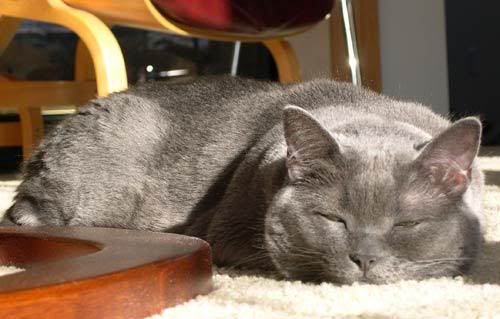
I am not a cat person but about a dozen years ago I became a minor version of one when I began a relationship with a woman who owned a little grey furball. Since I didn't really understand why anyone would want such a seemingly useless creature, I decided that if I wanted to hang out with this cat owner, I would at least pretend to like her cat.
The pretense lasted less than three weeks before it became abundantly clear that I REALLY liked this cat. She was amazingly affectionate and had decided I was going to be her personal oaf. She was this tiny 8.5 pound creature and I am 6'3" 260+ so I was forced to be incredibly gentle with her. She responded by getting all excited whenever I entered the room and purring loudly enough to wake the dead when I would pet her. She was a shameless flirt who knew she was very beautiful and seemed to understand that I am a sucker for beautiful things. When I had my computer next to my bed, she would curl up on the blankets and quietly watch while I worked. She especially liked it when I played Mozart chamber music but would run off if I started playing something boisterous like Beethoven.
Last weekend, she started getting agitated. She would shake like she was going to cough up a hairball but then would only drool. Sunday night she came into the room with a pained expression. I didn't know how to help her so I wound up petting her for over an hour. She seemed much better—it was as if I had "cured" her with affection. Even so, we had her down to the vet the first thing Monday morning. Of course, she wouldn't have one of her seizures for him so we were sent home with some medications and encouragement. But something was seriously wrong. Throughout the day, her seizures got worse and came closer together. By late afternoon, we were back at the vet's when she had one that looked so painful, we decided the only proper course of action was to put this wonderful cat to sleep.
I am going to miss my sweet and gentle buddy. I have been told many times that highly affectionate cats that like Mozart are rare so I cannot imagine replacing her. So goodbye Sweetpea. You taught me a lot about unconditional affection. And yes, I now understand why people like cats.
Subscribe to:
Posts (Atom)


