Wednesday, March 27, 2013

Krugman riles the free market ideologues

Barry Ritholtz noted on his blog today - Best Predictor of Financial Crisis: Huge Inflows of Foreign Money - that Paul Krugman's post on Monday, Hot Money Blues, has stirred up a lot of opposition. Here's the key part of Krugman's post:
But the truth, hard as it may be for ideologues to accept, is that unrestricted movement of capital is looking more and more like a failed experiment.

It’s hard to imagine now, but for more than three decades after World War II financial crises of the kind we’ve lately become so familiar with hardly ever happened. Since 1980, however, the roster has been impressive: Mexico, Brazil, Argentina and Chile in 1982. Sweden and Finland in 1991. Mexico again in 1995. Thailand, Malaysia, Indonesia and Korea in 1998. Argentina again in 2002. And, of course, the more recent run of disasters: Iceland, Ireland, Greece, Portugal, Spain, Italy, Cyprus.

What’s the common theme in these episodes? Conventional wisdom blames fiscal profligacy — but in this whole list, that story fits only one country, Greece. Runaway bankers are a better story; they played a role in a number of these crises, from Chile to Sweden to Cyprus. But the best predictor of crisis is large inflows of foreign money: in all but a couple of the cases I just mentioned, the foundation for crisis was laid by a rush of foreign investors into a country, followed by a sudden rush out.
Nothing there to disagree with here. But the real question is: Who has the cajones to take on the rich and force them to stop playing hot money games? I think Jon's little anecdote from this past Sunday is spot on:
"When I was a kid, an old farmer solemnly informed me that this is the primary lesson of Christianity. "Christ wanders a tiny area of the world healing the sick, making wine for weddings, comforting the oppressed, feeding the hungry, and teaching that the kingdom of God could be in each one of us. Nothing happens. But he starts messing with the moneychangers and they brutally executed him in less than a week on completely trumped-up charges."
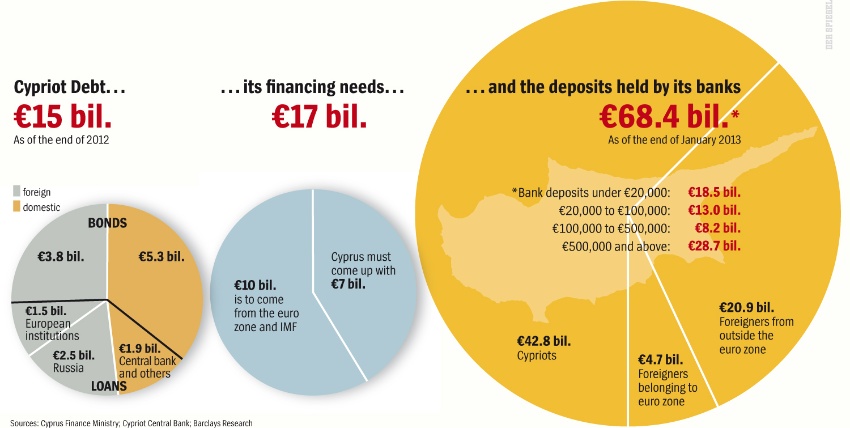
Ritholtz included a great graph from Speigel that shows how much outside hot money is in Cyprus:

Tuesday, March 26, 2013

Cyprus—the big money lies come undone

There is really no reason why the failure of the Cypriot banks should signal anything particularly important.  Cyrus is a little island with minimal involvement in the global real economy so how are their bank's failures qualitatively any different from those in Iceland, Ireland, or Greece?  It's probably just another stumble on the Euro's road to oblivion.  In fact, given the hatred of governments in northern Europe for offshore tax havens, there are probably many who are cheering the Cypriot banking collapse.

In fact, I would be cheering the collapse of those crooked Cypriot Banks were it not for all the innocent bystanders who will get swept away in the tides of economic damage.  Besides hosting a couple of British Navel installations, Cyprus has very little going for it.  They have been torn apart by a civil war and the island seethes with residual hatreds.  And even before all the troubles, their economy was pretty primitive.  Let's put it this way, no one was buying Cypriot computerized machine tools.  They were into being a tax haven because it was what they could do.

Of course, what has everyone chattering is that this time, the depositors in Cypriot Banks are going to have to take a haircut—a least those with deposits over 100,000 Euros.  This is new territory.  And considering the sorts of people who had a lot of money in those banks—Mediterranean drug dealers, Russian kleptocrats, arms traders, and other assorted bad guys—the bankers may be needing extra security for pulling this off.  It's one thing to screw over the world's poor—the banksters have been doing this for decades.  It's quite another to screw over folks who are armed and dangerous.

Monday, March 25, 2013

Public education is being wrecked - against the intentions of the republic's Founders

Regular readers are aware by now that I have a fondness for Founding Fathers. It simply amazes and annoys me to no end that most liberals and progressives have accepted the silly quasi-Marxist interpretation of the creation of the American republic as an extended power play by greedy old white men interested only in preserving and protecting their private property. That allows the wrong-wing to make the otherwise implausible claim that they wear the mantle of original patriotism, when nothing could be farther from the truth. A good example of this problem is what's now happening to education in the USA. A bunch of greedy old white men, who truly are greedy old white men, are absolutely destroying public education and trying to privatize education so they can make even more money (like they don't have enough already). Well, teacherken on DailyKos points to education blogger Diane Ravitch, who pointed to Louisiana blogger Crazy Catfish for what Ravitch termed "the most brilliant post of the day." The post which is the subject of all this pointing is titled "A Confederacy of Reformers," and it goes through how public education is being systemically dismantled. Here's Crazy Catfish's paragraph headings, to give you a flavor. It's a list of what's going wrong:
  • Intentionally Flawed Teacher Evaluation Systems
  • Vouchers and Charter Schools are better for “Choice” although not a better choice
  • It’s Okay to segregate our schools by class, race, disability as long as we claim to be doing it “for the children”
  • Student data is a commodity that can be handed over to private entities as long as they claim it is for an educational purpose
  • History and Science are negotiable and can be rewritten to suit conservative agendas
  • Virtual Schools with virtually no attendance compliance, or any compliance, and universally poor track records for preparing students are exploding in every education market
  • Teach for America has been converted into a temp teacher displacement and replacement organization
  • It’s better to close schools and spread the students around to higher performing schools to mask the problem.
And here's the final paragraph, which I think is the best summary I've seen in years of what's actually going on:
What I am seeing is a purposeful plot to destroy public schools, and to profit from the destruction. These folks say they are data conscious and want to rely on “data driven decisions” but if that were true the data already readily available shows that everything they are doing is having the opposite effect of what they are purporting to provide. There is too much coordination for this to be accidental, and they are too successful for me to believe they are simply not competent enough to understand the data that disproves everything they claim. These groups have gone out of their way to spin the data, falsify the data, or simply hide or destroy the data to prevent people from seeing what is going on. These groups are fully aware of what they are doing – destroying public education in our country. Some of them are doing it purely for profit driven motives....
What I always think is missing in critiques like this is a reference to the Founders and the importance they placed on education. Because it provides a stark and I think illuminating contrast to what USA elites are doing, and what they should be doing as measured by the idea of statesmanship in a self-governing republic.
Of all the amazing things he accomplished, John Adams took the most pride in the Constitution he wrote for the Commonwealth of Massachusetts. Here is Chapter V, Section II:
Wisdom and knowledge, as well as virtue, diffused generally among the body of the people being necessary for the preservation of their rights and liberties; and as these depend on spreading the opportunities and advantages of education in various parts of the country, and among the different orders of the people, it shall be the duty of legislators and magistrates in all future periods of this commonwealth to cherish the interests of literature and the sciences, and all seminaries of them, especially the university at Cambridge, public schools, and grammar schools in the towns; to encourage private societies and public institutions, rewards and immunities, for the promotion of agriculture, arts, sciences, commerce, trades, manufactures, and a natural history of the country; to countenance and inculcate the principles of humanity and general benevolence, public and private charity, industry and frugality, honesty and punctuality in their dealings, sincerity, good humor, and all social affections, and generous sentiments among the people.
And, I love the last sentence in this extract from John Adams' 1765 A Dissertation on the Canon and Feudal Law
The poor people, it is true, have been much less successful than the great. They have seldom found either leisure or opportunity to form a union and exert their strength; ignorant as they were of arts and letters, they have seldom been able to frame and support a regular opposition. This, however, has been known by the great to be the temper of mankind; and they have accordingly labored, in all ages, to wrest from the populace, as they are contemptuously called, the knowledge of their rights and wrongs, and the power to assert the former or redress the latter. I say RIGHTS, for such they have, undoubtedly, antecedent to all earthly government, - Rights, that cannot be repealed or restrained by human laws - Rights, derived from the great Legislator of the universe….  Liberty cannot be preserved without a general knowledge among the people, who have a right, from the frame of their nature, to knowledge, as their great Creator, who does nothing in vain, has given them understandings, and a desire to know; but besides this, they have a right, an indisputable, unalienable, indefeasible, divine right to that most dreaded and envied kind of knowledge, I mean, of the characters and conduct of their rulers…. The preservation of the means of knowledge among the lowest ranks is of more importance to the public than all the property of all the rich men in the country.
I think using these quotes is how you show that the people today who are trying to privatize education are doing the exact opposite of what was intended under the idea of promoting the general welfare.

Perforated graphene and desalination

The two greatest challenges facing humanity concern 1) capturing a reliable supply of energy from the sun; and 2) ensure that everyone has a reliable and abundant supply of clean fresh water.  I write about (1) energy almost all the time because deep down I believe that with enough energy, most—if not all—the other problems can be solved.  But that does NOT make the water problem any less serious.

Since the earth is 71% covered in water, the only reason water supplies could ever be a problem is that the overwhelming majority of it is too salty to drink or grow crops.  And until now, the existing methods for desalination have been energy intensive and hence, hideously expensive.  But if the claims in the following story are true, this is about to change radically.

It's hard to say which part of this story is more interesting—the fact that the inventor of the new technology is a defense contractor apparently beating some swords into plowshares, that the new filtering mechanism employs graphene which is so new, the researchers who figured it out only got their Nobels in 2010, or that the new filters are made of carbon—something we have in excess.  IF this works, this is the single most hopeful news I have seen in my adult life.  It is beyond merely significant.

And if it works, I will feel vindicated that I was right to focus on energy issues.  Because when it comes to energy, it is highly unlikely there will ever be a magic bullet that solves the problems as neatly as perforated graphene.

Sunday, March 24, 2013

Palm Sunday 2013

A few years ago, a woman who complained about how often her mother had dragged her to devout observances (Protestant Christian) asked me in all seriousness, "Why do they call it Palm Sunday?"  As a preacher's kid who had a pretty sheltered childhood, I was surprised because I am pretty sure that I was at least 18 years old before I met anyone who couldn't answer this question.  But after thinking about it for awhile, I decided that if Palm Sunday didn't start Holy Week, virtually no one would have heard of it.  And it certainly would not be a major marketing opportunity for the florists who ship palm fronds to those churches in the north that can afford them.

In some ways, this is part of a larger phenomenon.  Good Friday and Easter are supposed to be the highlights of the Christian calendar.  Yet if you measure them by something like specialized music, they are trivial compared to Christmas.  Don't believe me?  Ask someone who claims Christian roots to name their favorite Christmas carol and they will have major problems narrowing their list down to five examples. Then ask them to name their favorite Easter hymn and it's a rare bird who can think of one.  Of course, it doesn't help that most Easter sermons sound remarkably like funeral sermons.  And as for Palm Sunday, if it weren't for the fact that my mother would sing an obscure number called Open The Gates of the Temple every year, I couldn't think of any music for the occasion—and church music was a major part of the family business.

All of this is quite unfortunate because Palm Sunday and its lessons form a major elements of how Christianity came to be practiced.

1) According to the legend, Christ rode into Jerusalem on the back of a donkey—NOT a horse like a conquering general.  And while Christianity has a long bloodthirsty history, it also has serious wings (Quakers, Mennonites, etc.) devoted to ending wars and abolishing slavery.

2) Christ supposedly ended his triumphant entry by driving the moneychangers out of the temple.  When I was a kid, an old farmer solemnly informed me that this is the primary lesson of Christianity.  "Christ wanders a tiny area of the world healing the sick, making wine for weddings, comforting the oppressed, feeding the hungry, and teaching that the kingdom of God could be in each one of us.  Nothing happens.  But he starts messing with the moneychangers and they brutally executed him in less than a week on completely trumped-up charges."

And just think, that old farmer had never heard of Lloyd Blankfein or Jamie Dimon.

The Palm Sunday story from Matthew (King James Version)
Matt.21
[1] And when they drew nigh unto Jerusalem, and were come to Bethphage, unto the mount of Olives, then sent Jesus two disciples,
[2] Saying unto them, Go into the village over against you, and straightway ye shall find an ass tied, and a colt with her: loose them, and bring them unto me.
[3] And if any man say ought unto you, ye shall say, The Lord hath need of them; and straightway he will send them.
[4] All this was done, that it might be fulfilled which was spoken by the prophet, saying,
[5] Tell ye the daughter of Sion, Behold, thy King cometh unto thee, meek, and sitting upon an ass, and a colt the foal of an ass.
[6] And the disciples went, and did as Jesus commanded them,
[7] And brought the ass, and the colt, and put on them their clothes, and they set him thereon.
[8] And a very great multitude spread their garments in the way; others cut down branches from the trees, and strawed them in the way.
[9] And the multitudes that went before, and that followed, cried, saying, Hosanna to the Son of David: Blessed is he that cometh in the name of the Lord; Hosanna in the highest.
[10] And when he was come into Jerusalem, all the city was moved, saying, Who is this?
[11] And the multitude said, This is Jesus the prophet of Nazareth of Galilee.
[12] And Jesus went into the temple of God, and cast out all them that sold and bought in the temple, and overthrew the tables of the moneychangers, and the seats of them that sold doves,
[13] And said unto them, It is written, My house shall be called the house of prayer; but ye have made it a den of thieves.
Matthew 21:5 first appeared in Zechariah 9:9.
Rejoice greatly, O daughter of Zion; shout, O daughter of Jerusalem: behold, thy King cometh unto thee: he is just, and having salvation; lowly, and riding upon an ass, and upon a colt the foal of an ass.
And as G.F. Handel used it in his Messiah.

Friday, March 22, 2013

Replacing Hard Drives

It was with some trepidation that I read the news last fall that my computer was subject to a recall.  And what was being recalled—the hard drive?  In the old days, you would just pop off the side of your tower, unscrew the old hard drive and screw in the new one.  Format the sucker and start filling it up.  But I have a iMac.  To get to its hard drive, you must basically disassemble the whole computer—including using a suction-cup device to lift off the front glass.  In fact, there is a bunch of needed tools that I don't own.  But never fear, Apple was paying the freight.

It just that it's the freaking hard drive!

Mine is filled with an enormous assortment of applications, old projects, music, videos, a fairly extensive photo collection, thousands of emails—you get the picture.  Now rebuilding a hard drive is good for the computer.  Get a bunch of freshly installed applications running on a new hard drive and your computer runs like the day you took it out of the box.  The downside is trying to round up everything and then it takes about two days to install.  Then you must remember to back up everything important—address books, iTunes playlists, browser modifications, music, photos...  I was looking at a four-day grind.

So since everything was running fine, I decided I would simply clone my hard drive.  Bought a 2 Terabyte 5400 rpm (green) external drive for $100, fired up Carbon Copy Cloner and 7.5 hours later, I had a bootable external drive with everything where it belongs.

So last November I make an appointment with the "Genius Bar" at the nearest Apple store (at the friggen Mall of America) and on the appointed day carry my computer about a mile from the parking lot to the store only to be told I would have to leave my computer for a WEEK.  I was NOT happy.  I must of been told six times that I was shouting and that Apple was a family store.  I did discover during my complaining that the local little Apple dealer—who has managed to keep its doors open in spite of Apple's move into retailing—is authorized to do the repair.  I call them up.  They say sometime after Christmas but before April.  I keep making backups (about 15 minutes after you have done it once) in case my internal hard drive is dying.

Anyway, I got around to taking it in on Tuesday.  While it was gone, I was able to boot off my cloned drive using an aging laptop so I was back in business in about a hour.  My trusty iMac was ready yesterday.  Last night, I hooked up the drive and began cloning the backup to the new drive.  Another 7.5 hours.  I would check in occasionally to see what was taking so long and saw some spectacularly wasteful files.  So after the cloning was done, I went looking for these garbage files and managed to get rid of about 300 gigs worth.

I am still steamed at how badly Apple mishandled this recall.  Considering what a gigantic headache it is to replace a hard drive, one would think that they would have handed out a nice just reward for the hassle.  It's not like they couldn't afford it.  There are those who must job out the work I just did the last couple of days and I cannot imagine it would cost them less than $300. Apple has lost several hundred $billion in stock valuation since it became obvious they could not handle a routine recall.  I have friends who call this Karma.

Greider on Sherrod Brown—does size matter?

Is size really the problem with USA's banks?  There is plenty of evidence to suggest as much.  As Senator Brown from Ohio explains, “The four largest behemoths, now ranging from $1.4 trillion to $2.3 trillion in assets, are the result of thirty-seven banks merging thirty-three times. In 1995, the six biggest US banks had assets equal to 18 percent of GDP. Today, they are about 63 percent of GDP.”

63% of GDP certainly IS a problem.  But the far greater problem is that banking and finance don't think the rest of the economy is something to be grown and nurtured, but rather something to be ripped off as ruthlessly as possible.  If those big banks were even reasonably enlightened, their size would not be nearly so big a problem.

Thursday, March 21, 2013

Xcel hits Upper Midwest wind power record

Hooray for my local energy company.  The best thing about Xcel is they now have a growing body of institutional expertise.  They now know how making wind a significant part of the power equation is actually done.  They know who makes reliable parts, who has the best skills, and they know how to manage the grid based on much more accurate forecasts and weather modeling than ever before.

Also hooray for responsible citizen activism.  By writing some decent regulations, Xcel was enabled / compelled to add the Department of Wind to its management structure.  I've met some of the Xcel wind guys—they're pretty sharp.  One wonders what those geniuses would be doing if regulatory pressure hadn't gotten Xcel into wind.

Wednesday, March 20, 2013

Cyprus—Is the EU now bailing out tax havens?

Tax havens are an amazing economic phenomenon.  You have a location that is too small or backward to host much of a real economy like Bermuda which decides to market its corrupt ethics.  Cyprus is such a place and became an especially popular destination for hot Russian money.  They promised insane returns for depositors so as math would predict, the banks went bust investing in crazy schemes.

This time, the EU bailout included a tax on bank depositors.  The idea is to tax some of that hot Russian money.  The democratic Cypriot response has been a hearty screw you to the Eurocrats.  Iceland was able to do this and get away with it because they had already decided they hated being a destination for hot money.  They have locally-sourced energy and a real economy to return to.  I am not sure Cyprus can claim as much

At some point the realization has to occur to even the most cement-headed conventional economist that what they believe is mathematically impossible.  Of course, I have believed this since the 1980s so my faith in the perfectibility of human nature may be horribly misplaced.

Tuesday, March 19, 2013

Grillo at 30%

Chris Hedges probably put it best when he said, "(the) fundamental truth about American politics…(is) there is no way to vote against the interests of Goldman Sachs.”

So now we get to see what happens when folks ARE given the chance to vote against Goldman Sachs etc.  Grillo and his talented middle class following gave Italy a chance to vote against "Sachism" and got 25% of the vote.  A lot of people owe their livelihoods to Sachism and it IS the conventional "wisdom."  This is an incredible total.  So a couple of weeks after the elections, this has grown to 30%.  The vested interests WILL dump the shit-pile on the Grillini in the press organs and television but since Grillo and friends have already organized themselves around the internet, this shouldn't matter much.  The internet was designed to organize communication between members of the educated middle classes—organizing an honest government dedicated solving the problems of the real economy seems like a perfect application when you think about it.

Iraq—ten years after

One of the things that annoys me no end is that the idiots and liars who stampeded this country into the war crime that was the Iraq invasion are still, almost without exception, in the same jobs they had when the lying started.

The whole bunch should be in jail.  Seriously.  And that most especially includes the so-called "liberals" who should have known better.  And for those who claim that "everyone" was for the invasion I would like to point out that there were more protests against this crime than for any other "war" in history.  I would also like to point with a (very little) pride that my street was lined with lawn signs protesting the very idea of an invasion.

Windfarm "sickness"

There was a time not so very long ago when windpower advocates were considered the ultimate environmentalists.  Atmospheric carbon loading is obviously a real problem and the possible replacements for coal-fired electrical generation are very few.  Wind is one of them.  In 2006, I lived next to a pretty little church-based college that decided to put up their very own Vestas v82 wind turbine.  The week before the erection began, the campus chaplain devoted his Sunday sermon to explaining why their wind turbine fulfilled God's command that we care for creation.

I wasn't paying careful attention so I missed when it became cool to oppose wind projects but I began to notice it shortly after my neighbor's wind turbine went up.  At first I brushed of the objections to wind as so much hippie horseshit.  The complaints were crazy.  Wind turbines are supposedly ugly, (leave aside the fact that USA is a target-rich environment for aesthetic critics, I find wind turbines one of the most beautiful creations of humans) they kill birds, (at 14 rpm, this is extremely unlikely but there are occasional bird kills—but they occur at tiny fraction of the birds killed by housecats) and they make noises that harm human health (you must be very close to a wind turbine to even hear them.)

It is not clear if all these newly-hatched wind turbine opponents are cynical folks who are taking money from the coal industry.  In fact, I doubt it.  Most of these folks are true believers.  A major problem for them is that wind turbines are so large.  When they had imagined wind power, they were certain it would lead to neighborhood empowerment.  When it became clear that wind was NOT hippie enterprise, they felt betrayed.  Unfortunately, wind turbines must be large to be reliable power generators.  So instead of complaining about size, the critics use terms like ugly, corporate, and industrial.  The bird complaint is actually based on historical fact—the early wind farm WERE bird hazards because of poor design.  The health claims, however, are just absurd.  Importantly, wind turbines would have to be damn dangerous to be worse than burning coal.

And now we discover that some of the health claims are just a racket for con artists.  The con works because a substantial fraction of the environmental community is actually hostile to scientific methods.  And so we have the crazy situation where self-proclaimed "environmentalists" are standing in the way of one of the few working solutions to climate change.

Monday, March 18, 2013

Pope Francis

For the first time in history, the Catholic Church has selected a Jesuit as Pope.  The can of worms this opens is truly astonishing.  This order was founded in 1534 by a Spaniard named Ignatius Loyola who took it upon himself to roll back the Protestant Reformation by any means possible—including burning Protestants alive for heresy. The Jesuits swear their allegiance to the Pope. They have long been considered the storm troopers of the church. But mostly, they have decided that the most effective way to run things is to educate the future leaders and get their ear when they gain power. They are MASTER schemers. A Jesuit who cannot discuss politics effectively isn't much of a Jesuit. This reputation has kept a Jesuit from becoming a Pope until now.

Not surprisingly, the Jesuits faced organized opposition from Protestants.  They were banned in Massachusetts in 1647.  In 1872, they were outlawed in Germany during von Bismarck's Kulturkampf.  The Swiss constitution of 1848 banned them.  The Norwegians banned them in the early 1600s—a ban that held until 1956.  By the mid-18th century, the Society had acquired a reputation in Europe for political maneuvering and economic exploitation. The Jesuits were regarded by their opponents as greedy plotters, prone to meddle in state affairs through their close ties with influential members of the royal court in order to further the special interests of their order and the Papacy.  So starting in 1750, every Catholic monarch would suppress them until in 1773, they were even banned by Pope Clement XIV.  The Jesuits had been expelled from Brazil (1754), Portugal (1759), France (1764), Spain and its colonies (1767) and Parma (1768).

There have been many Jesuit conspiracy theories including the one focused on the personality of Adam Weishaupt, a professor of law at a Jesuit school who went on to found the Bavarian Order of the Illuminati. Weishaupt was accused of being the secret leader of the New World Order, and even of being the Devil himself.  Augustin Barruel, a conservative Jesuit historian, wrote at length about Weishaupt, claiming that the Illuminati had been the secret promoters of the French Revolution.  Jesuit conspiracy theories found fertile soil in Imperial Germany, where anti-Jesuits saw the order as a sinister and extremely powerful organization characterized by strict internal discipline, utter unscrupulousness in choice of methods, and undeviating commitment to the creation of a universal empire ruled by the Papacy.

All of this is merely an introduction to the big "Jesuit conspiracy" of the 20th century—Liberation Theology.  Jesuits were an important part of the revolution against Somoza in Nicaragua but in 1983, Pope John Paul II visited the country and made it abundantly clear that he wanted nothing to do with Marxist-inspired Liberation Theology and ordered the Jesuits to abandon their role in the Sandinista government.  Since Liberation Theology traces it roots back only until 1968, it can be argued it was merely a temporary and minor disruption in the Jesuit scheme of things.

So the interesting question about the new Pope from Argentina, Jorge Bergoglio, is whether he is an old-fashioned Jesuit schemer or was he influenced by Liberation Theology?  During the years of the "dirty war" of 1976-83 Bergoglio was an important cleric.  He may have wanted to stand up to the junta but was prevented from doing so by fear or expedience. This is certainly understandable for MOST of us who would rather not be tortured by pros who learned their skills at the School of the Americas. OK. So why hasn't he cooperated with the mothers who are still trying to find out what happened to the children? They are the ones accusing Bergoglio of being complicit with the junta. (see also below)  After all, Bergoglio has no trouble finding his voice when it comes to criticizing current Argentine President Ms. Fernandez / Kirchner.

Sunday, March 17, 2013

Energy efficiency—low hanging fruit?

I have been flashing charts like the one below in front of anyone I could get to look since the 1980s.  One time someone said with a completely straight face, "Well the Japanese and Germans have proved that you can have a highly industrialized economy that is much more energy efficient.  Their example proves that when it comes to efficiency, there is a lot of low-hanging fruit in the USA economy."

Well, NO!  The difference between USA and someplace like Germany is that the Germans have spent every day for the last century worrying about energy efficiency.  This isn't about replacing a few light bulbs.  This is about building to extremely high efficiency standards, employing strict land-use laws to achieve high urban densities, investing in mass transit, etc.  There are obvious ways to achieve German energy efficiencies but none that suggest picking some low-hanging fruit (unless you consider rebuilding our cities to triple population densities or getting folks to use public transportation for at least half their trips "low-hanging.")  Far from easy, such a project could easy require several decades and that is assuming everyone was on board.

Sullying the Progressive name

When I was a student at the University of Minnesota, it really was as Liberal as the conservatives now claim universities still are.  Favorite example.  A group of us were gassing about what to protest—this being 1968 and protests were THE thing to do on campus.  Someone suggested we start something like the Free Speech Movement at UC Berkeley.  A grad student smiled at our unfocused energy and said, "If you look, you will discover that everything the Free Speech folks are demanding already became university policy here due to the 30s activists."  That pretty much explains the lack of intense activism on my campus—except for Vietnam, there was literally nothing to protest.

Of course, Vietnam was enough and when I discovered the extent of the complicity my University had with the execution of that war, I was sickened to the point that in some ways, I have really not gotten over.  Turns out, Hubert Humphrey was not the only Cold War Liberal from Minnesota—well over half of the Liberals who staffed the University of Minnesota believed they were duty-bound to support the war effort.  These were the people who were furious at the antiwar movement in general and Eugene McCarthy in particular.  So long as the Liberals stuck to bread and butter issues like passing Medicare and supporting unions, I could forgive their moral confusion about Vietnam.  But when they switched their political interests to cultural issues, I was ready to say goodbye.

My search for a term to describe my political persona ended when I read the biography of Robert LaFollette.  He was one of the founders of the Progressive movement and founded the magazine called The Progressive.  Not only was LaFollette excellent on the bread-and-butter issues, he was willing to take courageous stands on the subject of war and peace.  If LaFollette wanted to be called a Progressive, so would I.  Unfortunately, as Liberal became a swear word, lots more folks would choose to be called Progressives.  The number who actually understood what that historically meant, however, would be tiny.

The Wall Street money boys knew how to deal with Liberals.  The story of The New Republic is an object lesson in how easy it really is to distract what passes for the left in USA.  So when Liberals started calling themselves Progressives, it was time for the funders to start distracting and co-opting them too.  Here John Stauber itemizes why Progressives will be just as confused and irrelevant as the Liberals ever were.  The whole point of The New Republic was to take the left's focus off Wall Street—this time the money is being spent to deflect the criticisms of Wall Street by the Occupy movement.  Seems to have worked just as well, too.

Saturday, March 16, 2013

The messy conversion to renewables

Even those of us who passionately cheer the coming of renewable energy must admit the changeover from fossil and nuclear is going to be extremely complicated.  There are sunk costs and leftover problems from existing infrastructure.  Even worse, USA hasn't relied on wind to power critical elements of the economy since the tall ships were retired in the 19th century.  To complicate matters, energy policy is a crazy mixture of subsidies.  Nuclear power doesn't even exist without government support and the subsidies that were put in place to support wind generation as an infant industry now pose problems as the industry grows up.

Friday, March 15, 2013

Abenomics—the MOST interesting economic experiment going

Whenever Japan's new expansionary monetary policies are discussed online, some clown will inevitably write that Zimbabwe tried this and the result was runaway inflation.  Well Japan is NOT Zimbabwe.  Progressive monetary theory postulates that while the value of money is determined in part by value of the natural resources and energy an economy can access, the BIG determinant of value is what the society does with those resources.  Since Japan has never had many natural resources, she has long concentrated on the what-do-you-do-with-those resources part of the equation—to the point where she is perhaps the best in the world at these things.  In order to meaningfully compare Japan and Zimbabwe economically, you must imagine Zimbabwe building a Lexus.

Because the Japanese have so many world-class industrial skills, an expansionary monetary policy will be like taking a kink out of the oxygen hose.  This solution has been so obvious for so long, one wonders why they have not tried it earlier.  I actually have no idea but I would imagine the answer is some sort of peer pressure.  The central bankers of the world tend to believe many of the same things and for at least a generation, they have believed a country's industrial sector is just another economic resource to exploit.  This is a terrible idea in any country—but it really stinks up the joint in Japan where her very survival depends on industrial excellence.  A lot of good things have happened to the Japanese economy because they were willing to learn from outside—this was NOT one of those times.  Even so, it takes a lot of intellectual courage to tell the rest of the world's central bankers they are wrong.

But now they have done it.  Japan has appointed three new BoJ Governors who seem to quite passionately believe that the rest of the world's central bankers ARE wrong.  They are going to change directions.  Marriner Eccles has gone to Washington Tokyo.

But here is what I find so amazing.  Japan is going to do VERY well with her new monetary policy.  She will attract imitators.  But they will not do so well.  Why?  When you print a lot of money, the outcome can easily BE inflationary.  The only time it isn't is when the money is used to finance necessary internal improvements.  You expand the money supply—you expand the wealth of your nation. Now Japan can do this.  Lots of countries cannot.

When Toyota decided to re-invent the idea of quality control, she didn't keep her methods secret.  Your local library can probably get their hands on 25 good books on how Toyota did it.  And yet, year after year, the ratings of build quality are published and some Toyota product will be on top—usually a Lexus.  Turns out while methods are important, it helps if you believe they will work.  Japan is almost certain to pull off this economic turnaround—she has too many strengths not to.  But we must be careful to learn the right lessons from their experiment and remember, they can build a sustainable society that runs as smoothly as a Lexus mostly because they already know how to build a Lexus.  This is a country that simply must play to its strengths—something that usually happens or how did they become strengths in the first place?

Thursday, March 14, 2013

Nick Turse on Vietnam

Yesterday, I had lunch with one of those people we claim to have plenty of here in Minnesota but in fact are unfortunately very rare—a genuine reader.  At one point, the subject of Chalmers Johnson and his incredible trilogy on USA foreign policy—Blowback, Sorrows of Empire, and Nemesis—came up.  I happen to have had a little personal history with Mr. Johnson—mostly because he is so obviously a member of my tribe.  During the days when guys like me were taking to the streets to oppose the USA attack on Vietnam, Johnson was making a name for himself at UC Berkeley by ridiculing our pathetic attempts.  At one point, he had gone to the University library to see if the most authoritative works on Asia were being read.  They weren't.  His conclusion was that we were so obviously uninformed, our acts of "conscience" were nothing more than crude anti-intellectialism.

Johnson was right about us knowing nothing—at least about me.  Because the news from official sources were lies made up of whole cloth, we wouldn't have known anything even if we were curious.  I didn't BEGIN to understand what had happened until the good books on Vietnam started coming out in the 1980s  But I did know one thing that fueled my passions and gave me courage to take on USA militarism even though I spent most days frightened about what would happen to me for my activism.  Let me explain.

When I was living in North Dakota 1965-66, we were about 85 miles from the Minot Air Force base.  Drive 25 miles and you began to see the missile silos.  And depending on weather conditions, there were the B-52s in flight patterns over our town.  Mutually Assured Destruction meant there were some in the air 24/7.  I was seriously into building flying model airplanes in those days.  The closest hobby store was in Minot.  Apparently not even being in the friggen' Air Force at one of geopolitically most important bases totally satisfied the airplane itch so the hobby store's customer base was almost all from Minot AFB.  The guy who owned it insisted I go to an Air show the base put on for their families.  Since I was obviously not a military family member, I had to sign up on a list.  When I showed up at the gate, they gave me a badge.  And what a badge!  I got to lay at the controls of a C-135 refueling rig.  I got to handle precision inner parts of a TF-33 engine and climb all over a B-52—the bomb bay was open!  They had found out I was building model airplanes on my own budget.  The Air Force has need of such people.  Lots of folks had been coached to explain to me (and fellow badge wearers) that the Air Force was the big leagues for airplane nuts whenever I wanted to ask a question about anything.


(MITO Minimum Interval Take Off.  These things are so large they barely notice any air disturbance from the plane ahead.)

As the day wore on, some of the fun visitors flew off.  A Crusader, a T-38 Talon, and then a F-4 Phantom did high-performance take-offs.  The runways at Minot are so long, these fighters could be all cleaned up and gaining momentum by the time they got to our position.  The Phantom went vertical and flew out of sight—no small accomplishment in North Dakota.  But for me, the most awesome display involved the take-off of a B-52.  This was a SAC-mission aircraft—the air show had been fun but now it was back to the business of scaring commies.  I walked out as far as I could so that it would take off more or less over my head.  The B-52 has eight engines.  It taxis along on 4 center-mounted trucks, with wingtip wheels to maintain some balance.  Fully loaded with some big fat nukes, it required about ten minutes to lumber down to the end of the runway.  With a puff of black smoke, it started to rumble towards us.  Soon the wing tips were flying and those drooping wings on the ground were curved up in a graceful arc.  And then it was flying.  The wheels retracted, the wings cleaned up, and this ugly duckling had become an amazingly graceful swan.  It was miraculous—like the hippos becoming ballerinas in Fantasia.  And then it passed overhead with an earthshaking roar and soon was gone.

To say I was utterly awestruck doesn't do the word justice.  Human beings, a lot like me, launched giant aircraft on 10,000 mile flights carrying 20 megatons worth of destruction, and they did it routinely through North Dakota winters.  Sign me up.  I wanted to play with such toys but now I wanted to feel their power.

Only not so fast.  Once I knew the B-52 up close, I began to follow it in the news.  And sure enough, they were using them to bomb the Vietnamese both North and South.  My graceful swans were being used to kill poor peasants working their fields on the backs of water buffalo from altitudes so high, the farmers could neither see nor hear them.  I may not have known what Johnson knew about Asia, but I knew this was wrong.  And it turned out, this form of analysis was better than his.  And in the opening of Blowback, he admits as much.  He has to because when it came to Vietnam, we were right—still are.

And now a new generation has waded into the battle.  Nick Turse was born the year Saigon fell.  As a result, he has no direct memory of Vietnam and so has a lot less baggage than we had.  But he is adding to the scholarship and doing a fine job. He has found yet another example of what happens when a superpower decides to use its technological muscle to bully a people who have nowhere else to go.

Wednesday, March 13, 2013

Easier money

The signs that the crushing monetary policies of the past 35 years may be ending seem to be found in many places.  But are we to believe them?—after all, it is still possible to get nicked for 30% on your Mastercard and up to 10% for your student loans.  Since 2.5% real interest is often enough to kill activity in the real economy, the idea that we have somehow landed in a low-interest rate environment depends largely on who you are.  The big banks are getting loans from the Fed at essentially 0%.

Now IF interest rates were to fall for consumer loans, the economy would perk up almost overnight. But that's not what's been happening—$85 Billion per month is being pumped into the big lenders which sounds like a bunch of money (federal Hurricane Sandy relief was $60 Billion) but that barely covers the bad banksters bets.  The bailout continues.

But the Bank of Japan has promised a new day.  Prosperity is back on their agenda.  If BoJ pulls this off, everyone else will be forced to copy them.

Tuesday, March 12, 2013

Italian politics—neoliberalism's Waterloo?

Damn!  This is getting interesting.  Italy has just lived through a banker's coup. And there are plenty of Italians who did not like that—not one little bit.  (Actually, I guess it was one little bit—Monti got almost 10% of the vote.)  But the big story is Beppe Grillo because unfortunately for the banksters, he actually understands the issues surrounding money—especially the idea that bankers get to create money out of thin air and then loan that newly-created money to the rest of us at interest.  And Grillo asks the interesting question (see below) which is, Why does that ability also give those people the right to meddle in a democracy?

Of course, the real answer is: It doesn't!   And now all the bets are off because this is the real fight.  This one really is a matter of life and death.  Money is a subject that explained well, can draw massive rallies like Grillo's in Rome the night before the election.  There are serious claims that 800,000 attended.  No Caesar ever addressed such a crowd.

The bankers will fight this understanding of money every step of the way.  This is their leverage.  Without the ability to create money out of thin air, the banksters will see a MAJOR reduction in living standards.  And as Evan-Pritchard points out, the moneychangers are organizing a new coup in case Grilloism gets out of hand—which is what they expect.